art tips

33 Easy Crafts That Trick Your Brain Into Feeling Productive

There are two types of people in this world:

People who wake up at

  • 5:55AM
  • drink green juice
  • complete a full morning routine

…and then there’s the rest of us, who consider moving a cup from the nightstand to the sink a relocation project.

If you’re here, I’m guessing you want to feel productive, without actually doing anything that feels like effort.

Welcome to ArtsyDrawings.com, you’re in a safe place.

This article will list out some easy crafts that are basically little mind tricks. They are small, low-effort wins that convince you to get off your lazy butt and be productive. These are the kinds of simple easy crafts that anyone can do, from adults to kids, even if you “can’t even draw a stick figure.”

And just so we’re all aligned: These low-effort, easy crafts are perfect when you want to feel productive without committing to a big project.

✨ Low Effort, High Satisfaction✨

1. Color-Sort Your Markers
I call this task a Marker Test in my bullet journal, but essentially you go through your markers and pens and see if they still work. Throw out anything that is no longer to your liking and try to align the colors in a fun way.

2. Do a Photoshoot by Yourself
Brush your hair, put on an outfit you feel confident in, and take some photos of yourself. Play around with perspective, props, and pops of color. Worst case scenario, you hate all the photos and delete them later, best case you got some cute and creative photos of yourself.

3. Paint Over an Old Canvas
Remember that terrible painting that you never finished? It’s time to pick your favorite color of paint and give that canvas a fresh coat. Color over all your mistakes and allow a new beginning to take root. You may still see some of the markings from the previous painting, but these scars tell your art’s history.

4. Make a Tiny Collage
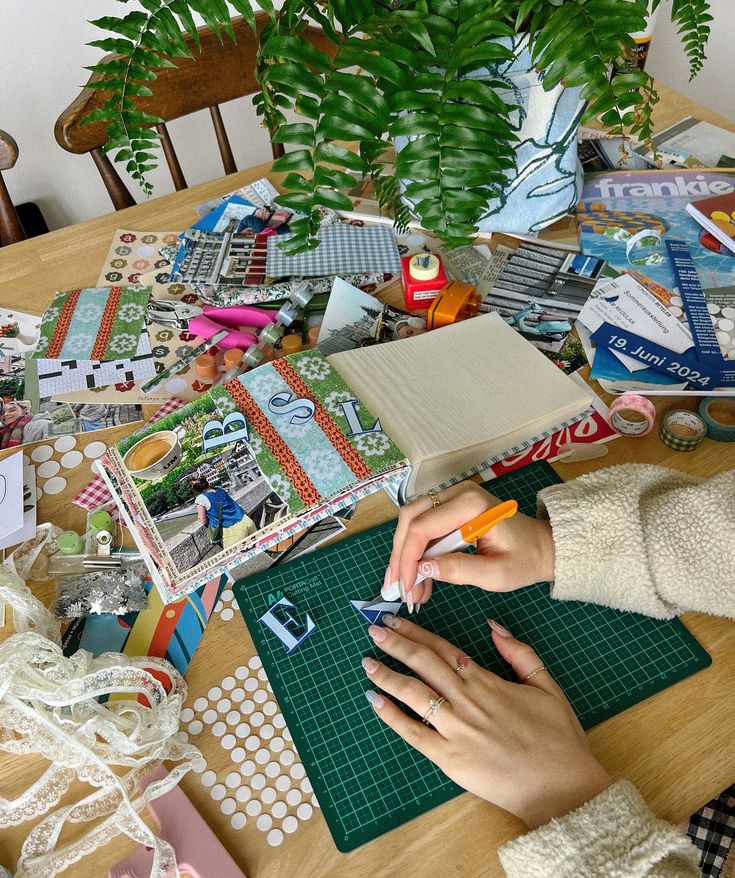
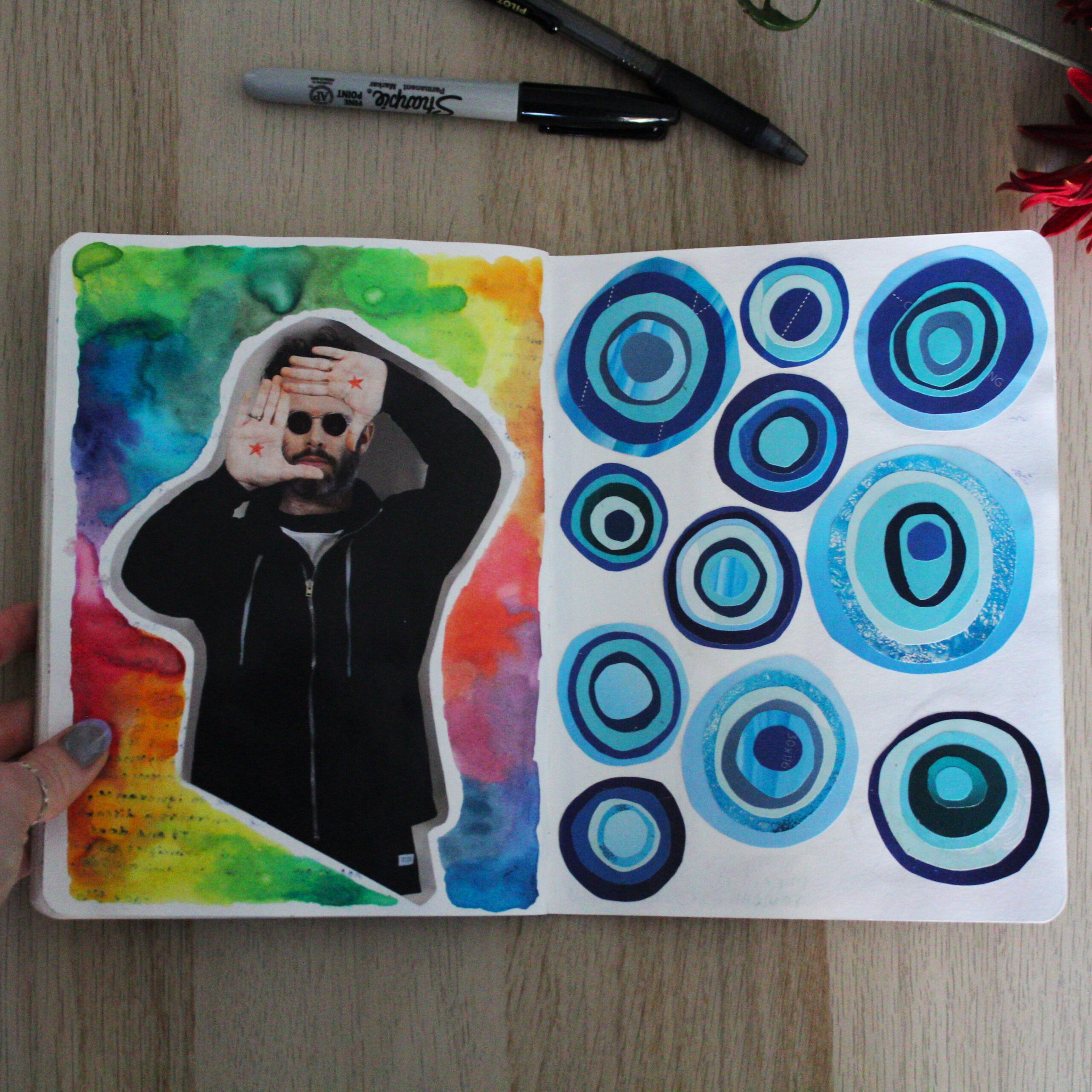
Grab some old magazines or junk journaling scraps from your last vacation and glue them together into a tiny masterpiece. It’s chaotic, it’s cute, it’s one of the best easy crafts to do at home when your brain is fried. Allow yourself to simply create without any expectations. To me, the best glue for junk journaling are glue sticks!

artsy and creative crafty ideas for easy crafts to do when your bored and want to be productive and creative but are really tired
Draw silly faces, they don’t have to be good, just silly

5. One-Line Drawing
Draw something without lifting your pen. It will look weird, but that’s the whole point. We love abstract art and no one can stop us.

6. Decorate a Notebook Cover
Turn something boring into something that screams “I journal” (even if you don’t). It’s functional and aesthetic, making it one of the best productive and easy crafts.

7. Make a Playlist
Go through some of your favorite songs and arrange a playlist based on how you’re currently feeling. Some of my favorite playlists came out of boredom and 30 minutes of simply sitting on a bench, watching the sunset, and listening to music I think would mix well together. It seems so simple, but can feel so productive to create.

8. Do a 5-Minute Sketch
Set a timer and draw anything you can see in your direct view. Stop when the timer goes off and go about the rest of your day. To expand on this easy craft, you can always plan to do multip0le short drawings. Jump from 1 minute to 3 minutes to 5 and 10.

9. Go on a Color Hunting Walk
Choose a color and follow it on a walk around your neighborhood. Chase the red tulips to the stop sign and turn when you see a red truck. Sometimes easy crafts require you to walk away from the desk and get some new inspiration.

10. Create Tiny Art Prints
Fold a paper into small sections and fill each one with a mini drawing or design. Tiny art feels less intimidating and way more doable. It’s giving productivity… but in snack form.

🧃 Tiny Tasks That Feel Weirdly Impressive🧃

11. Coffee Stain “Vintage” Paper
Why in the world would you ever buy coffee-stained paper for journaling or scrapbooking, when you can literally just make a mess yourself. Spill some coffee, or tea, or watercolors. Design paper to use for scrapbooking. For easy crafts like this, I do recommend you buy some heavier quality paper like this Canson XL Watercolor Paper on Amazon.

12. Reorganize your Closet by Style & Color
Not all easy crafts require drawing or painting, sometimes it’s enough to just be creative. Spring is the perfect time to re-sort your closet, so throw out what no longer serves you, and refresh your wardrobe with easy crafts that don’t feel like work.

artsy and creative crafty ideas for easy crafts to do when your bored and want to be productive and creative but are really tired
Organize your closet by color, it’s aesthetically pleasing and productive!

13. Paint Simple Patterns
Stripes, dots, wavy lines… that’s it. That’s the craft. This is one of those simple craft ideas that looks weirdly aesthetic with minimal effort. Fill a whole page and suddenly it looks intentional, like you had a plan the entire time (you didn’t, and that’s okay). Here’s a watercolor set under $20.

14. Sponge or Finger Painting
If a brush feels like too much responsibility, grab a sponge or even a paper towel. Heck, use your fingers for easy crafts like this. Dab paint around and call it abstracted texture. It’s impossible to mess up because there is no standard.

15. Tape-Resist Art
Put fun washi tape down in random lines, paint over everything, then peel it off. Boom—clean lines with zero actual control. This is one of those easy crafts at home that tricks people into thinking you’re precise and detail-oriented. We won’t correct them.

artsy and creative crafty ideas for easy crafts to do when your bored and want to be productive and creative but are really tired
Journal Idea by @linalovespages

16. Press Flowers in a Book
Go outside, touch grass (briefly), grab a few flowers, and stick them in a heavy book. Wait a few days and then try to remember the page number you chose to be delicate and poetic. Minimal effort now, max main-character-manic-pixie-dream-girl energy later.

17. Curate a “Pretty Corner”
Pick one tiny area of your space, it can be your desk, a shelf, even your nightstand. I want you to rearrange the space to be Pinterest-worthy: stack cute books, add a candle, lean a random piece of art against the wall. Will the rest of your room still be chaotic? Yes. But this one corner? Beautiful and organized.

18. Edit & Delete Photos on Your Phone
Go through your camera roll and edit a few photos, delete duplicates, and clear out your virtual storage. Often clutter isn’t always material, it can be digital. Easy crafts don’t have to be physical either.

artsy and creative crafty ideas for easy crafts to do when your bored and want to be productive and creative but are really tired
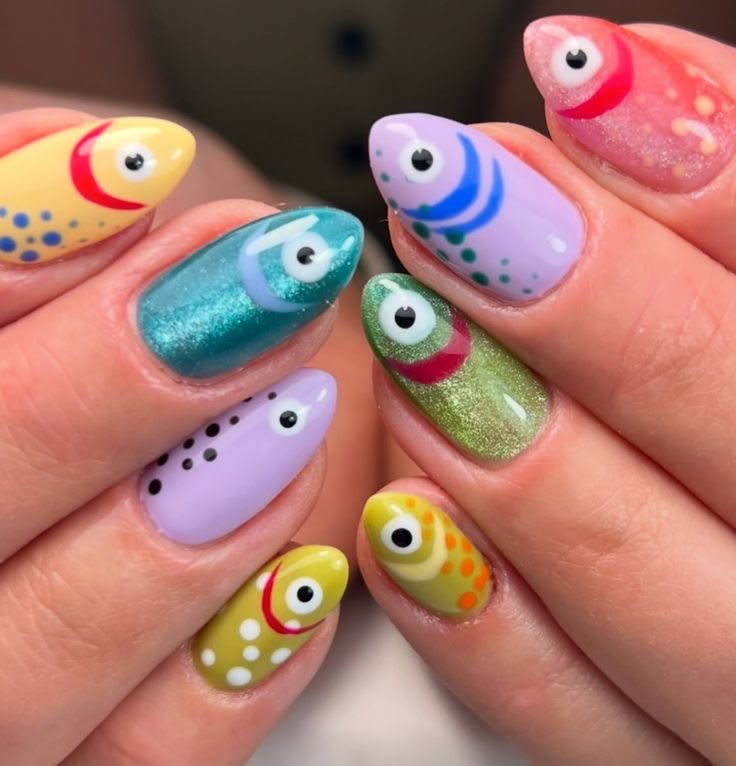
At Least 10 Beautiful Fish.

19. Draw the Same Thing 10 Times
It can be anything, from an egg to a ping pong ball to 10 different types of fish. Draw something over and over until you have 10 of them that fill the page. Are you happier with 10 fish?

20. Sticker Collage Something
Whether it be a laptop, the outside of a notebook, or a camping table, just use your stickers and decorate anything. Check out these cute granola-hiker-outdoorsy girl stickers.

🧠 Productivity Illusions 🧠

(we love being delulu)

21. Organize Your Sketchbook Pages
Flip through your sketchbook and add dates, titles, or little notes. You’re not making new art, but suddenly everything feels curated. Like a gallery. Like you planned this.

22. Finish One Old Drawing
Not five. Not all of them. Just one. Add a little shading, a background, maybe even your signature in the lower right hand corner. Closure is productive and, while not every artist is emotionally stable, it feels good to finish a project.

23. Label Your Supplies
You now own labeled items. That’s basically a personality trait and one of the best easy crafts. Also check out this fancy schmancy label maker!

24. Digitize One Piece of Art
Take a photo or scan a piece of art you’ve already made. Digitizing your art is one of those extra tidbits that is definitely still work but not as fun as making the actual painting. And yes, it’s still considered on the easy crafts list.

artsy easy crafts - wash your dirty paint brushes u silly artist
Wash your paint brushes!

25. Clean Your Brushes
This is a gentle reminder that you paid good money for those brushes and they’ve been sitting in water for way too long. Clean your freaking paint brushes!!

26. Set Up a “Perfect” Art Space
Figure out the best lighting, arrange your tools and easel, and set up everything to prep for your next few easy crafts. Will you use it immediately? Maybe not. But creating the space feels productive enough to count.

27. Photograph Your Old Artwork
Lay out your artwork, find good, flat lighting, and take multiple shots of that painting you worked so hard to finish. You’re documenting your work, which feels official and important. Because it is. Look at you, doing easy crafts, archiving actual artwork.

28. Make a Tiny Art Routine List
Write down 3 embarrassingly small creative tasks. I’m talking: “draw a circle,” “use one color,” “open my sketchbook without fear.” Keep it so easy it feels almost insulting. The goal is not discipline—it’s momentum. There’s something weirdly powerful about seeing a list, even if the list is basically “be a person for 4 minutes.” You trick your brain into thinking you have structure, which then makes you slightly more likely to do the thing. And if you don’t? Congrats, you still made a list. That’s administrative productivity. We’re counting it.

🌀Easy Crafts For When Your Brain Is Completely Offline🌀

29. Draw with Your Non-Dominant Hand
Lower your expectations immediately. This is not about skill—it’s about letting go. It will look bad, and that’s the entire point. Easy crafts are sometimes ugly, and that’s ok.

30. Blind Contour Drawing
Look at your subject, not your paper, and just draw. The results will humble you. But also? It’s one of the best beginner friendly art ideas because there’s literally no pressure to be good. For more beginner drawing tips, check out my article: 5 Easy Drawing Tips For Beginners and Intermediate Artists.

easy crafts for creative people

31. Scribble and Fill It In
Make a chaotic scribble, then color in all the little shapes it creates. It’s like turning nonsense into something structured. Accidental productivity is still productivity. Easy crafts are still easy.

32. Tear Paper for a Textured Collage
No scissors. No clean edges. Just rip paper and glue it down. It’s messy in a controlled way, which is honestly the goal for most of us right now.

33. Close Your Eyes and Draw Shapes
Shut your eyes, draw random lines, then open them and build something from it. It’s like collaborating with your subconscious… who may or may not know what it’s doing.

🧵Were we Productive ?🧵

easy crafts for creative people

Here’s the thing no one tells you: productivity doesn’t have to be big, impressive, or Instagram-worthy.

Sometimes it’s just doing a tiny creative thing instead of doom-scrolling for two or three or four hours. These easy crafts, DIY projects and beginner friendly art ideas aren’t about becoming the most disciplined version of yourself. They’re about reminding you to create rather than consume. Once you realize that creating is healthier than consuming, you’ll feel better, trust me, I’m an artist.

Remind yourself that you can still create, even on low battery mode. So go through the list again and just pick one: tear some paper, delete some photos, go on a walk, or swatch all your markers and throw out the ones that have died. At the end of the day, doing something small is still doing something.

33 Easy Crafts That Trick Your Brain Into Feeling Productive Read More »

100 Inspiring Quotes About All Types of Art

Art has a way of saying the things we can’t quite put into words.

Whether you’re sketching in the margins of a notebook, layering paint on canvas, editing photos at midnight, or wandering through a museum just to feel something shift inside you, art meets us where language falls short. Sometimes, all it takes is a single sentence to unlock a new way of seeing—or to remind us why we started creating in the first place.

That’s where quotes about art and painting come in. They capture the shared experience of artists across time: the doubt, the obsession, the joy, the quiet persistence. These quotes aren’t just decorative words—they’re creative compatriots. They sit beside you in the studio, whisper encouragement when a piece isn’t working, and remind you that uncertainty is part of the process.

This collection of quotes about art and painting is designed to inspire artists of every kind—painters, illustrators, photographers, designers, sculptors, journalers, and creatives who don’t fit neatly into one box. You’ll find well-known voices alongside lesser-known artists whose words feel deeply lived-in and honest. Whether you’re here to spark an idea, find motivation, or simply feel less alone in your creative practice, this page is meant to be returned to again and again.

“Photographers capture the truth of light.”

B. Eisman 2026
peru amazon jungle photography by brianna eisman
Camping in the Amazon jungle in Northern Peru by Brianna Eisman

Quotes About Art & Drawing

“Drawing is the honesty of the art. There is no possibility of cheating.” — Salvador Dalí

“A line is a dot that went for a walk.” — Paul Klee

“Drawing is not what one sees, but what one can make others see.” — Edgar Degas

“Drawing is thinking on paper.” — Saul Steinberg

“Every artist was first an amateur.” — Ralph Waldo Emerson

“Sketching is a way of asking questions without needing immediate answers.” — Jessica Hische, lettering artist

“Drawing teaches you how to really look.” — Dana Schutz

“Your sketchbook is a place to be wrong safely.” — Austin Kleon

“Drawing connects the hand to the mind in a way nothing else does.” — Peter Han, concept artist

“Sometimes the sketch holds more truth than the finished piece.” — Cathy Johnson, artist and art educator

Quotes About Art & Painting

“I dream my painting, and then I paint my dream.” — Vincent van Gogh

“Painting is poetry that is seen rather than felt.” — Leonardo da Vinci

“A painting is never finished—it simply stops in interesting places.” — Paul Gardner

“I shut my eyes in order to see.” — Paul Gauguin

“Color is my day-long obsession, joy, and torment.” — Claude Monet

“I shut my eyes in order to see.” — Paul Gauguin

“Painting is about trusting yourself enough to begin.” — Lisa Congdon

“Every canvas is an opportunity to forgive the last one.” — Chuck Close

“Paint what you feel, not what you think you should.” — Cecily Brow

“Art should comfort the disturbed and disturb the comfortable.” — Banksy (Check out my photos of Banksy’s work)

“Painting is an act of faith.” — Gerhard Richter

Quotes About Art & Sculpture

“I saw the angel in the marble and carved until I set him free.” — Michelangelo

“Sculpture is the art of the intelligence.” — Pablo Picasso

“Sculpture is made by taking away.” — Antoine-Louis Barye

“Materials have their own opinions.” — Eva Hesse

“Clay remembers every touch.” — Peter Voulkos, ceramic artist

“Sculpture exists in the space we share with it.” — Antony Gormley

“Form is emotion slowed down.” — Barbara Hepworth

“Sculpture teaches patience through resistance.” — Andy Goldsworthy

“You learn by listening to the material.” — Isamu Noguchi

“Space is as important as solid form.” — Henry Moore

Quotes About Art & Photography

“A photograph is a secret about a secret.” — Diane Arbus

“The camera is an instrument that teaches people how to see.” — Dorothea Lange

“Photography is the story I fail to put into words.” — Destin Sparks

“You don’t take a photograph, you make it.” — Ansel Adams

“Light makes the photograph.” — George Eastman

“Photography is about paying attention.” — Alex Webb

“Sometimes the blur tells the truth.” — Jonathan Topping, film photographer

“A camera is a diary with no eraser.” — Henri Cartier-Bresson

“Blur can be more honest than sharpness.” — Daido Moriyama

“Photographs feel like memories we didn’t live.” — Gregory Crewdson

Quotes About Art & Graphic Design

“Design is intelligence made visible.” — Alina Wheeler

“Good design is obvious. Great design is transparent.” — Joe Sparano

“Design is thinking made visual.” — Saul Bass

“White space is breathing room.” — Khoi Vinh

“Design is how it works, not just how it looks.” — Steve Jobs

“Clarity beats cleverness.” — Ellen Lupton

“Design is problem solving with empathy.” — Mike Monteiro

“A logo is not a brand—it’s a doorway.” — Debbie Millman (Check out her podcast, Design Matters! It’s one of the first, longest running and most respected podcasts in the world)

“Consistency is a form of respect.” — Pentagram Design Group

“Design should feel effortless, even when it isn’t.” — Paula Scher

Quotes About Art & Game Design

“Games are the most elevated form of investigation.” — Albert Einstein

“A game is a series of interesting choices.” — Sid Meier

“Play is the highest form of research.” — Stuart Brown

“Players remember feelings, not mechanics.” — Jenova Chen

“Game design is empathy expressed through systems.” — Eric Zimmerman

“Failure should be fun.” — Raph Koster

“Games teach through experience, not instruction.” — Jane McGonigal

“A good game respects the player’s intelligence.” — Shigeru Miyamoto

“Design for curiosity first.” — Brenda Romero

“Rules create meaning.” — Jesper Juul

Quotes About Art & Art History

“Art is a lie that makes us realize truth.” — Pablo Picasso

Every artist is shaped by their time.” — Ernst Gombrich

“Art history is a conversation, not a timeline.” — Linda Nochlin

“The past is never silent.” — John Berger

“To study art is to study humanity.” — E.H. Gombrich

“Movements are born from resistance.” — T.J. Clark

“Style is a response to culture.” — Rosalind Krauss

“Art history is full of rule breakers.” — Griselda Pollock

“Context changes everything.” — Hal Foster

“Nothing radical exists in isolation.” — Aby Warburg

Quotes About Art & Museums

“Museums are time machines.” — Orhan Pamuk

“Art belongs to everyone.” — Ai Weiwei

“You don’t have to understand art to feel it.” — Agnes Martin

“Museums teach us how to look slowly.” — Teju Cole

“Galleries are spaces for listening.” — Hans Ulrich Obrist

“Museums remind us we are not alone in time.” — Rebecca Solnit

“Every wall has a voice.” — Thelma Golden

“Museums hold questions, not answers.” — Glenn Lowry

“Art needs space to breathe.” — Ellsworth Kelly

“A gallery visit is a conversation across centuries.” — Jerry Saltz

Quotes About Art, Journaling, & Creative Reflection

“Your journal is a judgment-free zone.” — Lynda Barry

“Creativity grows in private first.” — Julia Cameron

“Write what you notice.” — Natalie Goldberg

“A journal is where art begins quietly.” — Keri Smith

“Messy pages are honest pages.” — Austin Kleon

“Reflection is part of the practice.” — Sark

“Your sketchbook is allowed to be imperfect.” — Danny Gregory

“Pages are patient.” — Anne Lamott

“Journaling is drawing with words.” — Shauna Niequist

“Your thoughts deserve space.” — Brené Brown

How to Create Your Own Inspirational Paintings

If reading quotes about art and painting sparks the urge to create, lean into it. You don’t need expensive tools, just a few reliable supplies and permission to experiment.

Here are my suggestions for art supplies to create a painting in acrylic paint:

Try painting one quote as a visual concept—use color, shapes, or mood instead of literal words. Let the quote guide the feeling, not the outcome. This is about expression, not perfection.

Final Thoughts on Quotes About Art

Quotes don’t replace practice, but they can reignite it. The right words can pull you out of a creative rut, soften your inner critic, or remind you that every artist you admire once stood exactly where you are now. These quotes about art and painting are proof that uncertainty, experimentation, and growth are universal parts of making art.

Creativity isn’t a straight line, and it was never meant to be. Some days you’ll feel inspired and confident; other days, you’ll question everything. Let these quotes serve as gentle reminders that showing up matters more than perfection—and that your work doesn’t need to look like anyone else’s to be meaningful.

Bookmark this page. Highlight your favorites. Paint from them. Journal about them. Let them sit quietly in the background of your studio or creative space. Art is made in moments both loud and subtle, and sometimes inspiration arrives simply by reading the words of someone who understands the process.

Most of all, remember this: your perspective is already enough. Keep creating, keep experimenting, and keep trusting that your voice—like the artists quoted here—deserves to exist in the world.

Like this article? Get Updated when I write the next one:

Subscription Form

AI AI art art art advice art drawings art history Artificial intelligence artsy artsy drawings artsydrawings art tips artwork Banksy brianna eisman bujo bullet journal color wheel Contemporary art craft crafting crafts Creativity Cubism design diy drawing drawings drawing tips drawing tips for beginners eisman Impressionism Inspiration journal landscapes painting paintings painting tips pencil scrapbooking sketchbook social media Surrealism Traditional art visual art words to describe art

100 Inspiring Quotes About All Types of Art Read More »

25 Date Night Christmas Crafts: Cozy Ways to Spice Up The Holidays

With the holidays practically here already, let’s get into my list for the best artsy holiday crafts of 2025.

This is officially the 2025 Date Night Christmas Crafts List—full of soft, silly, easy projects perfect for making memories. Try them solo, with your people, or with someone you’re trying to impress with your fantastic artsy crafting skills. I decided to come up with 25 crafts, so if you are really a competitive crafter, you could do one of these date night Christmas crafts every day til December 25th!

To start, I want to include a little disclaimer. Life is too short not to be silly and have fun. I wanna do stupid things and love big and create for the sake of creating, not because it’s meant to be something. Lately, I’ve been very busy and I’ve been putting off creating art. I’ve even missed October‘s newsletter. Here’s a shameless plug to subscribe to my monthly newsletter:

Sign up for my artsy newsletter!

Name
Email
The form has been submitted successfully!
There has been some error while submitting the form. Please verify all form fields again.

At the end of the day, I find myself consuming more than I create. And I think that may be my life lesson.

When you create, you feel a deeper pull into the project. It’s a sense of accomplishment because you know that what you’ve done is truly and irrevocably yours. It could be a beautiful turkey Thanksgiving dinner or a cozy Christmas coloring book page or beautiful photograph taken on your phone. Your creation is the combination of intention, task, and talent.

Now that all that sappy stuff is over, let’s go through my 2025 Date Night Christmas Crafts list!

Twenty Five Date Night Christmas Crafts for 2025:

1. Felt Gingerbread Ornaments – They’re adorable, easy, and don’t require me to preheat anything. You can try out this holiday themed felting kit or try your hand at making it from scratch with brown felt sheets, brown and white embroidery floss, needles, and maybe some white puff paint to bring your gingerbread man to life.

Date Night Christmas Crafts #1: Felt Gingerbread Ornament

2. Gold-Leaf Anything – Apply fake gold leaf to literally anything. You can get a good bottle of gold leaf paint for under $10.

3. New Year Vision Board – Collage photos and stickers to manifest the life you want in the new year. You can choose to make separate ones, or one combined relationship mood board.

4. Sustainable Velvet Ribbon Garland – Tie velvet ribbon together for a cozy, zero-waste garland. Check out this velvet ribbon set that’s perfect for your Christmas aesthetic! Also, make sure you glue them together with hot glue or glue dots.

Date Night Christmas Crafts: Holiday Paper Garland

5. Googly-Eyed Santa Claus – Go to a relative’s home and put googly eyes on as many Santa and Snowmen figurines as you can find. Get googly eyes with sticky backs like these: 500 Self Adhesive Googly Eyes!

6. Custom Printed Wrapping Paper – This girl on TikTok printed wrapping paper with her cat’s face on it for Christmas this year. I think this date night Christmas craft is adorable and fully customizable.

7. “Slay Bells” Christmas Banner – String cute felt flags that spell out “SLAY BELLS.” You could choose whatever you want it to spell out, but be silly with it! I recommend felt paper for the flags and letters, jute or ribbon to string it, and maybe some embroidery floss to add a cute sewed edge.

8. DIY Champagne Cork Reindeer – Add eyes, pipe cleaners, tiny scarf. Boom. Boozy Rudolph.

9. Salt Dough Lucky Charms – Make mini charms out of salt dough for New Year’s good luck, like stars or clovers. If you want to support a small business, you can also buy these charms from Lovely Crafting Mama’s Etsy shop. For crafting, I recommend everyone interested in making charms, earrings, or keychains get a full jewelry making kit. Trust me, it will make your life easier to buy it once.

10. Snowy Pinecone Place Cards – Frosty pinecones with name tags so no one fights over chairs this year. You can use spray snow to give that frosted effect.

11. Clay Peppermint Coasters – Swirl red and white polymer clay into peppermint circles and bake them. You can also get this 5 lb tub of airdry clay and paint the red swirl on with some gold leaf accent. Just make sure you seal your coasters with a nice varnish. To make this craft easier, you can also use acrylic paint pens to draw on the clay.

12. Build a Gingerbread House – Work together and try not to fight when someone eats the décor. You can also get this cute gingerbread village so everyone gets to decorate their own house.

13. Hand Sewed Holiday Scrunchies – Sew scrunchies with prints like gingerbread, reindeer, or cute elves. For a less in-your-face Christmas theme, opt for red and green gingham fabric, sparkles, or snowflake prints! Check out this tutorial for a no-sew scrunchie: LittleRedWindow.com/how-to-make-scrunchies-with-no-sewing/

14. Airdry Clay Magnets – From Nutcrackers to holly branches to snowmen, you could make a whole army of holiday themed magnets. I especially love these painted floral magnets made of airdry clay! I suggest you get this 5 lb tub of airdry clay, this sheet of magnet paper, and for a special holiday sparkle, go for this gold leaf paint.

15. Magnetic Advent Calendar Tiles – You can make it RedBull themed if you want. You can also use small envelopes, boxes, or fabric pouches filled with treats or sweet notes. I especially like this wooden advent calendar that you can fill with whatever you want!

16. DIY Velvet or Satin Ribbon Statement Bows – Easy and sustainable, this date night Christmas craft is definitely on my to-do list this year. Also, make sure you glue them together with hot glue or glue dots.

Christmas Crafts for Girls Night - DIY Hair Bow Christmas Tree date night christmas crafts

17. Love Letter Ornaments – Write tiny notes to each other and tuck them inside clear ornaments. You can use this 12 piece set of clear ornaments, or buy a couple from your local craft store.

18. Stamped Gift Bags & Wrapping Paper – One of my favorite sustainable stamp hacks is to carve a potato and use it as a custom stamp! This creator used a potato stamp to make checkered wrapping paper.

19. Memory Jar with Date Prompts – Decorate a mason jar with ribbons and jute string and fill it with written date ideas for the next year. This jute string set has some really cute options.

20. Pressed Orange Slice Chimes – Boho and festive, this craft uses dried orange slices and other random items you can find, like bells, feathers, cinnamon sticks and evergreen branches, to create a beautiful and sustainable holiday decoration. Also, if you dry out your oranges long enough, you can keep your chime for next year! For more ideas for what to do with your dried oranges, check out this article about Elegant & Cozy Dried Orange Christmas Decorations.

21. Holiday Friendship Bracelets – Channel your inner Christmas Swiftie with cute holiday bracelets! You could even use red and green beads to spell out “SLEIGH” or “HO HO HOMIES.”

22. Recycled Paper Bag Origami Stars – Fold and cut Trader Joe’s paper grocery bags to create really cute hanging stars for the holidays. Here’s a quick TikTok to follow along: www.tiktok.com/@its.kimberlyrodriguez/video

@its.kimberlyrodriguez

Don’t throw away your paper grocery bags! Instead make them into dreamy ornaments! Turning my @Trader Joe’s grocery bags into 3D stars this holiday season ✨🎄 #christmasdiy #papercrafts #holidaydecor #christmasdecor #christmascrafts

♬ Main Title (From “Elf”) – Dominik Hauser

23. Jingle Bell Keychains – Clip jingle bells to a keyring so everyone hears you arriving… or escaping. I recommend everyone interested in making charms, earrings, or keychains get a full jewelry making kit. Trust me, it will make your life easier to buy it once.

24. Spotify Wrapped Bullet Journal Page – With Spotify Wrapped about to drop, it’s basically begging to be turned into date night Christmas crafts. Design a Spotify Wrapped spread in your bullet journal to remember and look back on the wildly musical year you had. Bonus points if you listed to the Wicked soundtrack more than once!

spotify wrapped date night christmas craft artsy drawings brianna eisman bullet journal bujo

25. Holiday Simmer Pot – Slice oranges, and add cinnamon sticks and cloves to boiling water. I adore simmer pots this time of year, they smell fantastic, are more affordable than a candle and last longer. Check out this recipe for a Winter Solstice simmer pot.

Date Night Christmas Crafts

And that’s the lineup. Cute, easy, zero-pressure date night Christmas crafts that don’t require a personality change or an art degree. Use these date night Christmas crafts to make memories, make a mess, or just make it look like you tried this year. Whatever you choose, happy crafting and happy cuddling.


If this list of Date Night Christmas Crafts isn’t enough for you crafty artists, check out this other list I put together last year of 55 DIY Crafts to Do in December.

Hey, if you liked this article, go check out my other ones! ArtsyDrawings.com is for artists, by artists. From graffiti to journalling to pixel art and why I think people hate modern architecture, you can find some pretty cool reading material at my blog: https://artsydrawings.com/art-advice/. Enjoy!

25 Date Night Christmas Crafts: Cozy Ways to Spice Up The Holidays Read More »

Why Did the CIA Fund Brainrot Art? The Messy Truth of Jackson Pollock

If you scroll through the online artsy backrooms in 2025, you’ll run into two of my favorite art conspiracies:

  1. Jackson Pollock was secretly bankrolled by the CIA to serve as a weapon in the Cold War.
  2. Brainrot art is being idolized by wealthy cultural gatekeepers/money launderers.

Which one is true? Both? Neither? In this artsy article, I wanna take a winding, tortuous pathway through splatter paint’s journey from admired social activism to the embarrassing reality of being compared to children’s scribbles. Let’s critically judge some art, not to decide if it’s good or bad, but to attempt to find the truth behind brainrot art.

However thoughtful, I know some of you are only here to find brainrot art. And for you silly little brainrot artists, I have found you coloring pages with the worst memes on the internet. Enjoy: https://coloriagevip.com/en/coloriage-steal-a-brainrot/?img=37

The uncomfortable Story of the CIA, Abstract Expressionism, & A Chilly War

In the late 1940s and 1950s, Abstract Expressionism became the flagship avant-garde artistic style in the United States. Artists like Jackson Pollock, Willem de Kooning, Mark Rothko shaped the era. It was chaotic, expressive, often nonfigurative, the complete opposite of realism. Meanwhile, on the other side of the Iron Curtain, Socialist Realism reigned and art was required to depict workers, heroic scenes, factories, revolution, etc.

So you had an ideological clash: expression, freedom, individualism (in the West) versus collectivism, order, narrative (in the Russian Soviet bloc). Pollock was called a “rotten rebel from Russia” and according to co-curator of the Royal Academy exhibition, “Rothko said he was an anarchist.”

The U.S. government wasn’t immediately obsessed with splatter paint, but they quietly liked the idea that art could embody “freedom”— even if that meant non-representational squiggles.

Did the Government actually fund Brainrot Art?

Yes, there is credible evidence that U.S. intelligence and cultural agencies secretly funded or channeled money into promoting abstract art exhibitions as a form of “soft power.” They wanted to show that Americans could afford and enjoy “meaningless art,” implying they live in a freer, more prosperous society.

brainrot art on artsydrawings.com about jackson pollock

However, it may be a stretch to say Jackson Pollock personally cashed CIA checks. The funding was often indirect, via foundations, sponsors, international cultural exchanges. But the broader narrative is supported by many art historians: the U.S. used Pollock’s style as propaganda.

In 1973, Max Kozloff argued Abstract Expressionism was “a form of benevolent propaganda,” (Artforum.com) hinting at the impact of the art movement on changes in American culture. He wasn’t the only one to notice this change and eventually the true story started to leak out.

How did they do it?

So, how did the government get away with funding Pollock’s work? If they weren’t handing out splatter paint checks, how did these artists make any money? Here’s a quick history lesson:

The Cold War started in 1944 and in 1947, the U.S. created the CIA. Within the CIA was a special dedicated group called the Propaganda Assets Inventory. This group was responsible for managing a network of over 800 publications, organizations, and other entities to spread pro-American messages globally. They used psychological warfare in the form of modern art.

One such group was called the Congress for Cultural Freedom (CCF) and was known as “an anti-Communist advocacy group active in 35 countries.” The important part is that the CIA “helped to establish and fund” the CCF. According to Alastair Sooke’s BBC article, this group went on to bankroll a number of artistic platforms including a liberal anti-Communist magazine, the Boston Orchestra to perform in Paris, and “several high-profile exhibitions…including The New American Painting [tour]. This European art exhibit toured eight countries between 1958 and 1959, and our favorite brainrot artist was one of the stars! Below, you can see a clear image of Jackson Pollock’s work on display in The New American Painting exhibit.

The New American Painting ” Exhibition by Soichi Sunami. Photographed May 28, 1959–September 8, 1959, sourced from The Museum of
Modern Art Archives, New York.

Why did they choose Abstract (brainrot art)?

So, the CCF funded these galleries across the world. This still doesn’t explain why they chose the subject of abstract art.

From the Soviet side, abstract art was ideologically dangerous: it looked like chaos, it didn’t commit to narratives or legible messages, and it spoke of the individual’s inner life more than of the collective cause. A state that demands uniformity can’t fully comprehend ambiguity in art. So this Western “freedom art” was a cultural arrow pointed at the very heart of socialist doctrine.

Art critics and Soviet officials often ridiculed abstract expressionism as “decadent,” “bourgeois nonsense.” The tension was political, not just aesthetic.

If you’ve actually read a few of my more poignant articles, you know I enjoy art created for political reasons. Picasso challenged what it means to paint a portrait, Basquiat challenged tagging and street art norms, Stuart Semple and Anish Kapoor challenged color itself. Art is progress because artists consciously ask “why” and “how.”

If you are interested in reading more of my artsy articles with this level of cynicism and brattiness, I recommend you check out Why do people hate minimalist architecture?, The Destruction of Art., and Is AI art to be a valuable future or a scary end of originality?.

Maria Brito is an art advisor, curator, and author based in New York City. She believes art has always been political “because art, at its core, is about choices. Who gets to make it? Who gets to show it? Who gets to own it? These are all political questions.”

The story I believe is that art has always been political, whether it was financed by the church, the Medici, or the US government. Art sends a message and typically the rich decide what that message says. So, even though the art may look like splatter paint from a toddler, “brainrot art” was political for the time and context of which it was created. This is the truth behind art and many people struggle with this idea that art is not always pretty or aesthetic to what you want it to be in the present day.

Brainrot art in 2025: How to Judge Art for what it is

Now let’s jump a few decades forward to brainrot art in today’s world. The same Jackson Pollock that was once used as a moral and ideological emblem is widely dismissed as “paint splatter” and compared to that of a child’s drawings. Why would you pay over $100 million for something a toddler can make?

Here’s where things get tricky. I am a 25 year old artist with a little bit of an attitude. I want you, my dearest reader, to not only feel my angst around brainrot art, but to understand that it’s okay to judge art and to not like everything you see in a gallery.

1. Art is born in a context

You can’t just judge Pollock by your 2025 meme filters. You need to ask: what was happening in 1950, socially, politically, culturally? Who funded it? What audiences saw it?
To reject context is lazy criticism.

2. Intent, funding, and “authorship” matter

If a painting is partly propped up by propaganda, that doesn’t erase the artist’s vision — but it does shift how you interpret it. Every painting lives in a web: patronage, politics, fashion, personality. Disentangle where you can, acknowledge what you can’t.

3. Meaning is not fixed

In 1952, someone might see cosmic energy, Jungian spontaneity, or existential angst in Pollock. In 2025, someone might see chaos catered to white institutions. While both judgements are technically accurate, they speak to different viewers. Be humble in your judgment and remember that meanings change over time.

4. Humor and cynicism help

Let’s be real: lots of art gets overblown hype. Hype doesn’t disprove value — but healthy skepticism keeps us honest. It guards against the “emperor’s new clothes” effect.

brainrot art on artsydrawings.com about jackson pollock

Conclusion: Pollock as a Mirror, Not a Masterpiece or Meme

jackson pollock brainrot art

So, was Jackson Pollock really funded by the CIA? Absolutely, and art historians have traced enough circumstantial paths to take that question very seriously. But, does that automatically make his work a propaganda tool? No…?

In 2025, seeing Pollock’s splatter paintings as “brainrot art” is partly backlash: pushback against art-world gatekeeping, elitism, and all that fancy art jargon. But that rejection can also reduce the complexity of what abstract art was trying to do in a fraught political era.

My hope is that future artists and critics keep both their ambition and skepticism. Honor the context without worshipping the myth. Please judge art harshly and directly, but don’t forget about the context in which it was made. Laugh at Renaissance drawings of cats and then try to draw a cat from memory without a reference photo.

Remember that brainrot art used to be just art and trends will ebb and flow, but the joy of a good meme will never die.


Why Did the CIA Fund Brainrot Art? The Messy Truth of Jackson Pollock Read More »

100 Surreal Drawing Ideas for every artist

Staring at a blank page, waiting for inspiration to strike, is the worst. You have the skill, the motivation (kind of), and the urge to create, but… what do you even draw? Whether you’re sketching for fun, practicing your craft, or just trying to break out of an art block, having a list of creative drawing ideas at your fingertips can make all the difference. Sometimes, all you need is a single spark—an unusual prompt, a fresh challenge, or a concept that takes your art in an unexpected direction.

Below is a carefully curated list of 100 creative drawing ideas designed to help you experiment, refine your style, and, most importantly, enjoy the process.

Introduction

There’s no wrong way to use this list—pick one randomly, challenge yourself to a daily drawing spree, or combine ideas to create something truly unique. These prompts are broken into different categories to suit your mood and style: fantasy, portraiture, nature, surrealism, and more.

For example, if you’re drawn to character design, you might love the idea of sketching a cyberpunk warrior or a historical figure reimagined as a fantasy character. If you prefer atmospheric scenes, try creating a neon-lit city on a rainy night or an enchanted forest with glowing plants. Feeling conceptual? Play with gravity-defying landscapes or melting clocks dripping into dreamscapes. The goal is to let your creativity take the lead—these ideas are just the launchpad.

Having the right art supplies is essential for bringing your creative visions to life—whether you’re sketching quick ideas or crafting detailed masterpieces. Quality materials like smooth sketchbooks, vibrant pencils, and blendable markers not only make the process more enjoyable but also help your artwork look its best. Below are some of my favorite and cheap art supplies—click through my Amazon affiliate links to grab them and support my work at the same time!

If you’ve gone through the list, and are still artistically stumped, check out my portfolio or other artsy articles on ArtsyDrawings.com.

Fantasy & Floral Drawing Ideas

  1. A wilted flower coming back to life with magical energy
  2. A giant sunflower with an eye in the center
  3. A fairy sitting inside a blooming rose
  4. A cactus growing out of a teacup
  5. A tree with glowing blossoms that only bloom at night
  6. A tiny village hidden inside a hollow tree
  7. A mushroom house with little windows and a smoking chimney
  8. A snail with a succulent growing from its shell
  9. A flower that changes shape with the seasons
  10. A floating lily pad city in the middle of a peaceful lake

Mystic Nature Scenes Drawing Ideas

pigeon wearing yellow rain boots drawing ideas for artsy drawings
Pigeon in Yellow Rainboots by RM
  1. A twisting tree with roots reaching out like hands
  2. A hidden waterfall behind a wall of vines
  3. A forest path glowing under the light of fireflies
  4. A deer with antlers covered in hanging moss and flowers
  5. A secret garden only visible under the full moon
  6. A butterfly with flower petal wings
  7. A fox with fur that looks like swirling leaves
  8. A bird made entirely of vines and blossoms
  9. A mermaid whose tail turns into flower petals
  10. A rabbit with dandelion fluff instead of fur

Surreal Landscapes Drawing Ideas

  1. A tree growing upside down from the sky
  2. A crystal geode splitting open to reveal a tiny garden inside
  3. A flower field that turns into stars at night
  4. A floating rock covered in grass and wildflowers
  5. A mystical pond that reflects a different world than the one above it
  6. A garden where every flower glows a different color
  7. A river winding through the sky like a ribbon
  8. A giant daisy acting as an umbrella for a tiny creature
  9. A treehouse hidden among cherry blossoms in full bloom
  10. A stormy sky where lightning forms the shape of blooming flowers

Celestial & Atmospheric Drawing Ideas

street view drawing ideas daily sketch by maria
Yellow Street View Drawing Ideas by Daily Sketch by Maria
  1. A moonflower opening under a glowing full moon
  2. A rainbow forming from the mist of a magical waterfall
  3. A sunset where the clouds are shaped like giant blooming roses
  4. A path made of floating lotus flowers leading to an unknown place
  5. A glacier with frozen flowers trapped inside the ice
  6. A bird with crystal feathers that glow in the dark
  7. A forest where every tree has a different colored bark
  8. A giant lily pad floating through the sky like an airship
  9. A desert where the cacti are made of glass and reflect the stars
  10. A floating island with a single, massive cherry blossom tree

Whimsical Animals & Insects Drawing Ideas

  1. A hummingbird with wings made of flower petals
  2. A swan whose feathers turn into leaves when it spreads its wings
  3. A moth with wings that resemble dried autumn leaves
  4. A fox with a tail made of ivy and wildflowers
  5. A butterfly with stained-glass wings that reflect flowers in the light
  6. A river that glows in the dark, winding through a field of lavender
  7. A forest where the trees have golden leaves that never fall
  8. A moss-covered ruin overtaken by vines and blooming flowers
  9. A lake with floating flowers that light up like lanterns at night
  10. A meadow filled with oversized mushrooms and glowing spores

Dreamy Botanical Drawing Ideas

morning glory drawing ideas cami gonzalez calligraphy
Morning Glory Drawing By Cami Gonzalez
  1. A teapot pouring a stream of water that turns into a waterfall
  2. A giant sunflower bending down to whisper to a tiny creature
  3. A floating flower shop with bouquets tied to balloons
  4. A bridge made entirely out of intertwined vines and roses
  5. A giant dandelion puff releasing wishes into the sky
  6. A succulent terrarium with tiny people living inside
  7. A flower-covered skull as a symbol of life and rebirth
  8. A morning glory vine wrapping around an old, forgotten key
  9. A rose bush growing in the shape of a heart
  10. A water lily with a tiny fairy sleeping on its petals

Geometric & Abstract Conceptual Drawing Ideas

  1. A single line forming the silhouette of a city skyline
  2. Abstract shapes blending into each other to create a mysterious figure
  3. Geometric forms representing the concept of chaos
  4. A spiraling pattern that slowly morphs into a bird
  5. A circular pattern that gets increasingly disorganized the closer you look
  6. A series of interconnected dots forming a complex, surreal network
  7. A series of mismatched patterns swirling together into one image
  8. A minimalist sketch of a crowded subway, showing only the outlines of passengers
  9. A futuristic city skyline where every building is a different distorted shape
  10. A chaotic mix of black ink splatters and precise pencil details

Organic & Flowy Drawing Ideas

colorful Non-Local Pear Drawing ideas by Erika Lamar Buentello artsy drawings brianna eisman
Non-Local Pear Drawing by Erika Lamar Buentello
  1. A plant growing through a cracked window, creeping upward
  2. A half-drawn face with its features slowly dissolving into thin air
  3. A hollowed-out human figure with intricate patterns spilling out from inside
  4. A body with transparent parts that reveal a hidden world inside
  5. A melting object dripping into a chaotic pool of shapes
  6. A liquid that’s spilling from a cup, but instead of water, it’s made of words
  7. A deconstructed object—like a chair—rearranged into an abstract form
  8. A person holding a transparent sphere, and inside it, a completely different world
  9. A tangled mess of strings, each representing different emotions or concepts
  10. A floating object that shifts in shape the longer you look at it

Human & Emotional Drawing Ideas

  1. A faceless person standing in a crowd of shadows
  2. Two hands reaching toward each other, but never quite touching
  3. A hollowed-out human figure with intricate patterns spilling out from inside
  4. A body with transparent parts that reveal a hidden world inside
  5. A person holding a transparent sphere, and inside it, a completely different world
  6. A maze drawn inside a person’s silhouette, with no clear beginning or end
  7. A floating object that shifts in shape the longer you look at it
  8. A crumpled paper drawing, with creases creating a 3D effect
  9. A human figure dissolving into an array of fine, intricate lines
  10. An empty frame with only a shadow inside, suggesting what’s missing

Minimalism & Surrealism Drawing Ideas

  1. A blank page slowly getting filled with random scribbles
  2. A melting object dripping into a chaotic pool of shapes
  3. An open hand with light streaming out between the fingers
  4. A single brushstroke that seems to form a silhouette but fades into abstract swirls
  5. A sketch of a tree with roots that are made of tangled thread
  6. A bird with crystal feathers that glow in the dark
  7. A liquid that’s spilling from a cup, but instead of water, it’s made of words
  8. An abstract wave crashing into a geometric structure, like a solid wall
  9. A figure partially submerged in water, with only certain parts of them visible
  10. A cloud of dust swirling around an undefined object

Conclusion

At the end of the day, the best drawing ideas are the ones that excite you. Don’t be afraid to put your own spin on these prompts—merge ideas, push boundaries, and experiment with styles you wouldn’t normally try. The more you create, the more your artistic voice develops, and that’s where the real magic happens.

So grab your sketchbook, pick an idea, and start drawing! Who knows? That one random prompt might just lead to your next masterpiece.

Join my monthly newsletter!

Sign up for my monthly artsy newsletter and stay up to date with all things from ArtsyDrawings.com

*

100 Surreal Drawing Ideas for every artist Read More »

Canva AI: How to Actually Breakthrough Creative Challenges

Artificial intelligence (AI) has become the ultimate game-changer, sneaking into nearly every corner of our lives—from saving lives in healthcare to making binge-worthy shows even better. One area where AI really gets to shine is in the the world of art and design. Now, I know allowing artists to use artificial intelligence is controversial, but I’ve already shared my opinions on artists using AI. This article ascertains that AI is not going away anytime soon and it’s up to artists to either adapt or be left behind.

That being said, this article will talk about one of my favorite creative platforms: Canva! The beloved design platform has taken AI’s magic and turned it into tools that make creativity feel like second nature, especially when you’ve hit the “creative wall.” Canva AI is an incredible tool for inspiration, creativity, and what I consider a positive step in artists working with AI.

Living The High Life b y @Life_Of_Flower

This article will discuss where to find Canva AI, how to use it, what it can be used for, and the broader implications of AI on society. It is also important to note that every image in this article was created using some kind of artificial intelligence technology.

Where to Find Canva AI

Canva AI is embedded directly into the Canva platform, which can be accessed through any web browser or via the Canva mobile app. Whether you’re using Canva’s free version or its premium subscription, Canva Pro, the AI tools are available to explore. Simply navigate to www.canva.com and sign in or create an account. Once inside, you’ll find many of Canva’s AI features integrated seamlessly into the design interface.

For users seeking more in-depth step-by-step guidance, Canva’s help center offers tutorials and FAQs to help you get started.

How to Use Canva AI

Canva AI is designed with simplicity and accessibility in mind, ensuring that users of all experience levels can dive right in. Here’s a quick guide on how to get started with five Canva AI tools.

  1. Magic Resize: With this tool, you can instantly resize your designs to fit different platforms, such as Instagram, Facebook, or YouTube. Simply create your design, click “Resize” in the top menu, and select your desired dimensions.
  2. AI-Powered Text Suggestions: Canva AI assists with crafting headlines, captions, and even full paragraphs for your projects. Just click on the “Text” tool, and Canva will offer smart suggestions to save time and spark creativity.
  3. Background Remover: For those looking to refine photos, the AI-powered background remover eliminates unwanted elements with a single click. This feature is particularly useful for product photography, portraits, or creating clean design elements.
  4. Video Editing with AI: Canva’s video tools utilize AI to streamline editing processes. Features such as auto-alignment, smart transitions, and even script-to-video creation make video production approachable for everyone.
  5. Text-to-Image AI: One of Canva AI’s standout features is its ability to generate unique images from text prompts. To use this tool, open a blank design canvas, click on “Apps” in the left-hand menu, and select “Text to Image.” Type a description of the image you want, such as “a serene beach at sunset,” and Canva will generate options for you to use in your design.

AI Flower Art by Brianna Eisman

The Canva ai Image Generator

As an artist with an expansive imagination, I enjoy and use the Text-to-Image (or Image Generator) Canva AI tool the most. It’s created with DALL·E from OpenAI and converts your text into digitally created images which you can download as JPG, PNG, PDF, or GIF.

To find the Canva AI Image Generator, open up a new project and look under the “Elements” tab. There, you should see something like this image below:

Next, click the box that says “Generate your own” and let your imagination run free! From purple dinosaurs to a rainbow waterfall with flying sharks, your imagination (and Canva’s AI Product Terms⁠ and Acceptable Use Policy) are the only limits to your creativity.

Plus, if only one image is close to what you’re looking for, but not exactly, you can click on the three dots at the top of the image and “generate more like this.” This function offers 4 more images similar in style or content to the chosen image, and can help narrow your search for something that aligns closer to your intended creation.

What You Can Use Canva AI For

Canva AI opens up a world of possibilities for users across industries and interests. The tools are extremely versatile and can be used in many really cool ways.

Social Media Content: From Instagram posts to TikTok videos, Canva AI helps create eye-catching content that aligns with your brand.

Marketing Materials: Design professional brochures, flyers, and email templates that stand out from the crowd.

Educational Resources: Teachers and students can use Canva AI to craft presentations, worksheets, and infographics that make learning engaging.

Event Invitations: Whether it’s a wedding, birthday, or corporate event, Canva AI simplifies the process of creating beautiful invitations.

Branding: Small businesses and entrepreneurs can design logos, business cards, and merchandise with ease.

Custom Projects: From vision boards to art projects, you can turn your Canva AI creations into reality that reflect your own style. This Amazon store produces custom canvas prints of any image you want, even an AI one.

Artist and blogger, Tristina Dietz Elmes, created the following reference image using Canva AI, then drew it using her own artistry and mediums. I think this is a great way to use Canva AI to create art and expand your drawing and painting skills.

The Effects of AI on the World

So far you’re thinking, “Wow! This is such a cool and unique tool, why would anyone NOT want to use it?!” And to an extent, I agree with you. AI technology removes artistic barriers, improves productivity, and makes some really wacky looking images.

But, like almost everything nowadays, it has negative impacts worth noting. Using AI to create or imitate art imposes ethical concerns, can lessen opportunities for artists, and actually uses a lot of energy to produce. Personally, I think the pros outweigh the cons, but I try my best to use AI intentionally and with clear and concise purpose.

The good: Democratization of Creativity

Traditionally, professional design tools require specialized skills and training. Canva AI removes these barriers, enabling anyone with an idea to bring it to life. This democratization empowers individuals and small businesses to compete in spaces previously dominated by larger organizations with bigger budgets.

Graphic designer Navneet C. from the Art Insider explains this concept well in their statement on AI art:

“I think AI is a liberation of creativity for designers/artists. Creativity is no longer in service of economic activity but becomes a pure form of self-entertainment and self-expression. This represents two levels of purity: using AI to replace the utilitarian attributes of designers, allowing creativity to return to its essence, and using AI to rediscover the joy of experimentation and play in visual effects.”

The Good: Enhanced Productivity

AI tools save time by automating repetitive tasks. For instance, features like Magic Resize and AI-powered text generation allow users to focus on the creative aspects of their projects rather than tedious formatting. I personally have no quarrel with this argument; more efficient tools means more time to be creative. Period.

The Bad: stealing creativity

As AI tools become more advanced, they bring both exciting possibilities and important ethical considerations. While they enhance creativity and streamline workflows, they also introduce challenges such as copyright concerns and the potential for misuse.

One major issue is intellectual property rights. AI-generated content, including images and text, can sometimes be too similar to existing works, raising questions about originality and ownership. Without clear guidelines, artists and content creators may find their work unintentionally replicated or appropriated. Artists may also find themselves unknowingly competing with art produced using AI. In this article about AI art competitions, Jason Allen won first prize for his work titled Théâtre D’opéra Spatial under the category of digital art/digitally manipulated photography.

The Bad: Misinformation and Fake News

Misinformation is a growing concern, especially with the accuracy progression of AI images. AI can generate realistic yet misleading content, blurring the line between fact and fiction. This is especially problematic in media, marketing, and education, where accuracy is crucial.

This image received over 10,000 likes on Instagram with a caption describing a town filled with cabbage kids.

It is important to know the signs that something may be created using AI technology.

  1. Inconsistent or Unnatural Details – AI-generated images and videos often have strange distortions, like extra fingers, warped backgrounds, or mismatched lighting. Similarly, AI-written text may sound overly polished, vague, or repetitive.
  2. Lack of Credible Sources – Misinformation posts often make bold claims without linking to reputable sources. If a post presents shocking or controversial information, double-check by searching for confirmation from trusted news outlets.
  3. Emotionally Manipulative Language – AI-generated misinformation is often designed to provoke strong emotions like fear, anger, or excitement. If a post seems exaggerated or sensationalized, it may be crafted to mislead or go viral.
  4. Reverse Image or Fact Checks Don’t Match – Use tools like Google Reverse Image Search or fact-checking websites (Snopes, FactCheck.org) to verify suspicious images and claims. If an image appears elsewhere with a different context, it may be AI-generated or misleading.
  5. Unusual Engagement Patterns – Misinformation posts often have tons of engagement from bots—look for accounts with no profile pictures, generic usernames, or comments that seem repetitive. If a post suddenly gains massive traction with little credible discussion, it’s worth questioning its authenticity.

I will admit to using AI for content creation purposes here at ArtsyDrawings.com. However, I try my best to produce and communicate the most accurate information. I’ve experienced times where AI will write out the wrong steps for painting or when it will explain an arbitrary concept using a questionable artist reference. It’s important to use technology like this, but not to trust it 100%.

To address these challenges, platforms like Canva must establish strong ethical frameworks. This includes implementing safeguards such as content verification tools, clear usage policies, and educational resources to promote responsible AI use. By doing so, they can ensure that innovation remains ethical and beneficial for all users.

Workforce Transformation

As AI becomes more integrated into creative industries, traditional roles may evolve. While some fear job displacement, others argue that AI tools can serve as collaborators, augmenting human creativity rather than replacing it. The democratization of creativity imposes certain threats to artists, especially those artwork can be replicated or imitated using AI resources. Graphic designers, digital artists, and branding directors may need to adjust their strategy to reflect these changes in technology and keep up with the curve.

As an artist myself who supports the livelihood of other artists, I feel conflicted by the underlying surplus of those who can produce art. When you can make a logo and brand for your company in a free app, why would you ever hire an artist? What benefits does an artist bring to the table? Can an artist be replaced with technology?

Environmental Impact

Lastly, AI technologies require significant computational power, which contributes to energy consumption. Companies like Canva are increasingly exploring sustainable practices to minimize their carbon footprint. It’s ironic we can create stunning landscapes using technology that destroys the real ones.

Remember, it’s not up to you alone to save the planet. Until those in power support more sustainable technology, we have to work with what we have to create, learn, and find solutions.

Tropical Beach House by @Hi2uandwelcome

Conclusion

Canva AI represents a leap forward in making design accessible, efficient, and fun. Its tools empower individuals and businesses alike to create professional-grade content without requiring extensive training or resources. As AI continues to shape the way we work and create, it’s essential to balance innovation with responsibility, ensuring that these technologies benefit society as a whole. Whether you’re a seasoned designer or a complete novice, Canva AI invites you to explore, experiment, and redefine what’s possible in the realm of creativity.

As previously discussed at the beginning of this article, and in my other article about AI art, this topic about artificial intelligence and art is controversial.

Should artists be allowed to use AI?

Can AI truly create art?

How will AI impact the role of artists?

What ethical concerns are there regarding AI-generated art?

How can artists utilize AI as a tool to enhance their creativity?

What are the potential legal issues surrounding copyright and ownership of AI-generated art?

Well, I’m here to tell you that I do not know the answer to any of these questions. As someone who practices and has a passion for art, artists, and the art community, I of course have sympathy for artists who have lost opportunities due to the rise of AI technology. However, change in inevitable in any industry. Just in the past few years we have seen technology eliminate old jobs and create new jobs. Artificial intelligence is absolutely daunting, but it’s here to stay.

The truth of the matter is that if you are “afraid” of AI, then you maybe haven’t leveraged it to its fullest potential.

Canva AI: How to Actually Breakthrough Creative Challenges Read More »

How to Avoid Burnout: 13 Tips from A Tired Artist

Sometimes the ideas flood out and I can create painting after painting, each more whimsical than the last. As much as I enjoy these spurts of creativity, when they pass I tend to get burned out. I’ve been an artist for many years and I know I will always love it, but I’m only human. I get tired and frustrated when the art doesn’t turn out the way I want it to and there are a lot of drawings and paintings I choose not to share, out of fear of not being good enough.

So, how do I get out of the creative funk? How do I avoid burnout as a tired artist?

Below I’ve listed 13 tips for how I avoid burnout, from setting healthy boundaries to creating art just for myself. Please remember that these tips to avoid burnout are my suggestions and opinions. Everyone has different methods for how they avoid burnout, and I implore you to use what works best for you and your lifestyle.

How to Avoid Burnout by Brianna Eisman

Tip #1: Avoid Burnout by Scheduling Out “Art Time”

My first tip to avoid burnout is to maintain a schedule. Whether your schedule is ambiguous like sketching once a day or once a week, or crafting a structured calendar specifically for your creative endeavors, its important to include your art into your routine.

street view drawing ideas daily sketch by maria
Yellow Street Daily Sketch by Maria

For me, I keep a separate Google Calendar for everything involved in this website, ArtsyDrawings.com. I plan out my social media posts, articles, monthly newsletter, bullet journaling time, and sketchbook time. Of course, I wish I was more diligent in meeting each of the goals I set for myself, but sometimes life happens and interrupts my art time, and that’s okay.

Setting realistic goals, like working on a project once a week, helps break down large projects into manageable tasks. This helps me to stay motivated without feeling overwhelmed and burnt out. Likewise, maintaining a consistent schedule helps me manage my time better and reduces the chances of overworking and spending all my creative juices in one sitting.

Tip #2: Avoid Burnout by Organizing your Time and Space

Honestly, I’m surprised every artist isn’t tested for ADHD. I work on many different projects at the same time, sometimes with different mediums and in different parts of the house. So, tip #2 to avoid burnout is to stay organized!

Organization can be achieved through many different methods. Cleaning frequently, using sorting bins for different materials and mediums, and labeling everything with a label maker are some of my favorite ways to keep myself organized. I think the best way to stay organized mentally is to choose either multiple projects in one location or one project in multiple locations.

For example, when I bullet journal I select the materials I want to use for the journaling pages and I’ll take those materials wherever I want to work. For me, bullet journaling is a timely process that I can take with me wherever I go; sometimes I’ll work on it at a coffee shop or out on the porch on a nice day. Regardless, I’m choosing one project in multiple locations.

In contrast, when I paint I like to keep everything in one place next to my supplies and artist easel. Acrylic paint dries out pretty fast so once I create the paint palette I like to maximize the material. This means I stay in one place, but work on many different projects at once.

Staying organized physically and mentally helps reduce stress and allows me to focus on the art in front of me. When I know where my materials are located and have my workspace clear, its easier for me to work when creativity strikes.

Tip #3: Make Art Fun Again

I think sometimes artists get caught up in the business and outside expectations that we forget why we started drawing in the first place. Art is a way for people to express themselves and enjoy the process of creating something new. So, how can you find that passionate fire again after burnout?

make art fun again practice your skill white you wait for inspiration

Below I’ve compiled a list of different activities I like to do when I’m burned out of formal paintings and drawings. These activities help inspire me and get me back into the creative groove.

  • Practice mark making
  • Walk around a craft store
  • Create holiday or birthday cards
  • Paint a wooden figurine
  • Create a diamond painting
  • Paint ceramic plant pots
  • Go to a local arts market
  • Create a scrapbook mood board
  • Test your pens and markers
  • Get inspired on Pinterest

Allow yourself to create without deadlines or expectations. Make art just because you love it.

Tip #4: Avoid Burnout by Taking Regular Breaks

Just like school or work, your art requires time and energy. When you overexert yourself painting or drawing, sometimes it can lead to burnout. To help avoid reaching this breaking point, make sure you are taking regular breaks. Step away, take a walk, or engage in activities that relax you.

While this step is simple, it’s easy to forget, especially when you get really deep into the project. This tip goes hand-in-hand with Tip #1: Avoid Burnout by Scheduling Out “Art Time.”

Tip #5: Avoid Burnout with a Sketchbook

When you keep a sketchbook or journal it allows you space to write down thoughts, ideas, and feelings that can help declutter your mind promote creativity outside of finished pieces. This tip is important whether you are currently burned out, approaching burnout, or actively creating art.

I was introduced to regularly drawing and sketching in a journal/sketchbook in middle school, and I’m happy it’s stuck with me. Aside from jotting down quick ideas and sketches, keeping a sketchbook is a great tool to maintain your creativity. I keep a few different sketchbooks for different reasons:

  • Bullet Journal – My bullet journal is a formal sketchbook structured by month. Each month I choose a color scheme and theme and create tracking pages for my habits, moods, and special moments from that month. For example, I have pages for my phone use, music I listened to recently, seasonal produce, and positive events that occurred throughout the month.
  • Private Sketchbook – This is the sketchbook I don’t show anyone, at least for a few years. I started the sketchbook with the intention of keeping it private, so the drawings are bad and weird and wonky, and that’s okay. This journal erases the expectation of making “good” art and focuses on simply creating and improving my line work, color schemes, and overall creativity.
  • Public Sketchbook – This sketchbook is the exact opposite of the above mentioned “private sketchbook.” I started it with the intention to share it publicly and to create beautiful, finalized works of art. If I mess up or don’t like the way the drawing is going, I’ll draw or paint over it. My idea for this sketchbook is to be able to bring it to art markets with me as a easy way to show my portfolio and range.

Gantt chart showing sketchbook use over time
Sketchbook Timelines by Brianna Eisman

Tip #6: Avoid Burnout by Celebrating Small Wins

When you’re learning to draw it’s easy to compare your work to others, or even compare it to the image you had in your head. Don’t get yourself down on what you can’t do, you have to focus on celebrating the small wins. You won’t become a great artist overnight, it takes a lot of bad drawings and it’s frustrating.

I remember this one portrait painting in art school that I kept painting the face over and over again because I just couldn’t get it right. The acrylic paint was so thick that if you held the canvas up to the light, no light would shine through to the back. This was one of my first experiences with artistic burnout. I hated working on this painting and dreaded going to the class. So, one day I got so frustrated that I took Cadmium Red paint and blocked out the portrait’s face with a big red blob. A few different things transpired:

  1. I shocked myself and remembered that I choose to make art because it makes me happy and puts me in control.
  2. I stopped working on the portrait’s face and focused on other aspects of the painting like the hands, dress, and background. Improving these associated pieces helped improve the painting as a whole.
  3. I gave myself a clean slate to start over on the face and it worked. I was able to repaint the face without the original disproportionate sketch peeking through.

These were three small victories that contributed to finishing the painting. Honestly, I’m not sure where that painting ended up. But, I’m glad I was able to turn my artistic burnout and frustrations into positives. The acknowledgement of small wins help you stay motivated and help avoid burnout.

Tip #7: Avoid Burnout by Seeking Inspiration

Being creative doesn’t necessarily mean making art, there are many ways to be creative.

When burnout strikes, instead of forcing yourself to create, try seeking inspiration through nature, local arts markets and galleries, or connecting with fellow artists. If you’re unable to go outside, scrolling through online art platforms like Pexels, Doodle Addicts, and RedBubble can provide a much-needed boost.

I also enjoy using my connections on social media for inspiration. I’ll do a deep dive into a hashtag I like to find similar artists or scroll the explore page until I find something that stands out to me. Inspiration is all around you, but its up to you to allow yourself to be inspired by it.

Tip #8: Avoid Burnout by Experimenting

Experimenting with different mediums can lead to new ideas.

Maybe your problem isn’t your creativity, but rather that you’ve been working with the same material or medium for too long. I know I go through cycles of painting, drawing and photography. Basically, when I get bored of the one medium, I’ll switch to another, avoiding burnout.

My personal favorite mediums are typically acrylic paint and drawing markers, but I do love to switch things up. I have a box labeled “Misc. Art Supplies” for stuff like henna, ribbons, embroidery floss, beads, tape, magnets, felt, glitter and all sorts of different things. When I’m burned out, or trying to avoid burnout, I’ll trifle through this box and see if anything stands out.

how to avoid burnout as a tired artist
Photo by Jure Širić

Tip #9: Avoid Burnout by Knowing When to Say “No”

You may be at the point in your art career where you are accepting commissions, paid and unpaid. It’s important to know yourself and your limits when accepting commissions. Rushing your art can significantly impact the quality of it. Knowing your abilities and your boundaries can help you avoid burnout.

It’s important to set healthy boundaries and learn to say no to projects or commitments that will stretch you too thin or compromise your creative time.

Tip #10: Avoid Burnout by Hiding your Art

After working a piece for while, you no longer see the work as a whole, rather individual parts that still require work. So, the next time you decide to take a break, move the piece somewhere you won’t be able to see it on a regular basis. For good measure you can also turn the piece upside down.

Tip #4: How to Avoid Burnout by Taking Regular Breaks talked about taking regular breaks to help you recharge and reset your eyes when making art. Tip #10: Hide Your Art is about hiding your art to further help reset your eyes.

When I work on a painting for multiple hours, I have to take a longer break at some point. During the time I’m not painting (could be days, could be weeks) the piece is hidden away in my storage closet. When I eventually resume painting, it’s new again and I can see things I didn’t notice before.

This practice helps you avoid burnout by reinvigorating your art with new perspective and energy.

Tip #11: Avoid Burnout by Prioritizing your Physical Health

This tip is pretty straight forward, but it needs to be said. You are the machine behind the products, and if the machine breaks no products are made. It’s important to prioritize your health above your art. Northwestern defines physical wellness as “recognizing the need for physical activity, healthy foods, and sleep, as well as preventing illness and injury or managing chronic health conditions.”

  • Get enough sleep and recharge
  • Exercise regularly
  • Stay hydrated
  • Create well-balanced and healthy eating habits
  • Seek medical care when needed

Tip #12: Avoid Burnout by Engaging with the Art Community

Whether you are a sculptor, painter, or graphic designer, art is subjectively lonely. The practice is typically done by yourself and reflects your personal experiences, expressions, and style. I’ve mentioned before in this article about how you can help to avoid burnout by visiting museums, galleries, and arts markets. These activities are a great way to connect with the art community.

Connecting with others who share your passion helps you grow. One of the easiest ways you can connect with others is on the internet. I frequent r/ArtistLounge on Reddit. This group posts most anything art like progress photos asking for critiques, art business questions, recommendations for art supplies, and personal troubles that other artists may share.

Engaging with other artists can provide new perspectives, lessen isolation, and make projects more fun.

You can also connect with me and my art community by joining my monthly newsletter! I send out updates about my website, recent art I’ve created, and local galleries and artsy events.

artsydrawings.com newsletter sign up by Brianna Eisman

Tip #13: Avoid Burnout by Avoiding Perfectionism

Perfectionism is a spicy mix of anxiety, expectations, and procrastination. It’s something everyone deals with, no matter the industry.

As an artist, I see perfectionism at both the beginning and end of my projects. To start, I fear failing or messing up or marking the wrong mark on the page. I procrastinate or over-plan to the point that sometimes I have to tell myself “oh my goodness, just paint!!!” I see the same emotions pop up at the end of a project when I struggle with deciding when the piece is truly finished. I even debate varnishing paintings just in case I want to go back in and edit something. I’m stressing myself out when I should be enjoying making art.

Even as I write this article, I’m plagued with anxiety that I’m giving poor art advice or I’m not answering the questions the “right” way. But, that’s the thing with art, there isn’t really a “right” way.

Obviously, if you follow color theory or composition tips or imitate a certain historical style, your art is more likely to please the eye. But, at the end of the day, your art is an extension of your emotions and feelings; it’s subjective. Art focuses ideas and thoughts into shapes and colors that have depth and meaning. Ideas aren’t perfect, so why do you expect your art to be?

There’s this productivity phrase that says “Done is better than perfect.” It’s a motivator for those, like me, who struggle with perfectionism and avoiding burnout, to try and see the bigger picture. Not every piece has to be a masterpiece. When you learn to appreciate the process, and not just the result, you find deeper meaning in art.

How to Avoid Burnout: 13 Tips from A Tired Artist Read More »

Why Art Is Essential to Humanity and How It Makes the World Better

When someone asks why art is essential or important, you might struggle to explain it. It’s not just about pretty pictures or sculptures; art is a powerful need that improves our lives and makes the world better.

Some people see art as a drain on resources that could be used for more important things. They say: “What’s the point of art?”, “Why spend time and money on art?” and “art isn’t a real job.” They may say “it’s not like air or food where it hurts or kills you to go without it.”

How do you handle the dismissal of art? How can we stand up to naysayers and feel that what we do is meaningful?

Why Art is Essential: Art Is Our Shared History

Art has been with us since the dawn of human existence. From the earliest cave paintings to the masterpieces hanging in museums today, art is how we’ve documented our lives, expressed our beliefs, and passed down stories through generations.

Lascaux is famous for its Palaeolithic cave paintings and drawings, found in a complex of caves in the Dordogne region of southwestern France, because of their exceptional quality, size, sophistication and antiquity. Estimated to be up to 20,000 years old, the paintings consist primarily of large animals, once native to the region. This is why art is essential to humanity.
Hall of the Bulls in Lascaux, France

The ancient Lascaux cave paintings in France, created over 17,000 years ago, are more than just depictions of animals. They provide a window into the lives, thoughts, and experiences of early humans. These images are not just art—they are records of a culture, telling us what was important to our ancestors, how they viewed the world, and what they valued. This art is essential to understanding our ancestors. Without these artistic expressions, our understanding of prehistoric life would be far more limited.

As civilizations evolved, so did their art. The Renaissance period, for example, was a time when art flourished as a means of exploring humanity, religion, and the natural world. Leonardo da Vinci’s Mona Lisa and Michelangelo’s Sistine Chapel ceiling are not only remarkable for their technical skill but also for the way they encapsulate the intellectual and spiritual currents of their time.

The School of Athens represents all the greatest mathematicians, philosophers and scientists from classical antiquity gathered together sharing their ideas and learning from each other. These figures all lived at different times, but here they are gathered together under one roof. Art style is classicism
School of Athens by Raphael

These works reflect a society that was rediscovering classical ideas, questioning the nature of humanity, and celebrating the beauty of the human form. They are more than just paintings—they are symbols of an era that continues to influence us today.

Throughout history, art has served as a mirror, reflecting the values, struggles, and triumphs of the people who created it. Whether it’s the monumental sculptures of Ancient Greece, the religious icons of the Byzantine Empire, or the protest art of the 20th century, each piece tells a story.

When we study art history, we are not just learning about art; we are learning about ourselves, our collective past, and the forces that have shaped our world. Art keeps our history alive, reminding us of where we’ve come from and helping us to understand who we are today. Without art, the richness of human history would be lost, and our connection to our ancestors would be much weaker.

Personally, I think this feeling of lost humanity has influenced a fear of computer generated art and AI art. AI’s influence on the art community is controversial, but fascinating regardless.

Why Art is Essential: Art Connects People

One of the most powerful aspects of art is its ability to connect people, regardless of language, culture, or time period. Art speaks a universal language that everyone can understand on some level, even if they don’t share the same background or experiences. Art is essential as a universal communicator.

For instance, consider how people from all over the world are drawn to the works of Vincent van Gogh. His vibrant colors and emotional brushstrokes communicate feelings of loneliness, joy, and wonder that are universally relatable. You don’t need to know anything about his life to feel something when you look at Starry Night or Sunflowers.

Vincent Van Gogh's Starry Night painting is a good representation of why art is essential to understanding human connection and emotion.
Vincent Van Gogh’s Starry Night painting is a good representation of why art is essential to understanding human connection and emotion.

Similarly, Katsushika Hokusai’s The Great Wave off Kanagawa has become an iconic image recognized around the globe. Even though it was created in Japan during the early 19th century, its bold lines and dynamic composition capture the powerful force of nature in a way that speaks to people everywhere.

The Great Wave, by Brianna Eisman inspired by The Great Wave off Kanagawa
Print by Hokusai. Both works of art show the immense feeling of man vs. nature which connects all humans. This is why art is essential.
The Great Wave, by Brianna Eisman inspired by The Great Wave off Kanagawa
Print by Hokusai. Both works of art show the immense feeling of man vs. nature which connects all humans.

The wave, poised to crash down with unstoppable energy, evokes both awe and respect, reminding us of the universal human experience of facing forces beyond our control.

I made this painting using gouache paint on paper. Check out more of my art by looking at my Portfolio.

Why Art is Essential: Art Is Good for Your Mind and Soul

Art plays a crucial role in our mental and emotional well-being. It’s not just something to look at or listen to—it has a deep impact on how we think, feel, and live our lives.

Engaging with art can reduce stress, boost creativity, and improve our overall mood. When you draw, paint, or write, you’re not just creating something new; you’re also processing your thoughts and emotions in a healthy way. This is why art therapy is often used to help people deal with trauma, anxiety, and depression.

how to paint a flower painting - artist set up showing why art is essential
High Angle Shot of a Woman Painting by Leeloo The First

Even if you’re not creating art, simply surrounding yourself with it can have a profound effect on your well-being. Think about how you feel when you listen to your favorite song or watch a movie that really moves you. Art has the power to transport us to another world, offering a temporary escape from everyday worries.

Art has the power to inspire us, giving us new ideas and perspectives that we might not have ever considered. This is why so many people find comfort and joy in visiting art galleries, reading books, or watching films. Art is essential because it enriches our lives by making us more mindful, empathetic, and imaginative.

If you are new to art, I suggest you take a look at these articles:  5 Easy Drawings Tips,  How to Create an Artist Statement, and Easy Color Theory for Beginners.

Why Art is Essential: Art Enhances Our Surroundings

Art isn’t just something to be admired in a museum—it’s all around us, enhancing our surroundings and making our environments more enjoyable. Public art, architecture, and design can transform ordinary spaces into places of beauty and inspiration.

Take the Eiffel Tower, for example. It’s not just a structure; it’s a symbol of Paris, a work of art that has inspired countless artists, photographers, and dreamers. Or think about the colorful murals you might see in your city. These pieces of street art don’t just brighten up a wall; they add character to a neighborhood, tell a story, or make a statement. Street art decorating your community shows that art is essential to beautifying spaces.

form follows function showing how design is a reflection of reality. Art is essential in design and functionality.
“Form Follows Function” explains how design is a reflection of reality and how art is essential in merging design with functionality.

Good design in everyday objects—whether it’s a well-crafted chair, a beautifully illustrated book, or an innovative smartphone—also reflects the importance of art in our lives.

When art and design are integrated into the things we use and see every day, it elevates our experiences, making life not just functional, but also beautiful. It reminds us that art isn’t something separate from life; it’s a part of it, enriching our daily routines and surroundings in ways we might not always notice, but would surely miss if it were gone.

Why Art is Essential: Art Drives Social Change

Throughout history, art has been a powerful force for social change, challenging the status quo and inspiring people to think differently about the world.

Artists have always been at the forefront of movements for justice, equality, and freedom, using their work to highlight societal issues and provoke action. The Harlem Renaissance of the 1920s is a perfect example of this. This cultural movement was not just about creating beautiful works of art; it was about redefining African American identity, celebrating Black culture, and challenging the racist stereotypes that had dominated American society for centuries.

Norman Lewis was attuned to the importance of jazz and blues music, especially growing up in Harlem during the heyday of the Harlem Renaissance. It shows how art is essential to enacting social change.
Jazz by Norman Lewis c. 1938

Through the poetry of Langston Hughes, the novels of Zora Neale Hurston, the paintings of Aaron Douglas, and the prints of Norman Lewis, the Harlem Renaissance gave voice to a community that had been marginalized and oppressed. These artists used their creativity to assert their humanity and demand recognition, laying the groundwork for the Civil Rights Movement that would follow.

Art is essential to reaching people on an emotional level, making it a powerful tool for advocacy and activism. Picasso’s Guernica, for example, is one of the most famous anti-war paintings in history. Created in response to the bombing of the Spanish town of Guernica during the Spanish Civil War, the painting’s chaotic composition and haunting imagery convey the horror and suffering caused by war.

“Guernica” by Pablo Picasso shows how art is essential to enacting social change
Guernica by Pablo Picasso

Guernica is more than just a depiction of a historical event—it’s a universal condemnation of the violence and destruction that war brings. The painting has been displayed around the world, serving as a powerful reminder of the human cost of conflict and the need for peace.

In more recent times, artists like Banksy have used street art to critique contemporary issues such as consumerism, government surveillance, and environmental destruction. Banksy’s work is often provocative, using humor and irony to make serious points about the state of the world.

Banksy graffiti art drawings show that art is essential
Banksy creates some of the most well known graffiti art drawings like The Flower Thrower in which “the protester is a pacifist.”

By placing his art in public spaces, Banksy ensures that it reaches a wide audience, sparking conversations and encouraging people to think critically about the issues he addresses.

This kind of art isn’t just about aesthetics—it’s about challenging people to question their assumptions and consider new perspectives. Whether it’s through paintings, music, literature, or performance, art inspires change, making it an essential tool for building a better, more just society.

How to Bring Art into your Daily Life

You don’t have to be an artist or visit a museum to experience the benefits of art. There are many simple ways to bring more art into your daily life, helping you stay inspired and connected.

Start by surrounding yourself with art that speaks to you. This could be anything from posters of your favorite paintings, to playlists filled with music that makes you feel something, to books that transport you to another world. The key is to choose art that resonates with you personally.

Taylor Swift in regalia purple attire speaking at NYU graduation. Art is essential, even if it's Taylor Swift!

You can also make a habit of engaging with art in more active ways. Try visiting local galleries, attending live performances, or exploring public art in your community. You might discover something new that sparks your interest.

I try my best to incorporate art into my every day lifestyle, from bullet journaling to thrifting art supplies to data visualization. Follow me on social media to enjoy galleries, painting and photography tips, and behind the scenes of some of my favorite creations.

Also, don’t be afraid to create your own art, even if you don’t consider yourself particularly talented. The act of creating—whether it’s drawing, writing, dancing, or playing an instrument—can be incredibly fulfilling. It’s not about being perfect; it’s about expressing yourself, recording a feeling or a thought, and finding joy in the process.

summer bucket list bujo bullet journal ideas page for summer can show how art is essential even in every day scenarios for regular non-artistic people
Collecting photos and memorabilia for scrapbooking or bullet journalling is a fun and easy way to incorporate art in your everyday life.

Conclusion: Art Is Not a Luxury, but a Necessity

Art is much more than just a luxury—art is essential to being human. It connects us to our history, brings people together, nourishes our minds and souls, enhances our surroundings, and drives social change.

By recognizing the importance of art and making it a part of our daily lives, we can enrich ourselves and contribute to a world that values creativity, empathy, and beauty. Whether through painting, music, literature, or performance, art helps us understand the world and imagine new possibilities. And in a world that often feels divided and uncertain, that’s something we all need.

Subscribe

Sign up for my monthly newsletter and stay up to date on newest articles, galleries, and paintings

*

Why Art Is Essential to Humanity and How It Makes the World Better Read More »

How to Paint a Flower for Beginners: 6 Easy Steps

Have you ever wanted to paint a beautiful flower but didn’t know where to start? Painting can be a lot of fun and a great way to relax. Today, I’m going to show you how to paint a flower step by step. This guide is perfect for beginners or anyone who loves art and wants to create something beautiful. So, let’s get started!

Learn how to paint a flower in a few easy steps!

How to paint a flower step 1: Gather Your Supplies

Before we dive into painting, it’s important to gather all the necessary supplies. You can find these supplies at your local craft stores, or purchase them from Amazon. If you choose to buy from Amazon, please use the links below to support Artsy Drawings!

You will need paints, either acrylic or watercolor, depending on what you prefer. Acrylic paints are thicker and dry quickly, while watercolors are lighter and can be blended with water. For help choosing mediums, check out the article My Favorite Artistic Mediums. Choose colors that you love for your flower and background.

Next, you’ll need a variety of paintbrushes. Having a big brush for the background and smaller brushes for details will help you create different effects. You will also need a canvas or watercolor paper to paint on, and a palette to mix your paints. Regardless of whether you choose acrylic paints or watercolor paints, it’s important to keep a cup of water handy. If you’re using acrylics, a palette knife can be useful for mixing. Don’t forget to have some paper towels or a cloth to clean your brushes, and a pencil and eraser for sketching your flower.

Optional items that can make your painting experience better include an easel to hold your canvas or paper, an apron or old clothing to protect your clothes, and painters’ tape to keep your paper from moving. Once you have all your supplies ready, you’re set to learn how to paint a flower and create your masterpiece.

How to paint a flower step 2: Setting Up Your Workspace

how to paint a flower painting - artist set up
High Angle Shot of a Woman Painting by Leeloo The First

Creating a comfortable and organized workspace is crucial for a smooth painting experience. Find a well-lit area where you feel relaxed and can see your work clearly. Arrange your paints, brushes, and other materials within easy reach so you won’t have to interrupt your creative flow to hunt for supplies. Make sure your canvas or paper is secured on your easel or flat surface, and you’re ready to begin to learn how to paint a flower.

Having a reference photo can be very helpful. Choose a simple flower like a daisy, tulip, or sunflower. You can find pictures online or in books. Pinterest is a great source for reference material. A reference photo will guide you and help you understand the shapes and colors better.

Here are some helpful tips before you start: keep your workspace tidy to avoid distractions, use a color wheel for better color choices, and practice basic shapes before starting on the final sketch. These tips will make your painting experience more enjoyable and successful.

How to paint a flower step 3: Sketching the Flower

Now that your workspace is set up and your supplies are ready, it’s time for the real step 1 in how to paint a flower: sketching the flower. Using a pencil, lightly sketch the outline of your flower on the canvas or paper. Use simple shapes to get the proportions right. For instance, a daisy has a round center with long, thin petals radiating out. Use your reference photo to guide your sketch. Don’t worry about making your sketch perfect; it’s just a guide to help you when you start painting.

How to paint a flower step 4: Painting the Flower

how to paint a flower for beginners: different types of flowers in watercolor paint - Artsy Drawings
Learn how to paint a flower in a few easy steps!

Now comes the fun part—painting the flower! Start by applying a base layer to the petals using a light color. For example, if you’re painting a daisy, you might use white or light yellow. Use a smaller brush for this step and carefully paint each petal.

Once the base layer is dry, it’s time to add details. Remember, if you are using acrylic or gouache paint you can paint dark to light. If you are using watercolors, paint light to dark.

Use different shades and tints to create shadows and highlights. This will give your flower depth and make it look more realistic. For the center of the flower, use a different color like yellow or brown for a daisy, and paint the stem and leaves green. Blending the colors smoothly where they meet will help your flower look soft and natural. Add any final touches to enhance the details and make your flower pop.

Let your painting dry completely before moving on to painting the background. This will prevent the colors from mixing unintentionally.

How to paint a flower step 5: Painting the Background

With your flower fully based out, the next step is to paint the background. Pick a color that will make your flower stand out, such as a light blue or green, because these colors are opposite to red and orange on the color wheel. Using a big brush, apply the paint in long, even strokes to cover the entire background. If you want, you can blend different colors to create a more interesting effect. For example, you can blend blue and white to create a sky-like background. You can also add extra green colors for grass, trees, or whatever garden you may find your flower in.

Understanding Different Types of Flowers

While the daisy, tulip, and sunflower are excellent choices for beginners, it’s worth exploring a variety of flowers to expand your painting repertoire. Each flower has unique shapes, colors, and textures that can be both a challenge and a delight to paint. Let’s take a closer look at a few more flowers you might want to try.

how to paint a flower for beginners: different types of flowers in watercolor paint - Artsy Drawings
There are many different types of flowers you can choose to paint, from sunflowers and violets to hydrangeas and poppies.

Roses

Roses are classic and loved by many. They can be a bit challenging due to their layered petals, but with patience and practice, you can master them. Start by painting the central petals tightly together and gradually expand outwards, layering as you go. Use shades of red, pink, white, or yellow, and remember to add shadows and highlights to give depth.

Orchids

Orchids have an exotic and delicate appearance, making them a fascinating subject. Their petals often have intricate patterns and vibrant colors. When painting orchids, focus on capturing the delicate texture of the petals and the unique shapes of the flower parts. Use reference photos to help guide you.

Lilies

Lilies are elegant and can add a touch of sophistication to your artwork. Their large, curved petals and prominent stamens make them an interesting challenge. Use smooth, sweeping brushstrokes to capture the shape of the petals and pay attention to the subtle color variations in each petal.

Sunflowers

Sunflowers are cheerful and relatively straightforward to paint. Their bright yellow petals and large, dark centers make them instantly recognizable. When painting sunflowers, start with the center and work your way outwards, adding petals in layers to create a full, vibrant flower.

Cherry Blossoms

Cherry blossoms are delicate and often painted in clusters, creating a beautiful and serene scene. Use light pinks and whites, and focus on capturing the softness of the petals. Adding branches and buds can enhance the overall composition.

Hydrangeas

Hydrangeas are composed of many small flowers clustered together, creating a lush and full appearance. They can be painted in various colors, from blues and pinks to purples and whites. Use small, delicate brushstrokes to capture the individual flowers and create a sense of volume.

Practicing Different Flower Structures

As you become more comfortable with learning how to paint a flower, challenge yourself to explore different structures and compositions. Practice painting flowers from various angles and perspectives, such as a side view, top view, or even a close-up of a single petal. This will help you develop a better understanding of the shapes and forms of different flowers.

how to paint a flower for beginners: different types of flowers in watercolor paint - Artsy Drawings

Mastering Color Mixing and Techniques

Color mixing is an important part of painting. Mixing colors allows you to create different shades and tones, making your painting more vibrant and realistic. For example, you can mix blue and yellow to make green, or red and white to make pink. Experiment with mixing colors on your palette to see what new colors you can create. If you want to learn more about color theory and mixing, check out our blog post here.

There are some easy painting techniques that can make your flower look even better. The wet-on-wet painting technique is when you apply wet paint onto wet paper or another layer of wet paint. This creates soft edges and allows colors to blend easily. The dry brush technique involves using a dry brush with very little paint. This technique is great for creating texture. Lastly, the layering technique involves applying multiple layers of paint, letting each layer dry before applying the next. This technique adds depth and richness to your painting.

To learn more color and painting techniques, check out the articles about My Favorite Artistic Mediums, Color Knowledge Tips to Make You a Better Artist, and Color Theory for Beginners.

How to paint a flower step 6: Final Steps

After you’ve finished painting your flower, let it dry completely. This might take a few hours depending on the type of paint you used. Once it’s dry, you can handle your painting without worrying about smudging it. If you want to protect your painting, you can apply a clear varnish, though this step is optional. Sealing your painting can help it last longer and keep the colors vibrant.

At Artsy Drawings, we recommend using a good quality varnish, especially if you plan to sell your work or hang it in a sunny place. We use Liquitex Acrylic Medium Gloss Varnish for acrylic paintings.

Conclusion

You did it! You’ve painted a beautiful flower. In a few simple steps, you created a beautiful work of art, and became better at knowing how to paint a flower. Painting is all about practice and enjoying the process, so don’t worry if your first flower isn’t perfect. Keep practicing, and you’ll get better and better.

Knowing how to paint a flower can be a versatile skill that extends beyond your canvas. For instance, you can apply this talent to decorate pottery, adding a personal and artistic touch to ceramic pieces like vases or plates, making them unique gifts or home decor. Additionally, hand-painted flowers can be used to create personalized holiday ornaments or cards, infusing gifts with a special, handcrafted charm that reflects your creativity and attention to detail. This skill can also enhance your ability to design floral patterns for textiles or even decorate cakes with artistic precision.

We’d love to see your flower paintings! Share your finished artwork on social media and tag us. Feel free to leave comments and let us know how your painting experience went.

how to paint a flower for beginners: paint flowers on pottery
You can use this skill of how to paint flowers on all sorts of things: from canvas to pottery

How to Paint a Flower for Beginners: 6 Easy Steps Read More »

Scroll to Top