brianna eisman

33 Easy Crafts That Trick Your Brain Into Feeling Productive

There are two types of people in this world:

People who wake up at

  • 5:55AM
  • drink green juice
  • complete a full morning routine

…and then there’s the rest of us, who consider moving a cup from the nightstand to the sink a relocation project.

If you’re here, I’m guessing you want to feel productive, without actually doing anything that feels like effort.

Welcome to ArtsyDrawings.com, you’re in a safe place.

This article will list out some easy crafts that are basically little mind tricks. They are small, low-effort wins that convince you to get off your lazy butt and be productive. These are the kinds of simple easy crafts that anyone can do, from adults to kids, even if you “can’t even draw a stick figure.”

And just so we’re all aligned: These low-effort, easy crafts are perfect when you want to feel productive without committing to a big project.

✨ Low Effort, High Satisfaction✨

1. Color-Sort Your Markers
I call this task a Marker Test in my bullet journal, but essentially you go through your markers and pens and see if they still work. Throw out anything that is no longer to your liking and try to align the colors in a fun way.

2. Do a Photoshoot by Yourself
Brush your hair, put on an outfit you feel confident in, and take some photos of yourself. Play around with perspective, props, and pops of color. Worst case scenario, you hate all the photos and delete them later, best case you got some cute and creative photos of yourself.

3. Paint Over an Old Canvas
Remember that terrible painting that you never finished? It’s time to pick your favorite color of paint and give that canvas a fresh coat. Color over all your mistakes and allow a new beginning to take root. You may still see some of the markings from the previous painting, but these scars tell your art’s history.

4. Make a Tiny Collage
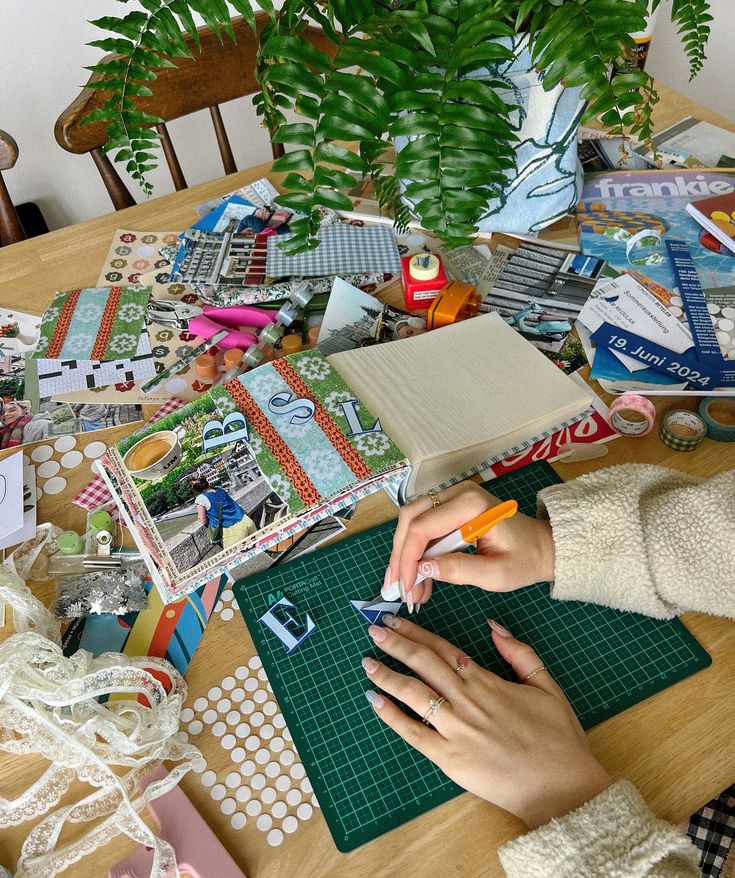
Grab some old magazines or junk journaling scraps from your last vacation and glue them together into a tiny masterpiece. It’s chaotic, it’s cute, it’s one of the best easy crafts to do at home when your brain is fried. Allow yourself to simply create without any expectations. To me, the best glue for junk journaling are glue sticks!

artsy and creative crafty ideas for easy crafts to do when your bored and want to be productive and creative but are really tired
Draw silly faces, they don’t have to be good, just silly

5. One-Line Drawing
Draw something without lifting your pen. It will look weird, but that’s the whole point. We love abstract art and no one can stop us.

6. Decorate a Notebook Cover
Turn something boring into something that screams “I journal” (even if you don’t). It’s functional and aesthetic, making it one of the best productive and easy crafts.

7. Make a Playlist
Go through some of your favorite songs and arrange a playlist based on how you’re currently feeling. Some of my favorite playlists came out of boredom and 30 minutes of simply sitting on a bench, watching the sunset, and listening to music I think would mix well together. It seems so simple, but can feel so productive to create.

8. Do a 5-Minute Sketch
Set a timer and draw anything you can see in your direct view. Stop when the timer goes off and go about the rest of your day. To expand on this easy craft, you can always plan to do multip0le short drawings. Jump from 1 minute to 3 minutes to 5 and 10.

9. Go on a Color Hunting Walk
Choose a color and follow it on a walk around your neighborhood. Chase the red tulips to the stop sign and turn when you see a red truck. Sometimes easy crafts require you to walk away from the desk and get some new inspiration.

10. Create Tiny Art Prints
Fold a paper into small sections and fill each one with a mini drawing or design. Tiny art feels less intimidating and way more doable. It’s giving productivity… but in snack form.

🧃 Tiny Tasks That Feel Weirdly Impressive🧃

11. Coffee Stain “Vintage” Paper
Why in the world would you ever buy coffee-stained paper for journaling or scrapbooking, when you can literally just make a mess yourself. Spill some coffee, or tea, or watercolors. Design paper to use for scrapbooking. For easy crafts like this, I do recommend you buy some heavier quality paper like this Canson XL Watercolor Paper on Amazon.

12. Reorganize your Closet by Style & Color
Not all easy crafts require drawing or painting, sometimes it’s enough to just be creative. Spring is the perfect time to re-sort your closet, so throw out what no longer serves you, and refresh your wardrobe with easy crafts that don’t feel like work.

artsy and creative crafty ideas for easy crafts to do when your bored and want to be productive and creative but are really tired
Organize your closet by color, it’s aesthetically pleasing and productive!

13. Paint Simple Patterns
Stripes, dots, wavy lines… that’s it. That’s the craft. This is one of those simple craft ideas that looks weirdly aesthetic with minimal effort. Fill a whole page and suddenly it looks intentional, like you had a plan the entire time (you didn’t, and that’s okay). Here’s a watercolor set under $20.

14. Sponge or Finger Painting
If a brush feels like too much responsibility, grab a sponge or even a paper towel. Heck, use your fingers for easy crafts like this. Dab paint around and call it abstracted texture. It’s impossible to mess up because there is no standard.

15. Tape-Resist Art
Put fun washi tape down in random lines, paint over everything, then peel it off. Boom—clean lines with zero actual control. This is one of those easy crafts at home that tricks people into thinking you’re precise and detail-oriented. We won’t correct them.

artsy and creative crafty ideas for easy crafts to do when your bored and want to be productive and creative but are really tired
Journal Idea by @linalovespages

16. Press Flowers in a Book
Go outside, touch grass (briefly), grab a few flowers, and stick them in a heavy book. Wait a few days and then try to remember the page number you chose to be delicate and poetic. Minimal effort now, max main-character-manic-pixie-dream-girl energy later.

17. Curate a “Pretty Corner”
Pick one tiny area of your space, it can be your desk, a shelf, even your nightstand. I want you to rearrange the space to be Pinterest-worthy: stack cute books, add a candle, lean a random piece of art against the wall. Will the rest of your room still be chaotic? Yes. But this one corner? Beautiful and organized.

18. Edit & Delete Photos on Your Phone
Go through your camera roll and edit a few photos, delete duplicates, and clear out your virtual storage. Often clutter isn’t always material, it can be digital. Easy crafts don’t have to be physical either.

artsy and creative crafty ideas for easy crafts to do when your bored and want to be productive and creative but are really tired
At Least 10 Beautiful Fish.

19. Draw the Same Thing 10 Times
It can be anything, from an egg to a ping pong ball to 10 different types of fish. Draw something over and over until you have 10 of them that fill the page. Are you happier with 10 fish?

20. Sticker Collage Something
Whether it be a laptop, the outside of a notebook, or a camping table, just use your stickers and decorate anything. Check out these cute granola-hiker-outdoorsy girl stickers.

🧠 Productivity Illusions 🧠

(we love being delulu)

21. Organize Your Sketchbook Pages
Flip through your sketchbook and add dates, titles, or little notes. You’re not making new art, but suddenly everything feels curated. Like a gallery. Like you planned this.

22. Finish One Old Drawing
Not five. Not all of them. Just one. Add a little shading, a background, maybe even your signature in the lower right hand corner. Closure is productive and, while not every artist is emotionally stable, it feels good to finish a project.

23. Label Your Supplies
You now own labeled items. That’s basically a personality trait and one of the best easy crafts. Also check out this fancy schmancy label maker!

24. Digitize One Piece of Art
Take a photo or scan a piece of art you’ve already made. Digitizing your art is one of those extra tidbits that is definitely still work but not as fun as making the actual painting. And yes, it’s still considered on the easy crafts list.

artsy easy crafts - wash your dirty paint brushes u silly artist
Wash your paint brushes!

25. Clean Your Brushes
This is a gentle reminder that you paid good money for those brushes and they’ve been sitting in water for way too long. Clean your freaking paint brushes!!

26. Set Up a “Perfect” Art Space
Figure out the best lighting, arrange your tools and easel, and set up everything to prep for your next few easy crafts. Will you use it immediately? Maybe not. But creating the space feels productive enough to count.

27. Photograph Your Old Artwork
Lay out your artwork, find good, flat lighting, and take multiple shots of that painting you worked so hard to finish. You’re documenting your work, which feels official and important. Because it is. Look at you, doing easy crafts, archiving actual artwork.

28. Make a Tiny Art Routine List
Write down 3 embarrassingly small creative tasks. I’m talking: “draw a circle,” “use one color,” “open my sketchbook without fear.” Keep it so easy it feels almost insulting. The goal is not discipline—it’s momentum. There’s something weirdly powerful about seeing a list, even if the list is basically “be a person for 4 minutes.” You trick your brain into thinking you have structure, which then makes you slightly more likely to do the thing. And if you don’t? Congrats, you still made a list. That’s administrative productivity. We’re counting it.

🌀Easy Crafts For When Your Brain Is Completely Offline🌀

29. Draw with Your Non-Dominant Hand
Lower your expectations immediately. This is not about skill—it’s about letting go. It will look bad, and that’s the entire point. Easy crafts are sometimes ugly, and that’s ok.

30. Blind Contour Drawing
Look at your subject, not your paper, and just draw. The results will humble you. But also? It’s one of the best beginner friendly art ideas because there’s literally no pressure to be good. For more beginner drawing tips, check out my article: 5 Easy Drawing Tips For Beginners and Intermediate Artists.

easy crafts for creative people

31. Scribble and Fill It In
Make a chaotic scribble, then color in all the little shapes it creates. It’s like turning nonsense into something structured. Accidental productivity is still productivity. Easy crafts are still easy.

32. Tear Paper for a Textured Collage
No scissors. No clean edges. Just rip paper and glue it down. It’s messy in a controlled way, which is honestly the goal for most of us right now.

33. Close Your Eyes and Draw Shapes
Shut your eyes, draw random lines, then open them and build something from it. It’s like collaborating with your subconscious… who may or may not know what it’s doing.

🧵Were we Productive ?🧵

easy crafts for creative people

Here’s the thing no one tells you: productivity doesn’t have to be big, impressive, or Instagram-worthy.

Sometimes it’s just doing a tiny creative thing instead of doom-scrolling for two or three or four hours. These easy crafts, DIY projects and beginner friendly art ideas aren’t about becoming the most disciplined version of yourself. They’re about reminding you to create rather than consume. Once you realize that creating is healthier than consuming, you’ll feel better, trust me, I’m an artist.

Remind yourself that you can still create, even on low battery mode. So go through the list again and just pick one: tear some paper, delete some photos, go on a walk, or swatch all your markers and throw out the ones that have died. At the end of the day, doing something small is still doing something.

33 Easy Crafts That Trick Your Brain Into Feeling Productive Read More »

Art Is Never Neutral

Art is never neutral.

From ancient murals to protest posters. Or Banksy’s contemporary graffiti. Art is expressive and has always told a story of power, resistance, value, and rebellion. In the tense political climate in the United States, artists are once again confronted with a choice: remain silent or create bravely.

“Somewhere along the way, art went from ‘let’s disrupt the government’ to ‘will this match my living room?’”
B. Eisman, February 2026
Tweet

To make art is to reveal what you believe — and history shows that when society shifts, art becomes both a witness and a weapon.

Intro: Just a quick art history lesson…

Picasso questioned what a portrait was supposed to look like. Banksy’s work “influence[s] the viewer…or simply opens someone’s eyes to contemporary problems,” expertly put by Sara M. White in her analysis of concrete rebellion.

Artists have always been at the forefront of movements for justice, equality, and freedom, using their work to highlight societal issues and provoke action. The Harlem Renaissance of the 1920s is a perfect example of this. This cultural movement was not just about creating beautiful works of art; it was about redefining African American identity, celebrating Black culture, and challenging the racist stereotypes that had dominated American society for centuries.

This kind of art isn’t just about aesthetics—it’s about challenging people to question their assumptions and consider new perspectives. Whether it’s through paintings, music, literature, or performance, art inspires change, making it an essential tool for building a better, more just society.

Art is Pink vs. Black

Stuart Semple and Anish Kapoor even turned color into a debate about ownership and access.

Kapoor is maybe most well known for the Chicago Bean sculpture, known by less as Cloud Gate in Millennium Park Plaza, Chicago. Kapoor decided he wanted to own a color, so he acquired exclusive artistic rights to a super-black paint material called Vantablack

In natural petty artist fashion, Semple rebelled the idea that a single artist could own a color. Semple made it his “mission to democratize art materials and make vibrant colors available to everyone,” according Hustle Culture paints. So in late 2016, Semple released a paint and called it “PINK – the world’s pinkest pink paint” and then subsequently banned Kapoor from ever purchasing the paint.

My favorite part of the story: In June 2024, Semple legally changed his name to Anish Kapoor.

Pinkest Pink by Anish Kapoor aka Stuart Semple

Real artists don’t just decorate. They question systems. They challenge expectations.

Art is trying new methods even when it makes people uncomfortable.

Art is tension pushing culture forward.

Art is Challenging Power

Art is inherently political because it either supports existing systems or resists them.

There really isn’t a neutral middle. Even when art claims to be “just beautiful,” it still reflects who funded it, who it was made for, and whose story it tells.

During the Renaissance, much of the most celebrated work was funded by the Church and European monarchies. Those paintings weren’t random acts of creativity — they reinforced religious authority, divine right, and hierarchy. They shaped how people understood God, power, and obedience. We call them masterpieces now, but at the time they functioned as messaging tools. Propaganda existed long before the word did (check out my other article on Brainrot Art & Jackson Pollock).

Lady Liberty Leading the People - Delacroix political art
Liberty Leading the People by Delacroix

Art is progress

Art moves forward because artists ask hard questions.

  • Why does this have to be done this way?
  • Who decided that?
  • Who benefits?

Maria Brito, a New York–based art advisor and curator, has said that art has always been political because it comes down to choice: Who gets to make it? Who gets to show it? Who gets to own it? Those aren’t neutral questions. They’re about power.

Being an artist isn’t just about making something that looks interesting. It’s about deciding what to say and how to say it. Every creative choice reflects something about the world around us. I know engineers who call themselves artists because they design or code in ways that translate information differently. That shift in communication — choosing to present something in a new way — is creative work.

Real artists don’t just decorate. They question systems. They challenge expectations. They try new methods even when it makes people uncomfortable. That tension is what pushes culture forward. What starts as disruption often becomes growth. And that’s how progress happens.

Art is a form of rebellion

When revolutions began reshaping the Western world, art shifted with them. During the American and French Revolutions, engravings, paintings, and prints circulated images of liberty, martyrdom, and resistance. They were documenting change and giving it fire. Liberty is designed to unify people around an idea.

  • Francisco Goya’s The Third of May 1808 did something different. Instead of glorifying war, it exposed its brutality. The faceless firing squad, the terrified civilian with raised hands — it documented state violence in a way that refused to romanticize it. It forced viewers to confront what power looks like when it turns violent.
  • Diego Rivera’s murals carried politics onto public walls. He painted workers, factories, farmers — elevating laborers to heroic scale. His work centered class struggle and economic injustice at a time when those conversations were volatile. Because they were public murals, they were accessible. They belonged to the people, not just collectors.
  • During World War II, posters became direct tools of persuasion. Governments used bold graphics and slogans to build national identity, encourage enlistment, ration supplies, and shape public morale. Art became strategy. It wasn’t subtle.
  • In the Civil Rights Movement, photography shifted public opinion in ways speeches alone could not. Images of peaceful protesters facing violence, children confronting segregation, marchers crossing bridges — those photographs made injustice undeniable. They moved people who might otherwise have looked away.
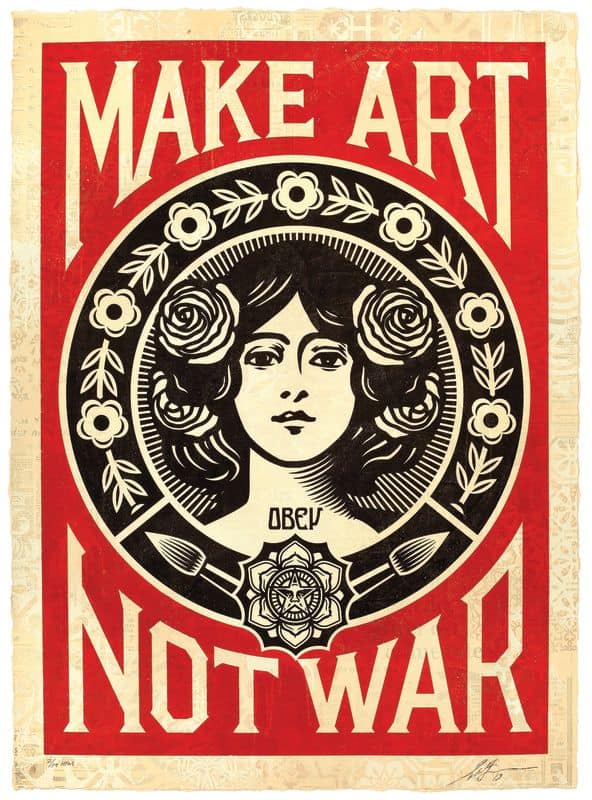
make art not war shepard fairey political poster
Make Art Not War by Shepard Fairey

Across centuries, the pattern is clear: Art is either strengthening those in power or challenging them.

Art shapes belief and documents truth. It persuades. It resists.

Whether hanging in a cathedral, printed on a poster, painted on a wall, or captured through a camera lens, art has always been part of the political conversation. Art has always reflected who holds power — and who is fighting it. It tells us who matters and who doesn’t. It decides what stories get preserved.

So if art has always been tied to power, what does that say about today?

The Modern U.S. Political Climate & Fears around Speaking out

@odesso

made out of the redacted parts. 113 layers, made in photoshop. #dubaichocolate #digitalcollage #collage

♬ Dancing and Blood – Low

Today’s political climate in the United States is tense.

Opinions waver. Headlines escalate. Families disagree. Communities split along ideological lines.

In this kind of environment, making art can feel complicated. The pressure isn’t always loud, but it’s there — in what we choose to say, what we avoid saying, and how much of ourselves we’re willing to reveal.

And social media has done nothing but amplify that pressure.

Artists can reach thousands instantly, but they can also face backlash just as quickly. The fear of being misunderstood, misquoted, or “canceled” is real. One post can shift an audience. One image can spark outrage. When your work lives online, it doesn’t just hang quietly in a gallery — it circulates, it’s screenshotted, it’s debated. That reality makes silence feel safer.

Neutrality feels strategic.

At the same time, corporate branding and monetization shape creative decisions in subtler ways.

Many artists rely on partnerships, sponsorships, or algorithms to sustain their work. That dependence can influence what feels “safe” to create. Artwork that is aesthetic, pleasing, and broadly palatable is rewarded. Artwork that is more vocal or politically specific can feel risky.

Abolish ICE Iron-On Patch
Cool Patch for purchase at Humboldt House

Art is Protest in visual form

And yet, outside curated feeds and brand guidelines, protest continues to take visual form.

Women’s marches fill streets with handmade signs. Racial justice movements transformed plywood-covered storefronts into murals. LGBTQ+ rights demonstrations flood timelines with bold graphics and reclaimed symbols. Reproductive rights protests carry typography that spreads across cities in hours.

Protest art today is immediate — cardboard, spray paint, digital illustration, viral design.

It travels fast. It speaks before policy changes.

Artists express culture, even when it is divided and reactive. Photographers capture history that reminds us that art can emerge from instability. War, revolution, civil unrest — these periods have repeatedly produced work that was urgent, uncomfortable, and necessary. The art that endures is rarely the art that tried hardest to offend no one.

Silence can feel protective in a polarized moment. It can preserve followers, partnerships, reputation. But art that avoids discomfort often risks becoming decorative instead of meaningful. To create honestly now requires courage and clarity. But remember, risk has always been played a part in the artist’s role.

To publish, post, exhibit, or even quietly share work that reflects conviction means accepting that not everyone will approve.

B. Eisman, world renowned photographer

@editsbyelsa

Alysa Liu, you’re a genius 🖼️✨ · Promise – Laufey 🕰️ —— #alysaliuedit #alysaliu #laufey #laufeyedit #mixedmedia —— @laufeyland @frigouscigous @laufeyfan

♬ son original – elsa

How Our Culture Has Changed in How We Value Art

Somewhere along the way, art went from “let’s disrupt the government” to “will this match my living room?”

Paintings are now investment assets and creativity is filtered through Instagram algorithms. ChatGPT gently whispers in your ear, “Have you considered making this more millennial grey?” and you say back “I need acrylic paint markers to be a real artist.”

Art is now optimized, branded, ai generated, and a/b market tested. Essentially, neutralized. Creativity is monetized and “if you don’t make money then you aren’t a real artist.”

Good thing I make money as an artist.

The Shape of Content, by Ben Shahn

I recently finished a book that discusses this idea of an artist’s role to push boundaries. It’s called The Shape of Content by Ben Shahn.

It’s a book of essays based on lectures by the artist at Harvard in 1957. However old, the ideas are not outdated, and I actually found them to be more relevant than ever in 2026. Shahn makes a case that all artists have an unavoidable responsibility to society, and I agree with many online reviews that anyone studying art should make an effort to read this book.

I have always believed that the character of a society is largely shaped and unified by its great creative works, that a society is molded upon its epics, and that it imagines in terms of its created things—its cathedrals, its works of art, its musical treasures, its literary and philosophical works.

Ben Shahn, The Shape of Content

It’s a reminder that art is not just an aesthetic exercise—it’s how we make meaning, shape memory, and build a shared imagination. It’s how we record what mattered to us, even when words fall short. When the world feels overwhelmed by noise, art quietly insists on depth. It challenges, comforts, questions, and preserves.

Shahn’s essays argue that artists don’t just reflect the world—they help shape its future. And in reading his words, I felt reminded that creativity isn’t a luxury or a hobby, it’s a responsibility. It’s how we leave something behind that speaks for us when we’re no longer here. It’s how we process the destruction of art and the value we assign it.

So paint on big canvases that don’t match couches. Make drawings that aren’t aesthetically pleasing. Force art to elbow its way through sponsorship emails and dashboards to stay alive and keep on kicking.

Conclusion: Art is never neutral

Art remembers what we try to forget. It remembers the injustice. It remembers the courage. It remembers who spoke and who stayed silent.

When we look back at history, we do not remember the neutral. We remember the brave.

There is something quietly tragic about realizing that every era believes it is too complicated, too divided, too fragile for bold expression.

And yet, history moves forward because someone painted anyway.

Someone wrote anyway.

Someone marched anyway.

annish kapoor
Sky Mirror by Anish Kapoor

Maybe the real question is not whether art is political.

Maybe the question is whether we are willing to let our art be our voice.

And years from now, when someone looks back at this moment in the U.S., what will they see? Silence? Or a voice?

Art Is Never Neutral Read More »

100 Inspiring Quotes About All Types of Art

Art has a way of saying the things we can’t quite put into words.

Whether you’re sketching in the margins of a notebook, layering paint on canvas, editing photos at midnight, or wandering through a museum just to feel something shift inside you, art meets us where language falls short. Sometimes, all it takes is a single sentence to unlock a new way of seeing—or to remind us why we started creating in the first place.

That’s where quotes about art and painting come in. They capture the shared experience of artists across time: the doubt, the obsession, the joy, the quiet persistence. These quotes aren’t just decorative words—they’re creative compatriots. They sit beside you in the studio, whisper encouragement when a piece isn’t working, and remind you that uncertainty is part of the process.

This collection of quotes about art and painting is designed to inspire artists of every kind—painters, illustrators, photographers, designers, sculptors, journalers, and creatives who don’t fit neatly into one box. You’ll find well-known voices alongside lesser-known artists whose words feel deeply lived-in and honest. Whether you’re here to spark an idea, find motivation, or simply feel less alone in your creative practice, this page is meant to be returned to again and again.

“Photographers capture the truth of light.”

B. Eisman 2026
peru amazon jungle photography by brianna eisman
Camping in the Amazon jungle in Northern Peru by Brianna Eisman

Quotes About Art & Drawing

“Drawing is the honesty of the art. There is no possibility of cheating.” — Salvador Dalí

“A line is a dot that went for a walk.” — Paul Klee

“Drawing is not what one sees, but what one can make others see.” — Edgar Degas

“Drawing is thinking on paper.” — Saul Steinberg

“Every artist was first an amateur.” — Ralph Waldo Emerson

“Sketching is a way of asking questions without needing immediate answers.” — Jessica Hische, lettering artist

“Drawing teaches you how to really look.” — Dana Schutz

“Your sketchbook is a place to be wrong safely.” — Austin Kleon

“Drawing connects the hand to the mind in a way nothing else does.” — Peter Han, concept artist

“Sometimes the sketch holds more truth than the finished piece.” — Cathy Johnson, artist and art educator

Quotes About Art & Painting

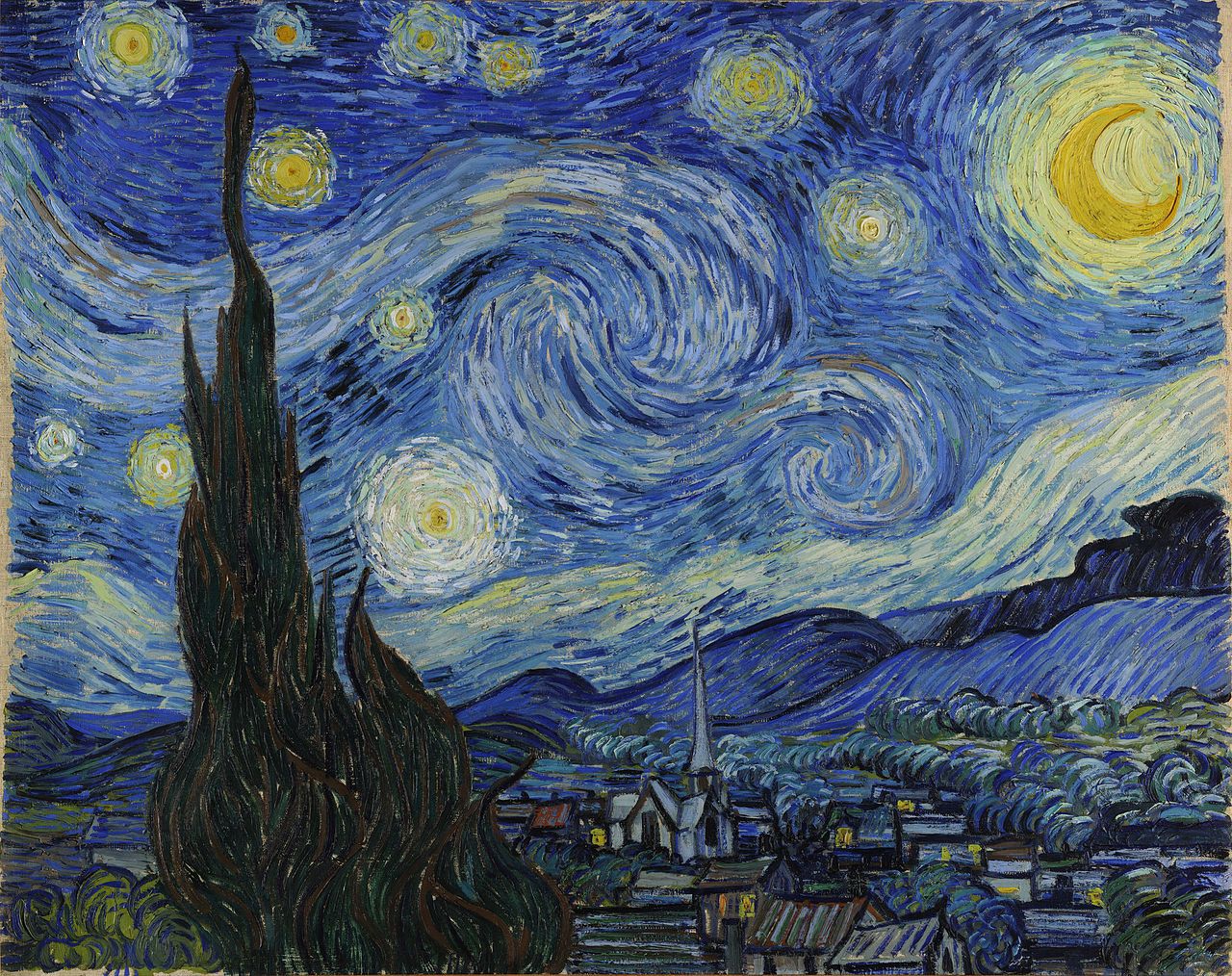
“I dream my painting, and then I paint my dream.” — Vincent van Gogh

“Painting is poetry that is seen rather than felt.” — Leonardo da Vinci

“A painting is never finished—it simply stops in interesting places.” — Paul Gardner

“I shut my eyes in order to see.” — Paul Gauguin

“Color is my day-long obsession, joy, and torment.” — Claude Monet

“I shut my eyes in order to see.” — Paul Gauguin

“Painting is about trusting yourself enough to begin.” — Lisa Congdon

“Every canvas is an opportunity to forgive the last one.” — Chuck Close

“Paint what you feel, not what you think you should.” — Cecily Brow

“Art should comfort the disturbed and disturb the comfortable.” — Banksy (Check out my photos of Banksy’s work)

“Painting is an act of faith.” — Gerhard Richter

Quotes About Art & Sculpture

“I saw the angel in the marble and carved until I set him free.” — Michelangelo

“Sculpture is the art of the intelligence.” — Pablo Picasso

“Sculpture is made by taking away.” — Antoine-Louis Barye

“Materials have their own opinions.” — Eva Hesse

“Clay remembers every touch.” — Peter Voulkos, ceramic artist

“Sculpture exists in the space we share with it.” — Antony Gormley

“Form is emotion slowed down.” — Barbara Hepworth

“Sculpture teaches patience through resistance.” — Andy Goldsworthy

“You learn by listening to the material.” — Isamu Noguchi

“Space is as important as solid form.” — Henry Moore

Quotes About Art & Photography

“A photograph is a secret about a secret.” — Diane Arbus

“The camera is an instrument that teaches people how to see.” — Dorothea Lange

“Photography is the story I fail to put into words.” — Destin Sparks

“You don’t take a photograph, you make it.” — Ansel Adams

“Light makes the photograph.” — George Eastman

“Photography is about paying attention.” — Alex Webb

“Sometimes the blur tells the truth.” — Jonathan Topping, film photographer

“A camera is a diary with no eraser.” — Henri Cartier-Bresson

“Blur can be more honest than sharpness.” — Daido Moriyama

“Photographs feel like memories we didn’t live.” — Gregory Crewdson

Quotes About Art & Graphic Design

“Design is intelligence made visible.” — Alina Wheeler

“Good design is obvious. Great design is transparent.” — Joe Sparano

“Design is thinking made visual.” — Saul Bass

“White space is breathing room.” — Khoi Vinh

“Design is how it works, not just how it looks.” — Steve Jobs

“Clarity beats cleverness.” — Ellen Lupton

“Design is problem solving with empathy.” — Mike Monteiro

“A logo is not a brand—it’s a doorway.” — Debbie Millman (Check out her podcast, Design Matters! It’s one of the first, longest running and most respected podcasts in the world)

“Consistency is a form of respect.” — Pentagram Design Group

“Design should feel effortless, even when it isn’t.” — Paula Scher

Quotes About Art & Game Design

“Games are the most elevated form of investigation.” — Albert Einstein

“A game is a series of interesting choices.” — Sid Meier

“Play is the highest form of research.” — Stuart Brown

“Players remember feelings, not mechanics.” — Jenova Chen

“Game design is empathy expressed through systems.” — Eric Zimmerman

“Failure should be fun.” — Raph Koster

“Games teach through experience, not instruction.” — Jane McGonigal

“A good game respects the player’s intelligence.” — Shigeru Miyamoto

“Design for curiosity first.” — Brenda Romero

“Rules create meaning.” — Jesper Juul

Quotes About Art & Art History

“Art is a lie that makes us realize truth.” — Pablo Picasso

Every artist is shaped by their time.” — Ernst Gombrich

“Art history is a conversation, not a timeline.” — Linda Nochlin

“The past is never silent.” — John Berger

“To study art is to study humanity.” — E.H. Gombrich

“Movements are born from resistance.” — T.J. Clark

“Style is a response to culture.” — Rosalind Krauss

“Art history is full of rule breakers.” — Griselda Pollock

“Context changes everything.” — Hal Foster

“Nothing radical exists in isolation.” — Aby Warburg

Quotes About Art & Museums

“Museums are time machines.” — Orhan Pamuk

“Art belongs to everyone.” — Ai Weiwei

“You don’t have to understand art to feel it.” — Agnes Martin

“Museums teach us how to look slowly.” — Teju Cole

“Galleries are spaces for listening.” — Hans Ulrich Obrist

“Museums remind us we are not alone in time.” — Rebecca Solnit

“Every wall has a voice.” — Thelma Golden

“Museums hold questions, not answers.” — Glenn Lowry

“Art needs space to breathe.” — Ellsworth Kelly

“A gallery visit is a conversation across centuries.” — Jerry Saltz

Quotes About Art, Journaling, & Creative Reflection

“Your journal is a judgment-free zone.” — Lynda Barry

“Creativity grows in private first.” — Julia Cameron

“Write what you notice.” — Natalie Goldberg

“A journal is where art begins quietly.” — Keri Smith

“Messy pages are honest pages.” — Austin Kleon

“Reflection is part of the practice.” — Sark

“Your sketchbook is allowed to be imperfect.” — Danny Gregory

“Pages are patient.” — Anne Lamott

“Journaling is drawing with words.” — Shauna Niequist

“Your thoughts deserve space.” — Brené Brown

How to Create Your Own Inspirational Paintings

If reading quotes about art and painting sparks the urge to create, lean into it. You don’t need expensive tools, just a few reliable supplies and permission to experiment.

Here are my suggestions for art supplies to create a painting in acrylic paint:

Try painting one quote as a visual concept—use color, shapes, or mood instead of literal words. Let the quote guide the feeling, not the outcome. This is about expression, not perfection.

Final Thoughts on Quotes About Art

Quotes don’t replace practice, but they can reignite it. The right words can pull you out of a creative rut, soften your inner critic, or remind you that every artist you admire once stood exactly where you are now. These quotes about art and painting are proof that uncertainty, experimentation, and growth are universal parts of making art.

Creativity isn’t a straight line, and it was never meant to be. Some days you’ll feel inspired and confident; other days, you’ll question everything. Let these quotes serve as gentle reminders that showing up matters more than perfection—and that your work doesn’t need to look like anyone else’s to be meaningful.

Bookmark this page. Highlight your favorites. Paint from them. Journal about them. Let them sit quietly in the background of your studio or creative space. Art is made in moments both loud and subtle, and sometimes inspiration arrives simply by reading the words of someone who understands the process.

Most of all, remember this: your perspective is already enough. Keep creating, keep experimenting, and keep trusting that your voice—like the artists quoted here—deserves to exist in the world.

Like this article? Get Updated when I write the next one:

Subscription Form

AI AI art art art advice art drawings art history Artificial intelligence artsy artsy drawings artsydrawings art tips artwork Banksy brianna eisman bujo bullet journal color wheel Contemporary art craft crafting crafts Creativity Cubism design diy drawing drawings drawing tips drawing tips for beginners eisman Impressionism Inspiration journal landscapes painting paintings painting tips pencil scrapbooking sketchbook social media Surrealism Traditional art visual art words to describe art

100 Inspiring Quotes About All Types of Art Read More »

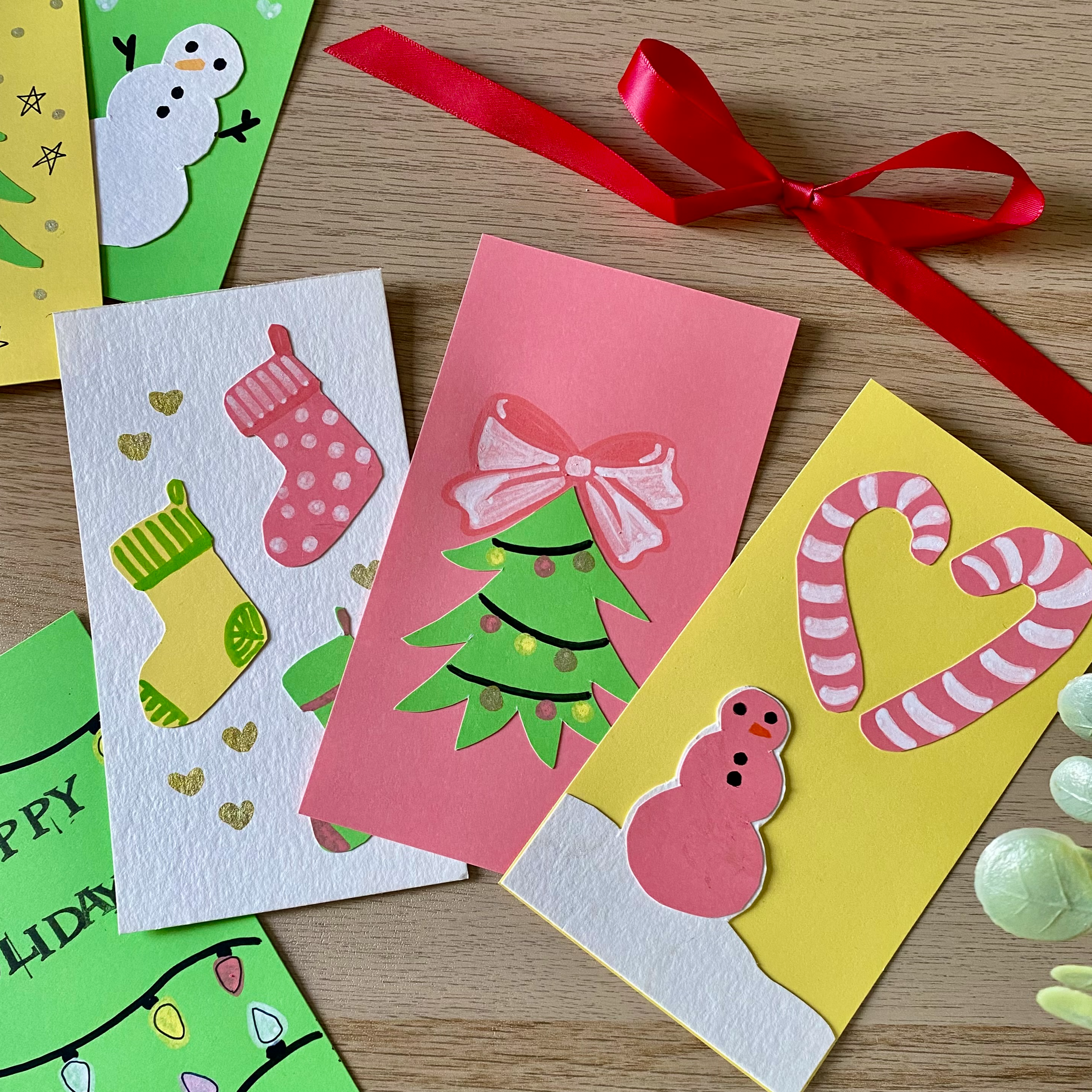
25 Date Night Christmas Crafts: Cozy Ways to Spice Up The Holidays

With the holidays practically here already, let’s get into my list for the best artsy holiday crafts of 2025.

This is officially the 2025 Date Night Christmas Crafts List—full of soft, silly, easy projects perfect for making memories. Try them solo, with your people, or with someone you’re trying to impress with your fantastic artsy crafting skills. I decided to come up with 25 crafts, so if you are really a competitive crafter, you could do one of these date night Christmas crafts every day til December 25th!

To start, I want to include a little disclaimer. Life is too short not to be silly and have fun. I wanna do stupid things and love big and create for the sake of creating, not because it’s meant to be something. Lately, I’ve been very busy and I’ve been putting off creating art. I’ve even missed October‘s newsletter. Here’s a shameless plug to subscribe to my monthly newsletter:

Sign up for my artsy newsletter!

Name
Email
The form has been submitted successfully!
There has been some error while submitting the form. Please verify all form fields again.

At the end of the day, I find myself consuming more than I create. And I think that may be my life lesson.

When you create, you feel a deeper pull into the project. It’s a sense of accomplishment because you know that what you’ve done is truly and irrevocably yours. It could be a beautiful turkey Thanksgiving dinner or a cozy Christmas coloring book page or beautiful photograph taken on your phone. Your creation is the combination of intention, task, and talent.

Now that all that sappy stuff is over, let’s go through my 2025 Date Night Christmas Crafts list!

Twenty Five Date Night Christmas Crafts for 2025:

1. Felt Gingerbread Ornaments – They’re adorable, easy, and don’t require me to preheat anything. You can try out this holiday themed felting kit or try your hand at making it from scratch with brown felt sheets, brown and white embroidery floss, needles, and maybe some white puff paint to bring your gingerbread man to life.

Date Night Christmas Crafts #1: Felt Gingerbread Ornament

2. Gold-Leaf Anything – Apply fake gold leaf to literally anything. You can get a good bottle of gold leaf paint for under $10.

3. New Year Vision Board – Collage photos and stickers to manifest the life you want in the new year. You can choose to make separate ones, or one combined relationship mood board.

4. Sustainable Velvet Ribbon Garland – Tie velvet ribbon together for a cozy, zero-waste garland. Check out this velvet ribbon set that’s perfect for your Christmas aesthetic! Also, make sure you glue them together with hot glue or glue dots.

Date Night Christmas Crafts: Holiday Paper Garland

5. Googly-Eyed Santa Claus – Go to a relative’s home and put googly eyes on as many Santa and Snowmen figurines as you can find. Get googly eyes with sticky backs like these: 500 Self Adhesive Googly Eyes!

6. Custom Printed Wrapping Paper – This girl on TikTok printed wrapping paper with her cat’s face on it for Christmas this year. I think this date night Christmas craft is adorable and fully customizable.

7. “Slay Bells” Christmas Banner – String cute felt flags that spell out “SLAY BELLS.” You could choose whatever you want it to spell out, but be silly with it! I recommend felt paper for the flags and letters, jute or ribbon to string it, and maybe some embroidery floss to add a cute sewed edge.

8. DIY Champagne Cork Reindeer – Add eyes, pipe cleaners, tiny scarf. Boom. Boozy Rudolph.

9. Salt Dough Lucky Charms – Make mini charms out of salt dough for New Year’s good luck, like stars or clovers. If you want to support a small business, you can also buy these charms from Lovely Crafting Mama’s Etsy shop. For crafting, I recommend everyone interested in making charms, earrings, or keychains get a full jewelry making kit. Trust me, it will make your life easier to buy it once.

10. Snowy Pinecone Place Cards – Frosty pinecones with name tags so no one fights over chairs this year. You can use spray snow to give that frosted effect.

11. Clay Peppermint Coasters – Swirl red and white polymer clay into peppermint circles and bake them. You can also get this 5 lb tub of airdry clay and paint the red swirl on with some gold leaf accent. Just make sure you seal your coasters with a nice varnish. To make this craft easier, you can also use acrylic paint pens to draw on the clay.

12. Build a Gingerbread House – Work together and try not to fight when someone eats the décor. You can also get this cute gingerbread village so everyone gets to decorate their own house.

13. Hand Sewed Holiday Scrunchies – Sew scrunchies with prints like gingerbread, reindeer, or cute elves. For a less in-your-face Christmas theme, opt for red and green gingham fabric, sparkles, or snowflake prints! Check out this tutorial for a no-sew scrunchie: LittleRedWindow.com/how-to-make-scrunchies-with-no-sewing/

14. Airdry Clay Magnets – From Nutcrackers to holly branches to snowmen, you could make a whole army of holiday themed magnets. I especially love these painted floral magnets made of airdry clay! I suggest you get this 5 lb tub of airdry clay, this sheet of magnet paper, and for a special holiday sparkle, go for this gold leaf paint.

15. Magnetic Advent Calendar Tiles – You can make it RedBull themed if you want. You can also use small envelopes, boxes, or fabric pouches filled with treats or sweet notes. I especially like this wooden advent calendar that you can fill with whatever you want!

16. DIY Velvet or Satin Ribbon Statement Bows – Easy and sustainable, this date night Christmas craft is definitely on my to-do list this year. Also, make sure you glue them together with hot glue or glue dots.

Christmas Crafts for Girls Night - DIY Hair Bow Christmas Tree date night christmas crafts

17. Love Letter Ornaments – Write tiny notes to each other and tuck them inside clear ornaments. You can use this 12 piece set of clear ornaments, or buy a couple from your local craft store.

18. Stamped Gift Bags & Wrapping Paper – One of my favorite sustainable stamp hacks is to carve a potato and use it as a custom stamp! This creator used a potato stamp to make checkered wrapping paper.

19. Memory Jar with Date Prompts – Decorate a mason jar with ribbons and jute string and fill it with written date ideas for the next year. This jute string set has some really cute options.

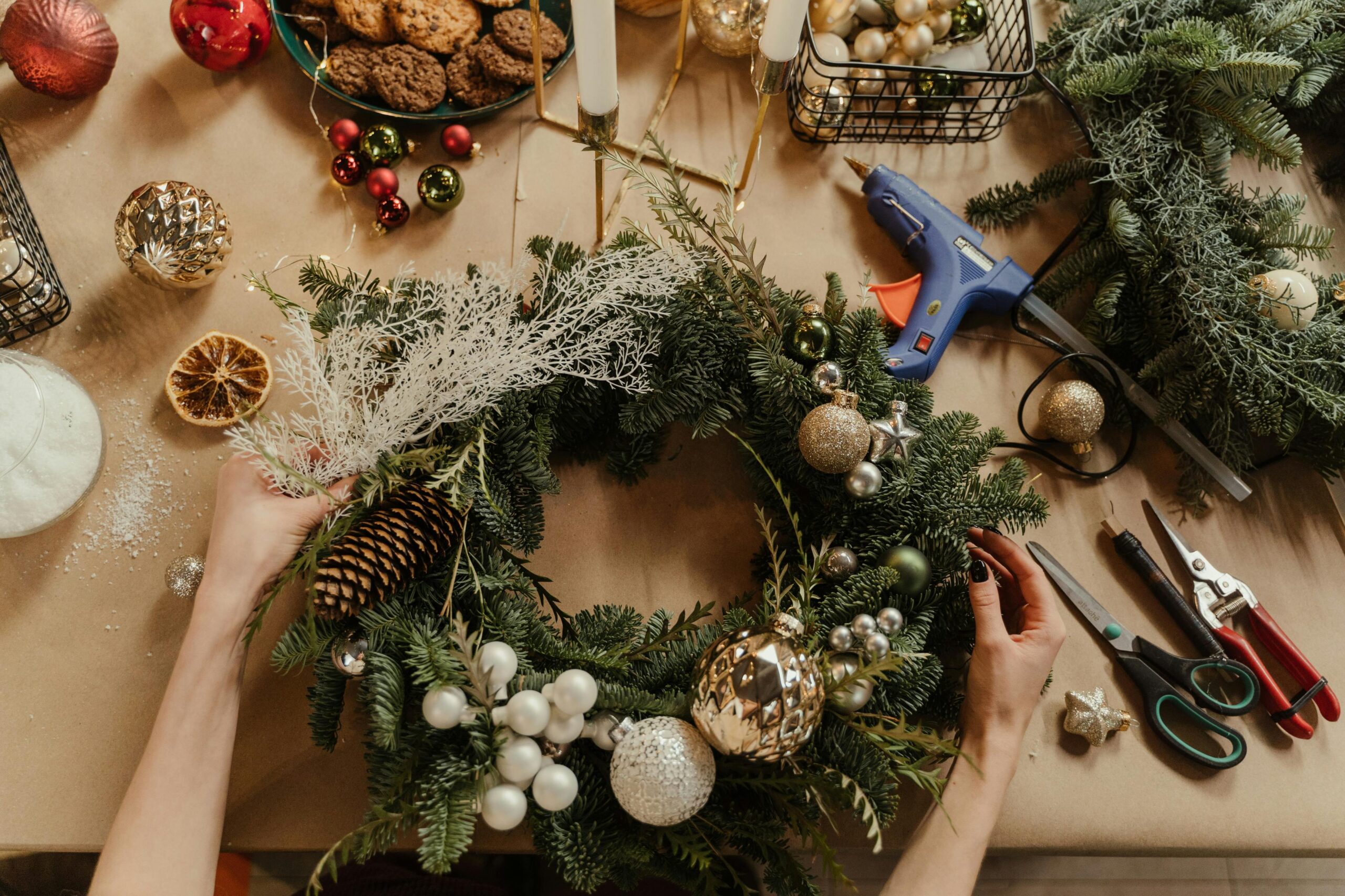
20. Pressed Orange Slice Chimes – Boho and festive, this craft uses dried orange slices and other random items you can find, like bells, feathers, cinnamon sticks and evergreen branches, to create a beautiful and sustainable holiday decoration. Also, if you dry out your oranges long enough, you can keep your chime for next year! For more ideas for what to do with your dried oranges, check out this article about Elegant & Cozy Dried Orange Christmas Decorations.

21. Holiday Friendship Bracelets – Channel your inner Christmas Swiftie with cute holiday bracelets! You could even use red and green beads to spell out “SLEIGH” or “HO HO HOMIES.”

22. Recycled Paper Bag Origami Stars – Fold and cut Trader Joe’s paper grocery bags to create really cute hanging stars for the holidays. Here’s a quick TikTok to follow along: www.tiktok.com/@its.kimberlyrodriguez/video

@its.kimberlyrodriguez

Don’t throw away your paper grocery bags! Instead make them into dreamy ornaments! Turning my @Trader Joe’s grocery bags into 3D stars this holiday season ✨🎄 #christmasdiy #papercrafts #holidaydecor #christmasdecor #christmascrafts

♬ Main Title (From “Elf”) – Dominik Hauser

23. Jingle Bell Keychains – Clip jingle bells to a keyring so everyone hears you arriving… or escaping. I recommend everyone interested in making charms, earrings, or keychains get a full jewelry making kit. Trust me, it will make your life easier to buy it once.

24. Spotify Wrapped Bullet Journal Page – With Spotify Wrapped about to drop, it’s basically begging to be turned into date night Christmas crafts. Design a Spotify Wrapped spread in your bullet journal to remember and look back on the wildly musical year you had. Bonus points if you listed to the Wicked soundtrack more than once!

spotify wrapped date night christmas craft artsy drawings brianna eisman bullet journal bujo

25. Holiday Simmer Pot – Slice oranges, and add cinnamon sticks and cloves to boiling water. I adore simmer pots this time of year, they smell fantastic, are more affordable than a candle and last longer. Check out this recipe for a Winter Solstice simmer pot.

Date Night Christmas Crafts

And that’s the lineup. Cute, easy, zero-pressure date night Christmas crafts that don’t require a personality change or an art degree. Use these date night Christmas crafts to make memories, make a mess, or just make it look like you tried this year. Whatever you choose, happy crafting and happy cuddling.


If this list of Date Night Christmas Crafts isn’t enough for you crafty artists, check out this other list I put together last year of 55 DIY Crafts to Do in December.

Hey, if you liked this article, go check out my other ones! ArtsyDrawings.com is for artists, by artists. From graffiti to journalling to pixel art and why I think people hate modern architecture, you can find some pretty cool reading material at my blog: https://artsydrawings.com/art-advice/. Enjoy!

25 Date Night Christmas Crafts: Cozy Ways to Spice Up The Holidays Read More »

Why Did the CIA Fund Brainrot Art? The Messy Truth of Jackson Pollock

If you scroll through the online artsy backrooms in 2025, you’ll run into two of my favorite art conspiracies:

  1. Jackson Pollock was secretly bankrolled by the CIA to serve as a weapon in the Cold War.
  2. Brainrot art is being idolized by wealthy cultural gatekeepers/money launderers.

Which one is true? Both? Neither? In this artsy article, I wanna take a winding, tortuous pathway through splatter paint’s journey from admired social activism to the embarrassing reality of being compared to children’s scribbles. Let’s critically judge some art, not to decide if it’s good or bad, but to attempt to find the truth behind brainrot art.

However thoughtful, I know some of you are only here to find brainrot art. And for you silly little brainrot artists, I have found you coloring pages with the worst memes on the internet. Enjoy: https://coloriagevip.com/en/coloriage-steal-a-brainrot/?img=37

The uncomfortable Story of the CIA, Abstract Expressionism, & A Chilly War

In the late 1940s and 1950s, Abstract Expressionism became the flagship avant-garde artistic style in the United States. Artists like Jackson Pollock, Willem de Kooning, Mark Rothko shaped the era. It was chaotic, expressive, often nonfigurative, the complete opposite of realism. Meanwhile, on the other side of the Iron Curtain, Socialist Realism reigned and art was required to depict workers, heroic scenes, factories, revolution, etc.

So you had an ideological clash: expression, freedom, individualism (in the West) versus collectivism, order, narrative (in the Russian Soviet bloc). Pollock was called a “rotten rebel from Russia” and according to co-curator of the Royal Academy exhibition, “Rothko said he was an anarchist.”

The U.S. government wasn’t immediately obsessed with splatter paint, but they quietly liked the idea that art could embody “freedom”— even if that meant non-representational squiggles.

Did the Government actually fund Brainrot Art?

Yes, there is credible evidence that U.S. intelligence and cultural agencies secretly funded or channeled money into promoting abstract art exhibitions as a form of “soft power.” They wanted to show that Americans could afford and enjoy “meaningless art,” implying they live in a freer, more prosperous society.

brainrot art on artsydrawings.com about jackson pollock

However, it may be a stretch to say Jackson Pollock personally cashed CIA checks. The funding was often indirect, via foundations, sponsors, international cultural exchanges. But the broader narrative is supported by many art historians: the U.S. used Pollock’s style as propaganda.

In 1973, Max Kozloff argued Abstract Expressionism was “a form of benevolent propaganda,” (Artforum.com) hinting at the impact of the art movement on changes in American culture. He wasn’t the only one to notice this change and eventually the true story started to leak out.

How did they do it?

So, how did the government get away with funding Pollock’s work? If they weren’t handing out splatter paint checks, how did these artists make any money? Here’s a quick history lesson:

The Cold War started in 1944 and in 1947, the U.S. created the CIA. Within the CIA was a special dedicated group called the Propaganda Assets Inventory. This group was responsible for managing a network of over 800 publications, organizations, and other entities to spread pro-American messages globally. They used psychological warfare in the form of modern art.

One such group was called the Congress for Cultural Freedom (CCF) and was known as “an anti-Communist advocacy group active in 35 countries.” The important part is that the CIA “helped to establish and fund” the CCF. According to Alastair Sooke’s BBC article, this group went on to bankroll a number of artistic platforms including a liberal anti-Communist magazine, the Boston Orchestra to perform in Paris, and “several high-profile exhibitions…including The New American Painting [tour]. This European art exhibit toured eight countries between 1958 and 1959, and our favorite brainrot artist was one of the stars! Below, you can see a clear image of Jackson Pollock’s work on display in The New American Painting exhibit.

The New American Painting ” Exhibition by Soichi Sunami. Photographed May 28, 1959–September 8, 1959, sourced from The Museum of
Modern Art Archives, New York.

Why did they choose Abstract (brainrot art)?

So, the CCF funded these galleries across the world. This still doesn’t explain why they chose the subject of abstract art.

From the Soviet side, abstract art was ideologically dangerous: it looked like chaos, it didn’t commit to narratives or legible messages, and it spoke of the individual’s inner life more than of the collective cause. A state that demands uniformity can’t fully comprehend ambiguity in art. So this Western “freedom art” was a cultural arrow pointed at the very heart of socialist doctrine.

Art critics and Soviet officials often ridiculed abstract expressionism as “decadent,” “bourgeois nonsense.” The tension was political, not just aesthetic.

If you’ve actually read a few of my more poignant articles, you know I enjoy art created for political reasons. Picasso challenged what it means to paint a portrait, Basquiat challenged tagging and street art norms, Stuart Semple and Anish Kapoor challenged color itself. Art is progress because artists consciously ask “why” and “how.”

If you are interested in reading more of my artsy articles with this level of cynicism and brattiness, I recommend you check out Why do people hate minimalist architecture?, The Destruction of Art., and Is AI art to be a valuable future or a scary end of originality?.

Maria Brito is an art advisor, curator, and author based in New York City. She believes art has always been political “because art, at its core, is about choices. Who gets to make it? Who gets to show it? Who gets to own it? These are all political questions.”

The story I believe is that art has always been political, whether it was financed by the church, the Medici, or the US government. Art sends a message and typically the rich decide what that message says. So, even though the art may look like splatter paint from a toddler, “brainrot art” was political for the time and context of which it was created. This is the truth behind art and many people struggle with this idea that art is not always pretty or aesthetic to what you want it to be in the present day.

Brainrot art in 2025: How to Judge Art for what it is

Now let’s jump a few decades forward to brainrot art in today’s world. The same Jackson Pollock that was once used as a moral and ideological emblem is widely dismissed as “paint splatter” and compared to that of a child’s drawings. Why would you pay over $100 million for something a toddler can make?

Here’s where things get tricky. I am a 25 year old artist with a little bit of an attitude. I want you, my dearest reader, to not only feel my angst around brainrot art, but to understand that it’s okay to judge art and to not like everything you see in a gallery.

1. Art is born in a context

You can’t just judge Pollock by your 2025 meme filters. You need to ask: what was happening in 1950, socially, politically, culturally? Who funded it? What audiences saw it?
To reject context is lazy criticism.

2. Intent, funding, and “authorship” matter

If a painting is partly propped up by propaganda, that doesn’t erase the artist’s vision — but it does shift how you interpret it. Every painting lives in a web: patronage, politics, fashion, personality. Disentangle where you can, acknowledge what you can’t.

3. Meaning is not fixed

In 1952, someone might see cosmic energy, Jungian spontaneity, or existential angst in Pollock. In 2025, someone might see chaos catered to white institutions. While both judgements are technically accurate, they speak to different viewers. Be humble in your judgment and remember that meanings change over time.

4. Humor and cynicism help

Let’s be real: lots of art gets overblown hype. Hype doesn’t disprove value — but healthy skepticism keeps us honest. It guards against the “emperor’s new clothes” effect.

brainrot art on artsydrawings.com about jackson pollock

Conclusion: Pollock as a Mirror, Not a Masterpiece or Meme

jackson pollock brainrot art

So, was Jackson Pollock really funded by the CIA? Absolutely, and art historians have traced enough circumstantial paths to take that question very seriously. But, does that automatically make his work a propaganda tool? No…?

In 2025, seeing Pollock’s splatter paintings as “brainrot art” is partly backlash: pushback against art-world gatekeeping, elitism, and all that fancy art jargon. But that rejection can also reduce the complexity of what abstract art was trying to do in a fraught political era.

My hope is that future artists and critics keep both their ambition and skepticism. Honor the context without worshipping the myth. Please judge art harshly and directly, but don’t forget about the context in which it was made. Laugh at Renaissance drawings of cats and then try to draw a cat from memory without a reference photo.

Remember that brainrot art used to be just art and trends will ebb and flow, but the joy of a good meme will never die.


Why Did the CIA Fund Brainrot Art? The Messy Truth of Jackson Pollock Read More »

Perspective in Art: Making Mountains Small and Worms Feel Tall

Introduction to Perspective in Art

Ever wondered why your mountain sketches look a little flat, almost like cardboard cutouts stacked on top of each other? The secret isn’t that you’re bad at art, but you may need some fine tuning when it comes to perspective.

Basically, this article is all about gaslighting.

How do you convince your viewer that a flat sheet of paper is a immersive world, filled with distance, depth, and atmosphere? Perspective in art is that magical mix of size, placement, color and contrast that makes your drawings feel lifelike. Without perspective, you’re stuck with paper cutouts or a very sad painting.

In this artsy article, I’ll break down the best tips for drawing depth in landscapes, using mountains as our main example. You’ll learn how to use atmospheric perspective (light, contrast, and color shifts), as well as linear perspective (vanishing points and angles) to create believable spaces. We’ll explore bird’s-eye view, worm’s-eye view, one-point and two-point perspective, and reference resources from other artists to give you a foundation you can actually use. Still not convinced? Check out this other article about why drawing is important.

Art Supplies for Learning Perspective (Most to Least Essential)

As a professional artist of over 20 years, I feel as though I can fairly accurately provide insight and advice for those wanting to purchase art supplies. I have drawn with mechanical pencils, #2 pencils, professional graphite sets, raw graphite, and chalk. For a list of my favorite art mediums, check out my article listing out my top art supplies.

Of course, take my advice with a grain of salt. Not everything that works for me will work for you. Be an artist, experiment with your materials and find what works best for you.

  1. Graphite Pencils Set – Core tool for sketching all types of perspective. Affordable sets are widely available and versatile. This Faber Castell 6 pack will last you years.
  2. Sketchbooks – Essential for practicing consistently. Spiral-bound, acid-free options are reasonably priced for students. They come in all shapes, sizes and paper types. Use what works best for you, but I like this sketchbook brand.
  3. Erasers – Kneaded and precision erasers are inexpensive but crucial for correcting mistakes while learning perspective. Try out this Prismacolor kneaded rubber eraser.
  4. Rulers & Triangles – Simple, inexpensive tools that make drawing straight lines and accurate angles much easier. This ruler/protractor/geometry kit comes in its own cute box. A yard stick comes in handy for bigger projects!
  5. Colored Pencils or Markers – Helps teach depth and atmospheric perspective; moderate cost and highly versatile. Prismacolor is the best on the market. Get the 24 count and expand from there. Trust me.
  6. Drawing Pens & Fine line Pens – Optional for adding crisp lines or refining perspective sketches; mid-range price. For expert level, I suggest the Faber Castell Pitt or the YISAN drawing set for a more affordable versatile set under $10.

The Greatest Hits of Perspective in Art

Claude Lorrain (c. 1600 – 23 November 1682) was a French painter, etcher, and draughtsman of the Baroque era.
According to Wikipedia, in French, the name “le Lorrain” is sometimes used for him.

Here’s a guide to the main types of perspective in art and how artists can use them to make the viewer feel like looking through a window to another reality.

Artists have long experimented with these techniques to evoke emotion, guide the viewer’s eye, or highlight certain elements. Claude Lorrain, for example, used atmospheric perspective in his golden-hued landscapes, letting hazy light and softened edges create a sense of infinite distance and tranquility. His skies often bleed into the horizon with delicate warmth, making the viewer feel as if they’re peering into an endless, sunlit world.

One-Point Perspective

“Le pont de l’Europe” by Gustave Caillebotte c. 1876

With one-point perspective in art, all lines in a drawing lead to a single vanishing point on the horizon, to create the illusion of depth (see? gaslighting.) Picture a road stretching straight for miles until it disappears into the horizon. Think about how everything from trees and fences to shadows all seem to funnel back to that one spot.

It’s a simple trick, but it makes a flat surface feel like a real space.

Two-Point Perspective

two poiint perspective in art artsy drawings brianna eisman
two point perspective cityscape drawing

Two-point perspective in art uses two vanishing points on the horizon, which is perfect for showing objects at an angle. Imagine a mountain ridge stretching off in two directions, or a cabin set in front of the peaks—everything seems to recede toward two separate spots. It’s a simple way to make angled views feel realistic and grounded.

I also recommend you take a look at this article on architectural sketches or why I think people hate modern architecture.

The magic of two-point perspective in art is how it makes a scene feel alive. Even simple lines and shapes suddenly suggest space, movement, and depth. By guiding the viewer’s eye along two vanishing points, artists can create tension, drama, or even a quiet sense of harmony. It’s like giving your drawing a heartbeat, showing that every edge and corner exists in a real, believable world.

Three-Point Perspective

How To Draw Simple City in 3 Point Perspective by
BudisArch on Youtube

Three point perspective in art is a type of linear perspective in art in which parallel lines along the width of an object meet at two separate points on the horizon and vertical lines on the object meet at a point on the perpendicular bisector of the horizon line. It makes a triangle.

The thrill of three-point perspective is how it transforms ordinary scenes into something cinematic. Buildings soar, mountains plummet, and even a simple street corner can feel like it’s alive with scale and drama. By adding that extra vanishing point, artists can control not just distance but vertical tension, making viewers feel tiny, grand, or entirely disoriented—all at once. It’s a bold tool, but when used well, it makes a drawing feel like a world you could step into.

Bird’s-Eye View

perspective in art artsy drawings brianna eisman
Traditional Chinese painters like Fan Kuan mastered this type of perspective in art—his Travelers Among Mountains and Streams layers peaks and valleys from above.

The German phrase “Vogelperspektive architektur” translates to bird’s-eye view architecture. It refers to an aerial view of a building or a city, as if seen from a great height like a bird. This type of perspective in art is essentially looking down from above. You see ridges, valleys, rivers, even how mountains chain together.

Fan Kuan is often seen as one of the great masters of Chinese landscape painting. His work captures how atmosphere, weather, and the changing seasons shape the natural world. His masterpiece, Travelers Among Mountains and Streams, embodies this vision—it’s a monumental scene that conveys the solemn grandeur of towering mountains and the smallness of humanity within them.

In art, this technique is powerful because it instantly changes scale—mountains shrink into patterns, cities turn into grids, and people become small figures in a vast space. It’s often used to show the relationship between objects and their surroundings, giving a sense of overview and grandeur. Artists and illustrators love the bird’s-eye view because it tells the story of space itself, not just the subject inside it.

“You see ridges, valleys, rivers, even how mountains chain together.”
B. Eisman, multi-media painter
Tweet

Worm’s-Eye View

perspective in art artsy drawings brianna eisman
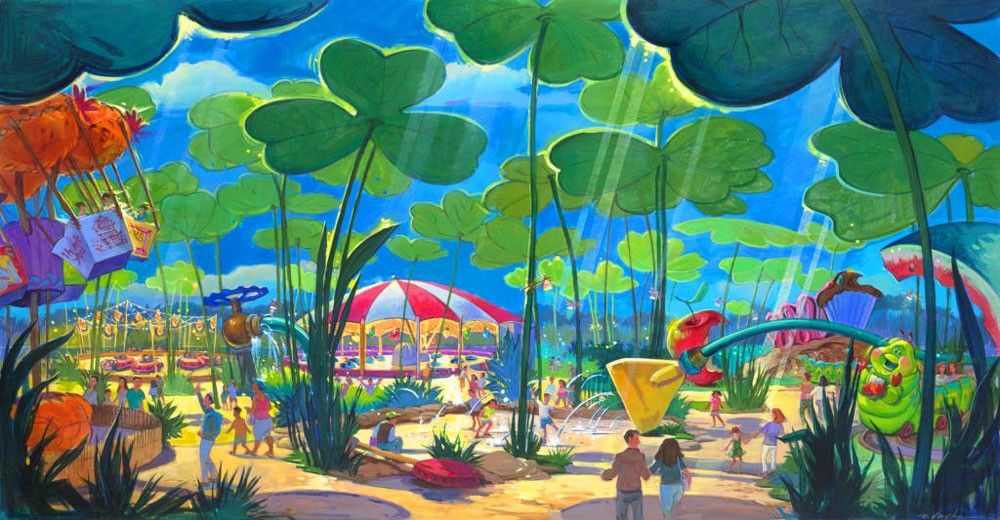
Disney’s concept art for ‘Bug Land‘ shows an incredible worm’s eye view perspective.

“Froschperspektive” translates from German to English as “worm’s-eye view” or “frog’s-eye view.” Figuratively, it can also mean a “blinkered view” or a narrow outlook, suggesting a limited perspective. In film and photography, it refers to a low-angle shot taken from below the subject.  So, in this type of perspective in art you would be looking up from below.

Think about how mountains look monstrous, looming, like they could squash you with a single explosion from Yellowstone volcano. You’re insignificant, an ant. Now remember why you’re an artist and use that power for good. Your hands were made for color, not combat.

Example: Stand at the base of Yosemite’s El Capitan, look up, and try not to faint.

Artists: Romantic painters (hello again, Friedrich) milked this for drama.

Atmospheric (Aerial) Perspective

Will Turner Artist Calais Pier 1803 - Atmospheric Perspective in art
Calais Pier by Will Turner c. 1803

According to art auction house Invaluable.com, “The term was first coined by [Leonardo] da Vinci, who observed in his Treatise on Painting that colors “become weaker in proportion to their distance from the person who is looking at them.” In other words, objects that are further away have blurry edges and appear lighter in color.” What does that mean? It means its not about lines and annoying rulers, it’s about air. The farther away something is, the lighter, bluer, and softer it looks.

“[Colors } become weaker in proportion to their distance from the person who is looking at them.”
Leonardo da Vinci on atmospheric perspective, Treatise on Painting
Tweet

Example: Foreground mountains have crunchy detail; distant peaks fade into pastel smudges.

Artists: From Leo’s silly metaphoric artistry to any romantic painter, including one of my all time favorite artists (Will Turner!!)

Some say Turner’s foggy landscapes are textbook. Though, personally, I think J.M.W. Turner’s landscapes are ethereal and soft. One of my favorite artists, English painter WILLIAM Turner (yes, like Orlando Bloom’s pirate alter ego) was a central figure of the Romantic era. He is often regarded as one of the greatest English Romantic artists, whose work embodied the movement’s themes of emotion, individualism, and the sublime power of nature.

Bonus: Overlapping Planes


 When closer to the subject, the image will be larger, and when
further away from the subject, the image will be smaller or subject size.

Overlapping planes, while technically not a type of perspective, is still a good technique for creating depth (if all else fails). You create the illusion of depth and dimension on a flat surface by having one object partially or completely cover another.

Sometimes overlooked, but vital. When one mountain covers part of another, boom—instant depth. For example, you could layer three different ranges (foreground, middle, background) and you’ve created a believable world.

How to Use These Types of Perspective in Your Own Work

Once you know the menu, you can mix and match. You don’t need to use all seven at once. Pick the perspective that tells the story you want, and go from there.

  • Start with a horizon line to set your eye level.
  • Decide your viewpoint (bird, worm, or human-on-a-hike).
  • Block in overlapping mountain ranges.
  • Use linear perspective for paths, fences, or valleys that guide the eye back.
  • Apply atmospheric perspective to knock back the distant peaks.
  • Add details up front; let the background breathe.

Seasonality in Perspective

While I was researching perspective in art for this artsy article, I noticed a weird trend. Google searches for “perspective drawing” and “perspective in art” spike in August, September, and October way more than any other time of year. Likewise, the search traffic dips in June and July.

For those of you who know my background, you know I love some good seasonal analysis. Likewise fi you don’t know my background, check out my About page!

Over the past 15 years in the U.S., Google searches for “examples of perspective,” “types of perspective,” and “perspective in art” consistently spike in fall and spring, then drop off in summer and winter breaks when schools are out.

Here’s my theory for the seasonality in perspective in art: the jumps in searches correlate with when school is in session. During August, September and October, every art teacher from Utah to Florida is cracking open the “How to Draw Perspective” chapter. I also recommend you take a look at this article on architectural sketches or why I think people hate modern architecture.

Let’s take a look at Google searches over the past 15 years in the U.S. for “examples of perspective,” “types of perspective” and “perspective in art.” Seasonally, these keywords spike in fall and again in spring way more than any other time of year. Likewise, the search traffic dips in June and July and the last two weeks of December, typically when most schools are out for the summer and winter breaks.

It makes sense, perspective is one of those fundamentals that gets hammered in early, so the internet fills up with frantic students Googling “why are my boxes broken” and “two-point perspective easy.” Honestly, I think it’s kind of cool how search data mirrors the school year. If you are a student wrestling with perspective right now, comment below or DM me on social media, I’d love to see if my theory holds up.

Also, if you are struggling to even get in the right mindset to make art, you may like this article: How to Avoid Burnout: 13 Tips from A Tired Artist.

And trust me, I get it. I absolutely struggled through perspective lessons in school. My sketchbook was full of warped drawings of buildings that looked like they’d been microwaved. But now, as a landscape painter, I use perspective in art constantly, especially atmospheric perspective to push mountains back or linear perspective when sketching paths that lead into a valley. It’s funny how the thing that once gave me headaches is now second nature in my artwork. Perspective in art is just one of those lessons that feels painful when you’re learning it, but eventually, you realize it’s the backbone of nearly everything you draw.

Conclusion to Perspective in Art

Perspective in art is not just about rulers and geometry—it’s about storytelling. Perspective in art is what decides whether your mountains look grand, serene, intimidating, or flat as pancakes. By experimenting with one-point, two-point, three-point, bird’s-eye, worm’s-eye, atmospheric, and overlapping planes, you start to see depth not as a mystery but as a set of tools you can play with.

Remember these tips for noticing and using perspective in art:

  • Foreground = detail, background = vibes/bokeh.
  • Squint at your reference photo: what vanishes first? That’s what needs to be lightest and softest.
  • Use three planes (foreground, middle-ground, background).
  • Warm colors pop forward, cool colors recede. Vincent Van Gogh’s fields vs. his skies? (I won’t talk about Gainsborough here but you can read about why he’s a baddie here.)
  • Don’t overwork your background. Turner didn’t, he just let the fog do the work.

So grab your pencil and ask yourself: Am I going for towering drama, wide-open serenity, or misty mystery? Once you pick the perspective, the mood falls into place. Because at the end of the day, perspective isn’t about rules—it’s about deciding how you want your viewer to experience your world.

And remember: perspective isn’t a prison of rules, it’s a playground. Once you understand it, you can bend it, break it, or exaggerate it like the best artists always have.

Perspective in Art: Making Mountains Small and Worms Feel Tall Read More »

Yellowing of AI: The Golden Hour Before Sunset

When I visit home, I love flipping through old photo albums. From ski trips to vacations to Disney and every birthday in between, my mom has collected dozens of filled photo books. Recently, she realized the photos are taking on a yellow varnish, simply from being 20+ years old. To preserve these memories, she started a detailed and extensive project to digitally scan the collection.

Of course, paper yellows, photographs fade, varnish cracks. Time fades memories as much as we try to hold onto them.

But, I noticed a funny similarity between the photos Mom scanned and the AI images created online. And, if you’re here, I think you noticed it too: AI is yellowing.

Artificial intelligence seems to be skipping ahead in the aging process. The yellowing of AI was first noticed over the past few months where images generated by models like DALL-E, Midjourney, and ChatGPT appear glowing with a yellow haze. It’s always golden hour, and my theory is that AI is close to sunsetting.

Yellowing of AI: Yellowing in History

The irony is that visual art and photography have wrestled with yellowing for centuries. Early photographs often took on a sepia look as chemicals oxidized. Paintings varnished in the Renaissance turned amber with age, muting stunning blue skies into a mustard yellow.

Many museums spend years restoring blues swallowed by time. Over time, many paintings start to yellow, which hides bright colors like blue. Museums use careful restoration to clean away the discoloration and bring those original colors back. Restoring the blue isn’t just about looks—it helps people today see the artwork as the artist meant it to be seen.

Conservation efforts, whether through careful restoration, climate regulation, or digital archiving, allow art to keep speaking, generation after generation. Without preservation, we risk losing not just the work itself, but the voice, struggle, and spirit behind it.

If you are interested in the restoration and preservation of art, you may like this other article I wrote on The Destruction of Art.

The “why” behind all this is even more mysterious.

One theory for this yellowing is the use of linseed oil in oil painting. According to George O’Hanlon and Painting Best Practices, “this phenomenon occurs due to the oxidation and polymerization of the oil.” But, it seems this yellowing is reversible by sun-bleaching your oil painting, as seen in the experiment visualized below.

Unfortunately, the mystery of why paints yellow has yet to be solved. Numerous environmental factors play into testing materials, contributing to complicated chemistry behind the mustard-ization of artwork over time. Sarah Sands with JustPaint.org lists these environmental factors including the following:

  • “Humidity,
  • temperature,
  • the amount and type of light,
  • periods of darkness,
  • exposure to chemicals,
  • the pigments used,
  • the type of oil and the method of processing it,
  • presence of impurities,
  • the thickness of the paint,
  • use or lack of driers,
  • added mediums,
  • differences in formulations,
  • and a host of other variables…”

Yellowing of AI: The Color Theory Problem

If you ask a color theorist, yellow can be tricky. As the lightest primary color, yellow can sometimes dominate a piece when it’s unbalanced, just like bananas in smoothies.

An artist knows the general basics of the color wheel and easy color theory: you mix blue and yellow to get green. A more developed artist like a watercolor painter knows to mix 90% yellow with 10% blue to create a green smoothie that doesn’t taste solely like bananas.

They also know that warmer colors are pushed forward while cooler colors are pushed back. It’s why Gainsborough was such a baddie.

blue boy by Gainesborough The painting is notable for its use of the color blue, which was unusual for the time
The Blue Boy by Thomas Gainsborough
A great mastery of color theory and artistic ego and spunk

All this to say, an artist understands the principles, elements, theories, and nuances of art. A human understands the need for art and how it makes humanity better. AI does not.

In AI’s case, it isn’t a painter reaching for cadmium—it’s a statistical hiccup. Are we really surprised that the robot favors warmth?

Yellowing of AI: Ouroboros

In late March and early April 2025, the AI art world noticed this new quirk and called it “the yellowing of AI.” Images created from DALL-E, Midjourney, and especially ChatGPT kept showing up with a yellow tint, as if every canvas had been washed in yellow ochre. Subreddits like /r/ChatGPT and /r/ChatGPTPro first noticed the trend, and it’s grown more popular since.

While the possibilities for this golden hiccup are unknown, I have my theories.

Matt Verges dragon eating its own tail to show the yellowing of AI
Ouroboros by Matt Verges

The first theory is that AI models are trained on yellow images. If you put in old, sepia photos and filtered Instagram posts, you may see them circulate back to you. The models are fed information from all over, most notably the free and public internet. If the AI can’t differentiate an old image from a heavily filtered image, then it may believe that both photos come from the same time period and are actively relevant.

Another theory is that AI is chewing on its own leftovers. As more generated images feed back into training sets, the flaws are exponentially exaggerated. If half those images lean yellow, the model doubles down, convinced it has discovered the truth of beauty. The ouroboros metaphor is almost too perfect: the AI swallows its tail, burps out more golden sludge, and calls it progress.

In project management terms, AI’s golden hour isn’t shining. It’s sunsetting.

Yellowing of AI: Do Artists Still Matter? P.S. They Do!

A painter knows when to glaze a yellow to add warmth and that sunset glow to a landscape painting. A photographer knows to run outside to capture the golden hour at the perfect moment. An AI model doesn’t know the nuances of creating art, it just predicts what it thinks the audience wants.

When every image comes out mustard, it reminds us why actual artists are irreplaceable. We don’t just reproduce—we choose, edit, and improvise. The yellowing glitch is proof that craft and judgment can’t be automated away.

The Yellowing of AI Art by Brianna Eisman

The real question we need to be asking is whether AI models will learn and evolve to comprehend and create true art. Personally, I think this process will take time, but it may be inevitable. And its not because the AI will get smarter, though that is true. AI will learn to comprehend and create art because we as a species and as a society are failing human artists.

A beautiful painting is created, but if no one sees it, is it art?

I can write article after article about this, but if no one reads them, do they matter?

We live in a time where creativity is everywhere, but meaning feels harder to find. I think about this a lot when I watch a video of an artist paint the Mona Lisa in 30-seconds, but it’s buried under trends, or dismissed as “just content.” Somewhere along the way, we stopped giving art the space it deserves.

During the Renaissance, fine art was meant to challenge people. It questioned power, religion, and beauty in ways that made people feel uncomfortable. It meant something. But now, fine art feels like it’s everywhere and nowhere at the same time. It’s not that people don’t care about art, it’s just that so much of it is made to be content, not to be felt.

Yellowing of AI: Why Actually Nothing Matters

When art starts to lose its value, it tends to start to disappear. We scroll past talent, overlook technique, and straight up ignore beauty. And what happens if people can’t recognize the value of a painting or sculpture in peace, what happens to that art in times of conflict? The less we appreciate it, the less we fight to protect it.

When artists are threatened and AI can develop a complex emotion visually better than you can create it on paper, do you choose the path of least resistence? Or do you fight for the art you love? Do you give in to technology and progress because AI said it was “progressive?”

Obviously I can’t answer these questions without sounding like a hypocrite, so I will leave it here for your own judgement. The truth is that AI is yellowing. Images created by AI models are turning mustard and you can choose to see it as a pretty sunset or a sick and twisted death.

Are we watching a golden revolution in art—or just the longest sunset in history?

Yellowing of AI: The Golden Hour Before Sunset Read More »

100 Surreal Drawing Ideas for every artist

Staring at a blank page, waiting for inspiration to strike, is the worst. You have the skill, the motivation (kind of), and the urge to create, but… what do you even draw? Whether you’re sketching for fun, practicing your craft, or just trying to break out of an art block, having a list of creative drawing ideas at your fingertips can make all the difference. Sometimes, all you need is a single spark—an unusual prompt, a fresh challenge, or a concept that takes your art in an unexpected direction.

Below is a carefully curated list of 100 creative drawing ideas designed to help you experiment, refine your style, and, most importantly, enjoy the process.

Introduction

There’s no wrong way to use this list—pick one randomly, challenge yourself to a daily drawing spree, or combine ideas to create something truly unique. These prompts are broken into different categories to suit your mood and style: fantasy, portraiture, nature, surrealism, and more.

For example, if you’re drawn to character design, you might love the idea of sketching a cyberpunk warrior or a historical figure reimagined as a fantasy character. If you prefer atmospheric scenes, try creating a neon-lit city on a rainy night or an enchanted forest with glowing plants. Feeling conceptual? Play with gravity-defying landscapes or melting clocks dripping into dreamscapes. The goal is to let your creativity take the lead—these ideas are just the launchpad.

Having the right art supplies is essential for bringing your creative visions to life—whether you’re sketching quick ideas or crafting detailed masterpieces. Quality materials like smooth sketchbooks, vibrant pencils, and blendable markers not only make the process more enjoyable but also help your artwork look its best. Below are some of my favorite and cheap art supplies—click through my Amazon affiliate links to grab them and support my work at the same time!

If you’ve gone through the list, and are still artistically stumped, check out my portfolio or other artsy articles on ArtsyDrawings.com.

Fantasy & Floral Drawing Ideas

  1. A wilted flower coming back to life with magical energy
  2. A giant sunflower with an eye in the center
  3. A fairy sitting inside a blooming rose
  4. A cactus growing out of a teacup
  5. A tree with glowing blossoms that only bloom at night
  6. A tiny village hidden inside a hollow tree
  7. A mushroom house with little windows and a smoking chimney
  8. A snail with a succulent growing from its shell
  9. A flower that changes shape with the seasons
  10. A floating lily pad city in the middle of a peaceful lake

Mystic Nature Scenes Drawing Ideas

pigeon wearing yellow rain boots drawing ideas for artsy drawings
Pigeon in Yellow Rainboots by RM
  1. A twisting tree with roots reaching out like hands
  2. A hidden waterfall behind a wall of vines
  3. A forest path glowing under the light of fireflies
  4. A deer with antlers covered in hanging moss and flowers
  5. A secret garden only visible under the full moon
  6. A butterfly with flower petal wings
  7. A fox with fur that looks like swirling leaves
  8. A bird made entirely of vines and blossoms
  9. A mermaid whose tail turns into flower petals
  10. A rabbit with dandelion fluff instead of fur

Surreal Landscapes Drawing Ideas

  1. A tree growing upside down from the sky
  2. A crystal geode splitting open to reveal a tiny garden inside
  3. A flower field that turns into stars at night
  4. A floating rock covered in grass and wildflowers
  5. A mystical pond that reflects a different world than the one above it
  6. A garden where every flower glows a different color
  7. A river winding through the sky like a ribbon
  8. A giant daisy acting as an umbrella for a tiny creature
  9. A treehouse hidden among cherry blossoms in full bloom
  10. A stormy sky where lightning forms the shape of blooming flowers

Celestial & Atmospheric Drawing Ideas

street view drawing ideas daily sketch by maria
Yellow Street View Drawing Ideas by Daily Sketch by Maria
  1. A moonflower opening under a glowing full moon
  2. A rainbow forming from the mist of a magical waterfall
  3. A sunset where the clouds are shaped like giant blooming roses
  4. A path made of floating lotus flowers leading to an unknown place
  5. A glacier with frozen flowers trapped inside the ice
  6. A bird with crystal feathers that glow in the dark
  7. A forest where every tree has a different colored bark
  8. A giant lily pad floating through the sky like an airship
  9. A desert where the cacti are made of glass and reflect the stars
  10. A floating island with a single, massive cherry blossom tree

Whimsical Animals & Insects Drawing Ideas

  1. A hummingbird with wings made of flower petals
  2. A swan whose feathers turn into leaves when it spreads its wings
  3. A moth with wings that resemble dried autumn leaves
  4. A fox with a tail made of ivy and wildflowers
  5. A butterfly with stained-glass wings that reflect flowers in the light
  6. A river that glows in the dark, winding through a field of lavender
  7. A forest where the trees have golden leaves that never fall
  8. A moss-covered ruin overtaken by vines and blooming flowers
  9. A lake with floating flowers that light up like lanterns at night
  10. A meadow filled with oversized mushrooms and glowing spores

Dreamy Botanical Drawing Ideas

morning glory drawing ideas cami gonzalez calligraphy
Morning Glory Drawing By Cami Gonzalez
  1. A teapot pouring a stream of water that turns into a waterfall
  2. A giant sunflower bending down to whisper to a tiny creature
  3. A floating flower shop with bouquets tied to balloons
  4. A bridge made entirely out of intertwined vines and roses
  5. A giant dandelion puff releasing wishes into the sky
  6. A succulent terrarium with tiny people living inside
  7. A flower-covered skull as a symbol of life and rebirth
  8. A morning glory vine wrapping around an old, forgotten key
  9. A rose bush growing in the shape of a heart
  10. A water lily with a tiny fairy sleeping on its petals

Geometric & Abstract Conceptual Drawing Ideas

  1. A single line forming the silhouette of a city skyline
  2. Abstract shapes blending into each other to create a mysterious figure
  3. Geometric forms representing the concept of chaos
  4. A spiraling pattern that slowly morphs into a bird
  5. A circular pattern that gets increasingly disorganized the closer you look
  6. A series of interconnected dots forming a complex, surreal network
  7. A series of mismatched patterns swirling together into one image
  8. A minimalist sketch of a crowded subway, showing only the outlines of passengers
  9. A futuristic city skyline where every building is a different distorted shape
  10. A chaotic mix of black ink splatters and precise pencil details

Organic & Flowy Drawing Ideas

colorful Non-Local Pear Drawing ideas by Erika Lamar Buentello artsy drawings brianna eisman
Non-Local Pear Drawing by Erika Lamar Buentello
  1. A plant growing through a cracked window, creeping upward
  2. A half-drawn face with its features slowly dissolving into thin air
  3. A hollowed-out human figure with intricate patterns spilling out from inside
  4. A body with transparent parts that reveal a hidden world inside
  5. A melting object dripping into a chaotic pool of shapes
  6. A liquid that’s spilling from a cup, but instead of water, it’s made of words
  7. A deconstructed object—like a chair—rearranged into an abstract form
  8. A person holding a transparent sphere, and inside it, a completely different world
  9. A tangled mess of strings, each representing different emotions or concepts
  10. A floating object that shifts in shape the longer you look at it

Human & Emotional Drawing Ideas

  1. A faceless person standing in a crowd of shadows
  2. Two hands reaching toward each other, but never quite touching
  3. A hollowed-out human figure with intricate patterns spilling out from inside
  4. A body with transparent parts that reveal a hidden world inside
  5. A person holding a transparent sphere, and inside it, a completely different world
  6. A maze drawn inside a person’s silhouette, with no clear beginning or end
  7. A floating object that shifts in shape the longer you look at it
  8. A crumpled paper drawing, with creases creating a 3D effect
  9. A human figure dissolving into an array of fine, intricate lines
  10. An empty frame with only a shadow inside, suggesting what’s missing

Minimalism & Surrealism Drawing Ideas

  1. A blank page slowly getting filled with random scribbles
  2. A melting object dripping into a chaotic pool of shapes
  3. An open hand with light streaming out between the fingers
  4. A single brushstroke that seems to form a silhouette but fades into abstract swirls
  5. A sketch of a tree with roots that are made of tangled thread
  6. A bird with crystal feathers that glow in the dark
  7. A liquid that’s spilling from a cup, but instead of water, it’s made of words
  8. An abstract wave crashing into a geometric structure, like a solid wall
  9. A figure partially submerged in water, with only certain parts of them visible
  10. A cloud of dust swirling around an undefined object

Conclusion

At the end of the day, the best drawing ideas are the ones that excite you. Don’t be afraid to put your own spin on these prompts—merge ideas, push boundaries, and experiment with styles you wouldn’t normally try. The more you create, the more your artistic voice develops, and that’s where the real magic happens.

So grab your sketchbook, pick an idea, and start drawing! Who knows? That one random prompt might just lead to your next masterpiece.

Join my monthly newsletter!

Sign up for my monthly artsy newsletter and stay up to date with all things from ArtsyDrawings.com

*

100 Surreal Drawing Ideas for every artist Read More »

Why is pixel art so popular?

I’ve been going back and forth on writing on this topic. I’ve taken painting and drawing classes, I’m a photographer, I’ve dabbled in sculpture and printmaking and even some digital art in Procreate on my iPad. So, this is your disclaimer — I have never attempted pixel art nor am I a pixel artist. I know very little about the subject, except that it is absolutely mesmerizing.

That being said, much of this article is research, opinion, and hearsay. But I don’t think that devalues the article. If anything, it makes it more human. I used websites and forums, talked to friends and strangers, people who had never heard of pixel art and others who were studying game development. So, here’s my compilation of thoughts about the art form.

I bought a Nintendo Switch last year and fell in love with a game called Stardew Valley. For those who don’t know, Stardew Valley is a cute pixelated farming game where you can grow crops, take care of animals, and fight monsters in the caves. There was something nostalgic about the game, I felt it with Pokémon Violet too; something that reminded me of Minecraft and Flappy Bird.

This pixelated style brought me back to a simpler time, and maybe that’s just how nostalgia works. But, growing up in the early 2000s, where your generation saw Nokia phones turn into iPhones, tends to make you nostalgic for low quality video games and well, pixels.

Introduction: What is pixel art?

Pixel art is defined by Max Trewhitt as “an art form that uses singular pixels to build a digital 2D image block by block.” Skeddles on Lospec defined it as “a digital art where pieces are created through a unique process of manipulating the individual pixels of an image document using minimal size and number of colors.”

From a traditional artist’s standpoint, I think it’s more challenging than painting or drawing, but others see differently. Many find pixel art is a more accessible and feasible art style for games and game developers. It requires minimal tools, has a forgiving learning curve, and is efficient for digital and game-related applications.

Where did pixel art come from?

Some say that mosaics and embroidery could be considered “non-digital counterparts or predecessors,” but where did pixel art really come from? Digital pixel art first emerged in the late 1970s in video games like “Space Invaders (1978) and Pac-Man (1980).” It was a practical solution for early computer graphics and video games, with low-resolution screens and limited color palettes.

Games like Super Mario Bros helped defined the aesthetic of pixel art. It’s said that “artists had to rely on their creativity and ingenuity to create recognizable images using the limited resources available.” From “strategic choices in color usage” to “meticulous attention to detail,” I completely think early video game designers were artists.

As technology advanced in the 1990s, 16-bit consoles like the Super Nintendo and Sega Genesis introduced more detailed and colorful pixel-based graphics, pushing the medium’s artistic potential. However, the rise of 3D graphics in the 2000s led to a decline in mainstream pixel art. It wasn’t until the 2010s when we saw the indie game boom (and a fear of an “indiepocalypse”) which brought back pixel art as a deliberate style choice.

Today, pixel art continues to thrive in gaming, digital art, and animation, celebrated for its nostalgic charm, efficiency, and unique artistic appeal.

How ConcernedApe changed the pixel art game: The Indie Game Boom

ConcernedApe, aka Eric Barone, is the genius behind Stardew Valley, one of the most beloved indie games of the decade. Released in 2016, the game quickly became a hit thanks to its relaxing gameplay, engaging story, and—let’s not forget—the stunning pixel art.

Barone’s success with Stardew Valley has had a lasting impact on the indie game world. It showed that pixel art isn’t just a relic of the past—it’s still a powerful storytelling tool.
“Barone’s success with Stardew Valley has had a lasting impact on the indie game world. It showed that pixel art isn’t just a relic of the past—it’s still a powerful storytelling tool.”

What makes Barone’s work so impressive is that he did it all himself: the programming, art, music, and writing. His pixel art, in particular, stood out. Barone’s approach to pixel art has become a game-changer, proving that you don’t need a huge team or budget to create something visually stunning.

Barone’s pixel art revolutionized the boundaries of what the medium could do. The way the game transitions through different times of day and seasons, the way characters move, and even the subtle animations in the background all show pixel art can be more than just static images. Barone made the mundane tasks of farming, like planting crops or fishing, visually engaging, making each moment feel rewarding. His animations, though simple, have a fluidity that was rarely seen in pixel art before Stardew Valley, and that’s what helped make the game feel so immersive.

Barone’s success with Stardew Valley has had a lasting impact on the indie game world. It showed that pixel art isn’t just a relic of the past—it’s still a powerful storytelling tool. Since the game’s release, countless indie developers have embraced this style, inspired by how Barone used it to create such a memorable and emotionally resonant experience. His work on Stardew Valley has proven that pixel art can not only be beautiful and nostalgic, but also dynamic and deeply expressive.

The trend of pixel art’s popularity sparked an indie game boom and a flourish of experimental design, diversity and innovation.

R/Place and the pixel art community

In my search for a more comprehensive perspective of pixel art, I was introduced to an internet phenomenon many call a “great experiment.” r/Place is a subreddit on the platform Reddit where individuals are invited to participate in a community canvas.

Everyone has one block to place on a blank page of 4 million pixel squares, and together a great work is created.

r/place is a subreddit on the platform Reddit where individuals are invited to participate in a community canvas of pixel art

According to Medium.com, “the experiment lasted around 3 days with over 1 million Redditors placing around over 16 million pixels in 2017 and over 10 million Redditors placing over 160 million pixels in 2022.” It broke records and created community and advertised, inspired, and protested. r/Place eventually ended in 2023 due to targeted hate speech towards the Reddit CEO for controversial decisions.

Many wonder if r/Place will ever return, though I found another rendition on the internet called CryptoCanvas.

I also found a topographical visualization of the 2022 version, created in Minecraft and recorded in the video below. Each tower represents the literal stacking of colors on top of others.

Regardless of its continuance, r/Place was a massive work of art. It embodied community and conversation and served as a place of free speech, which is kinda the whole point of art. I’d be curious to explore this concept further in a follow up article to see if there are other “places” that can compare to r/Place.

Pixel art in Minecraft

Speaking of Minecraft, pixel art has become a significant form of creative expression, leveraging the game’s block-based structure to mimic pixel-by-pixel digital art. Since each block in Minecraft acts as a “pixel,” players can create massive, detailed artworks by carefully selecting and placing colored blocks like wool, terracotta, and concrete. This approach allows artists to recreate classic pixel art designs, original characters, and even dynamic shading effects within the game’s three-dimensional world.

One notable artist in the Minecraft pixel art community is BismuthEif, aka the “Gradient Guy.” He specializes in hyper-detailed, high-resolution artwork that often resemble traditional digital pixel art, showing an advanced understanding of shading and color theory using Minecraft’s limited block palette. His creations stand as a testament to how Minecraft is not just a sandbox game but can be viewed as an artistic medium, allowing players to transform simple blocks into intricate masterpieces.

@bismuthief

Here’s what a day’s worth of progress of my Survival Hostile Minecraft build looks like- it’s next to nothing! I barely make any visible progress but that’s just because of how many blocks I need to place for each block. It’s a lot of work but I’m having a great time with it! #minecraft #minecraftbuilding #hermitcraft #minecraftbuilds #minecraftbuildingideas #minecraftbuild #minecraftbuildings #minecraftupdate #minecrafttutorial #pixelart #art #colortheory #gradient

♬ original sound – Keith_kate – DID YOU KNOW

For those who want to get into pixel creations on Minecraft, I found the Minecraft Image Converter tool. It allows players to create Minecraft block-based designs from images. It works by analyzing an image and mapping each pixel to the closest matching Minecraft block based on color. This automation significantly reduces the time and effort required to create large-scale pixel art within the game, making it a popular tool among builders and artists.

Players can upload an image, adjust parameters such as resolution and block types, and then generate a schematic or blueprint to recreate the image in Minecraft. Some advanced converters like WorldEdit or Litematica enable instant in-game construction. While manually placing blocks offers more artistic control, the Minecraft Image Converter makes high-quality pixel art accessible to those who may not have the time or patience for block-by-block placement.

This tool has been widely used for recreating famous artworks, logos, and even photorealistic portraits in Minecraft, further proving how the game serves as a canvas for digital creativity.

einstein pixel art in minecraft

Physical types of pixel art

Pixel art extends beyond digital screens, finding a place in various hands-on crafts. I mentioned a couple of these crafts in the introduction as precursors to the modern digital idea of pixel art. However, you can make all of these at home. I linked crafting kits to each title, so go get creative!

  • Diamond Painting – small resin “diamonds” are placed onto a pre-printed adhesive canvas, much like placing pixels in digital art.
  • Embroidery – follows a similar grid system, where each stitch acts as a pixel, allowing for detailed designs using thread instead of pixels.
  • Mosaics – made from tiles, beads, or other small materials, also follow a pixelated format, using placement and color variation to build larger images.

Crafts like diamond painting, embroidery, and mosaics are a great way to introduce your kids to pixel art, without the digital aspect. For more crafting ideas, check out my list of DIY girls night craft ideas!

The trend of pixel art

So, why is pixel art popular? Throughout all the research and conversations, I think I’ve narrowed it down to a few key possibilities:

  1. It’s nostalgic and reminds us of a simpler time
  2. The medium is widely accessible and relatively inexpensive
  3. Simple graphics allow for more detailed gameplay
  4. Constraints like colors and shape promote creativity and innovation

Ironically, “pixel art” is currently trending higher than “art history” on Google Trends. As someone who enjoys traditional art and art history, I find this really funny and strangely progressive. I mentioned briefly the indie game boom in the 2010s, and I think now in 2025 we see more of a general acceptance of pixel art as an actual art style.

I also think it’s notable that on this graph of searches for “pixel art” since 2004, there are spikes in March of 2020 and March of 2022, possibly correlating with popularity of r/Place.

Google Trends of “Pixel Art” in blue and “Art History” in red from 2004-2025

So, is it art?

From graffiti to bullet journals, if you know my website ArtsyDrawings.com, you know I like to discuss different forms of art, and their credibility to the age old question: is it art?

When I started this article, I chose the SEO keyword “pixel art” in order to rank well, but now I think I chose it because I subconsciously believe pixel art is art. Many of the works I’ve found follow the elements and principles of design, they follow techniques of traditional fine art, and are aesthetically pleasing to the eye.

Pixel art promotes deep contemplation and emotional responses. It inspires.

Bouquet No. 14 by André Shulze

André Schulze is an artist who merges pixel design with still life oil paintings. He started out as a painting conservator, restoring old artworks, but eventually began adding his own creative spin—taking vintage thrift store paintings and overlaying them with pixelated elements, almost like a glitch in time. His work creates a cool contrast between the old and the digital, making classic landscapes and still lifes feel fresh and unexpected.

His work reflects the style of pixel art in a traditional medium, seamlessly merging the digitization of our modern world with the photorealistic style of the past.

I personally think he is successful at evolving the definition of art.

Pixel art in the age of AI

When you define art, it’s important to mention artificial intelligence (AI) and the evolution of the definition of art.

I’ve written a couple articles now about the rise of AI in the art community and some controversial opinions surrounding it. Many artists despise AI and fear it will steal jobs and threaten creativity, while others believe it promotes creativity. As I discussed in my previous AI article, it’s not going away, so artists have a choice to either accept it and adapt, or get left behind.

Both AI art and pixel art have this futuristic aura that applies pressure to change the game and redefine the meaning of art. They’re in the same boat, rocking against the waves of defined art styles like impressionism or classicism. I think they’re onto something, and the popularity I see on the internet confirms my suspicions.

Throughout art history, great artists strive for change and challenge the norm. Caravaggio defined Baroque painting with sharp lighting and startling compositions. Turner shocked audiences with stormy weather landscapes, when everyone else was painting sunny days. Kilmt challenged authority. Khalo showed pain and suffering. Close strapped a paint brush to his wrist after paralyzing his hand.

Artists willingly accept criticism and defeat; they triumph through pain and challenge those who try to put them down. Those who create pixel art are just in their trauma era. Mediums are changing, art is actively being redefined, and movements are formed in suffering.

The world may not see it yet, maybe because we aren’t ready or we’re scared of a robot apocalypse, but I beg you, please keep going. Keep making art.

Conclusion

In conclusion, pixel art’s popularity comes down to its mix of nostalgia, creativity, and accessibility. It’s a style that indie game developers can use to create stunning games without massive budgets, while still feeling fresh and engaging. The simple, clean visuals make games easy to enjoy.

In the art world, pixel art is becoming more renowned and admired. It’s no longer just a gaming medium, pixel art has established itself as a creative style allowing room for more artists to grow.

Whether it’s the vintage appeal or the unique creativity it inspires, pixel art has earned its place in the art world and shows no signs of fading away.


Subscribe to my monthly newsletter!

Did you enjoy this article? Get notifications about new articles, artsy tips and tricks, and art by me in my monthly newsletter. Sign up for free today!

*

Why is pixel art so popular? Read More »

Scroll to Top