color theory

The Art of the Junk Journal: Passion Over Perfection

I was recently posed with a question while on the side of a mountain on a sunny Thursday morning: is a junk journal considered art?

For my young grasshopper artists, a junk journal is exactly as it sounds: a sketchbook filled with every little receipt, sticker, ticket stub, or cute napkin you pick up as you go about life. Mine is currently so full that I have to have multiple rubber bands to hold it close so it fits in my desk drawer. A junk journal is a organized chaos.

The Art of Junk Journaling: Passion Over Perfection

As a fine artist painter myself, I’ve always believed that art is more than just formal techniques and polished masterpieces.

Art is what we create with intention and passion. From Visual Art like painting, drawing, printmaking, sculpture, and photography to Performance Art like theatre and acting or Musical Art like the drums or the piccolo. Coding can be art, a PowerPoint can be art. Art is the product of the study of something we find passion in. And that passion can be expressed in many forms, including the wonderfully imperfect world of junk journaling.

“Art is the product of the study of something we find passion in.”

b. eisman

Real art is messy and loud. Junk journaling is the ultimate act of creative freedom: a place where old ticket stubs, torn fabric, vintage stickers, and glitter glue collide in glorious disarray. It’s about capturing the essence o true and intentional art.

junk journal

A junk journal embodies this perfectly.

It’s a beautifully chaotic collection of memories, thoughts, and creative experiments, crafted from what most would consider “junk.” The joy of junk journaling lies in embracing imperfection and making something meaningful out of everyday materials. Whether you’re an experienced artist or a curious beginner, creating a junk journal is accessible, low-stress, and incredibly freeing: whether that’s a doodle, a splash of color, or a weird sticker you found at along the travels of your life.

Remember, it’s not about looking “good,” because at the end of the day, it’s just trash. But you have to be intentional about making it not trash. You’re creating joy and something nice to look at. Ai says it’s about feeling alive, loud, and unapologetically YOU.

The Creative Power of Combining Materials

junk journal hamburger scrapbook

One of the most inspiring aspects of junk journaling is the endless combination of materials you can use.

Think of it as a visual language—ribbons, vintage postcards, stamps, stickers, or even glitter glue—each piece adds personality and story to your journal.

Some of my favorites I’ve collected are letters sent to me, but just my name cut out, fruit stickers because they’re fun and fruit is expensive, and a recipe for a Berry Tipsy Sorbet. When I create, I love to grab my trusted Tombow Dual Tip Pens and go wild with colors, or splash some Posca Pens for bold, rebellious lines. Glitter glue adds a touch of sparkle and of course don’t forget stickers….lots of stickers. Sometimes chaos is the best art.

Here’s a quick craft list:

🎀Patterned Ribbons
📖Dotted Bullet Journals
🎨Stick Glue
🔵Glue Dots
🎞️Double Sided Tape Roller
✒️Tombow Dual Tip Pens
🖍️Posca Pens
🌸Stickers
🌿Ink Pad Wooden Plant Flower Stamps
💌Envelopes

Ai’s extra suggestions for your junk journal: a pack of vintage game pieces, a bag of tiny plastic dinosaur figurines and googly eyes. “Yes, googly eyes. Because sometimes, your journal needs a little evil eye to keep the boredom away.”

Junk Journal Tips

The Rule of Thirds

The rule of thirds is a fundamental composition principle in design that helps create balanced and visually appealing layouts. By dividing your page into nine equal parts both horizontally and vertically, you can position key elements—such as photos, embellishments, or focal points—along these lines or at their intersections to draw the viewer’s eye naturally.

According to Wikipedia, “it is common to line the body up to a vertical line and the person’s eyes to a horizontal line. If filming a moving subject, the same pattern is often followed, with the majority of the extra room being in front of the person (the way they are moving).”

Another good composition trick is to know and understand perspective! Check out this article: Perspective in Art: Making Mountains Small and Worms Feel Tall

Focal Point

A focal point is another major composition principle in journaling that helps create a clear center of interest and prevents a page from looking cluttered. By intentionally selecting one dominant element, like a large vintage photograph or a bold stamp, you give the viewer’s eye a natural place to land before it explores the rest of the page’s textures and layers.

According to art theory principles, a successful focal point relies on contrast, isolation, or placement to stand out. When designing a junk journal layout, it is common to make the focal point the largest or most detailed object on the page, surrounding it with subtler background elements like torn book pages, music sheets, or faint stenciling so that the main subject is not overwhelmed by the surrounding chaos.

Color Scheme

You can also highlight a focal point by color, in which you would need a dedicated color scheme. A color scheme helps create mood, unity, and visual harmony across a single page or even an entire sketchbook junk journal. By intentionally selecting a limited palette, such as a warm monochromatic sepia, a high-contrast complementary duo, or a soothing trio of analogous tones, you bind disparate scraps of paper, fabric, and ink into a cohesive and deliberate story.

flower drawing color scheme junk journal
Flower Drawing by Brianna Eisman

According to color psychology, design theory, and Josef Albers, the Bauhaus artist and educator in his 1963 masterwork, Interaction of Color, “colors do not exist in a vacuum; their meaning and impact are entirely dependent on the colors that surround them.”

In junk journaling, establishing a strict or fluid palette allows you to mix wildly different eras and styles of trash while maintaining a sense of deliberate curation rather than random clutter. If you are interested in learning more about color theory and how to craft your own color scheme, I suggest you take a look at these other articles on my website:

Background wash

Another effective technique is to start with a background layer, like a wash of paint or a large piece of patterned paper, before layering additional elements. This will help your color scheme form.

Experiment with composition and colors by placing layers loosely and without glue first, you can assess how the various components like colors, textures, and focal points interact, ensuring the final arrangement has depth and harmony. Playing with these techniques encourages a dynamic, cohesive design that guides the viewer’s eye through your story while maintaining visual interest.

Why Start Your Junk Journal Today?

The best part? Junk journaling is easy and stress-free.

You don’t need to be a professional artist or worry about making everything perfect. The point is to have fun, experiment, and connect with your passions. It’s a process of discovery—an intimate conversation between you and your materials.

Plus, your junk journal becomes a tangible reflection of your journey, with all its imperfections and surprises.

Junk Journal Prompts inspiration

So, I invite you to start your own junk journal today. Dive into your stash of old papers, ticket stubs, and fabric scraps. Grab some pens and glue, and just create. Remember, art is about passion, not perfection. Your junk journal is a beautiful mess waiting to tell your story.

Here’s the truth: junk journaling is low-stress, ridiculously fun, and wildly freeing. It’s about making a mess, laughing at your own chaos, and loving every second of it. Who cares if it looks like a colorful tornado threw up on the pages? That’s the point. Art should be passionate, messy, and totally YOU. So grab that old notebook, tear out some pages, and start sticking.

Let your inner rebel run wild.

artsy and creative crafty junk journal ideas for easy crafts to do when your bored and want to be productive and creative but are really tired
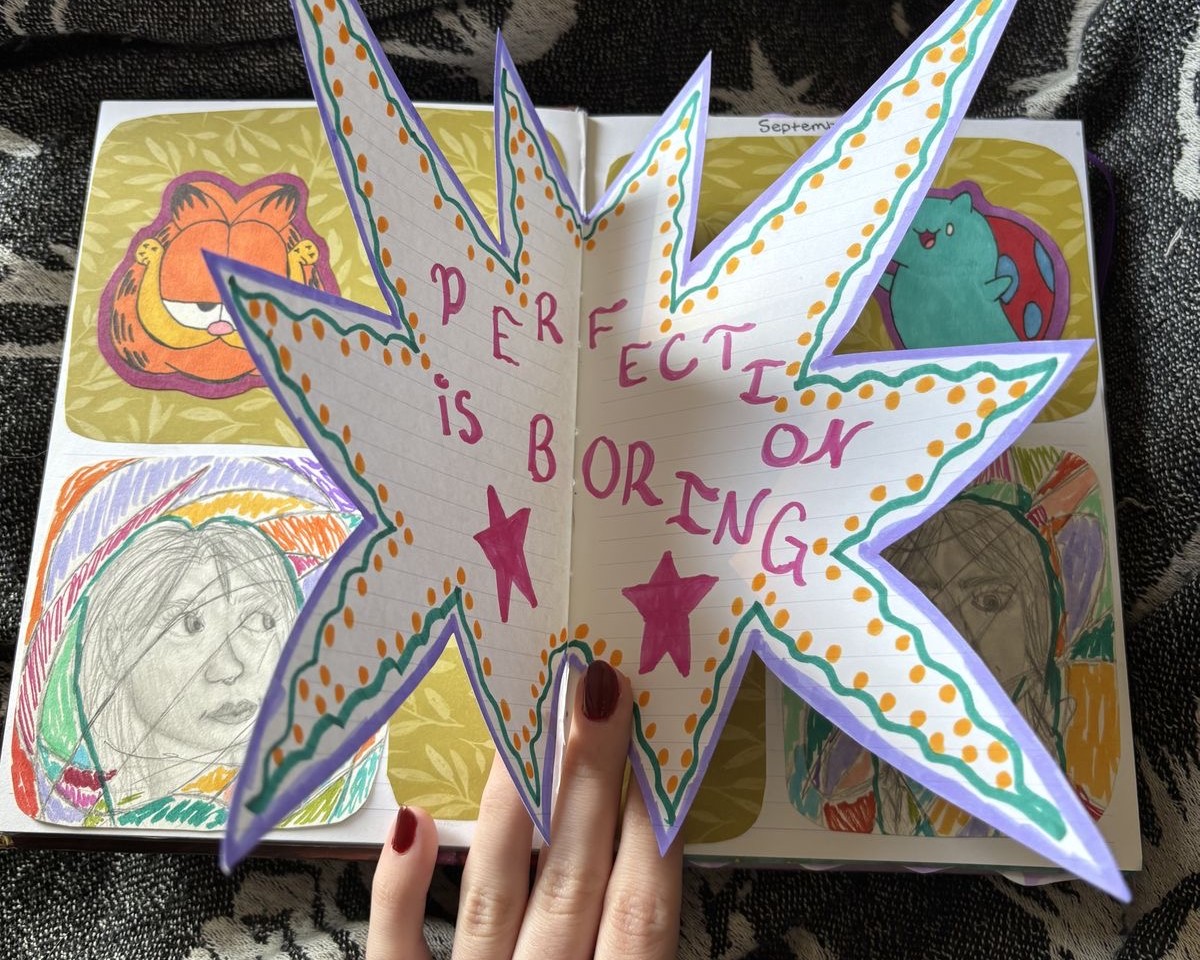
Journal Idea by @linalovespages

Remember: your junk journal isn’t supposed to be perfect. It’s supposed to be perfectly YOU. So, get glittery, get chaotic, and make some art that’s as wild and wonderful as your imagination. Because the best art is the one that breaks all the rules—and that’s what junk journaling is all about.

The Art of the Junk Journal: Passion Over Perfection Read More »
Easy Color Theory for Beginners

Color theory is all about how colors work together and the rules that tell us how to use them in art, design, and in our daily lives. It’s really important for those who are just starting out in art and design because it helps you make things that look nice and balanced.

One important person in the story of color theory is Sir Isaac Newton. He found out that white light is actually made up of all different colors – red, orange, yellow, green, blue, indigo, and violet. This discovery helped us create the color wheel, which is a tool that shows us how colors relate to each other and how we can mix them to get different effects. In this blog post, you’ll learn how color makes a big difference in art, design, and even in your daily life.

For a more in-depth evaluation of color theory, check out this article on color knowledge tips for artists.

What is Color Theory?

Understanding color theory is really important when you’re creating art or designs. If you’re just starting out, it might seem a bit hard, but don’t worry! Once you get the hang of some basic ideas, you’ll be able to use color theory in your own work with no problem.

Let’s start with primary, secondary, and tertiary colors. These are the main parts of color theory.

Primary colors are red, blue, and yellow. They’re the starting point for all other colors. Secondary colors are made when you mix two primary colors together. That’s how you get green, orange, and purple. Tertiary colors come from mixing a primary color with a secondary color. That gives you colors like red-orange, yellow-green, and blue-purple.

So, how can we see all these colors and how they relate to each other? That’s where the color wheel comes in. It’s a tool that arranges the primary, secondary, and tertiary colors in a circle. By looking at the color wheel, you can learn about how colors work together.

color theory for beginners shows primary secondary and tertiary colors like numbers on a clock
If the Color Wheel was a clock, primary, secondary, and tertiary colors would sit at numbers from 1-12.

For example, complementary colors are colors that are right across from each other on the color wheel. When you use them together, they make each other stand out and your artwork look really vibrant. Color harmonies are combinations of colors that just look good together. They can be analogous colors, which are next to each other on the color wheel, or triadic colors, which are evenly spaced around the color wheel.

Guidelines in Color Theory:

Understanding these guidelines in color theory can help you make informed decisions when creating art and design. By using the color wheel as a guide, you can create cohesive color schemes that enhance the overall look and feel of your work. Whether you are painting a piece of art, designing a website, or choosing an outfit, incorporating color theory can take your creations to the next level.

The color wheel is like a rainbow in a circle. It has primary colors (red, yellow, and blue), secondary colors (orange, green, and purple), and tertiary colors (mixtures of primary and secondary colors). Understanding these colors can help beginners create nice color combinations for their artwork.

Complementary colors are colors that are directly across from each other on the color wheel, like red and green or blue and orange. When you use them together, they create a strong contrast and make the artwork pop. On the other hand, color harmonies are groups of colors that look good together, like analogous colors (colors that are neighbors on the color wheel) or triadic colors (three colors that are spaced evenly around the color wheel).

Using Colors in Everyday Life:

Colors are really important in our daily lives because they can affect how we feel. For example, red can make us feel excited and passionate, while blue can make us feel calm and peaceful. Understanding how colors can affect our feelings can help us when we’re creating art or designs.

Artists like to use colors to make people feel different things. Two famous artists who did this are Piet Mondrian and Wassily Kandinsky. Mondrian liked to use big blocks of colors like red, blue, and yellow in his paintings. Kandinsky liked to use bright and bold colors to make people feel different emotions.

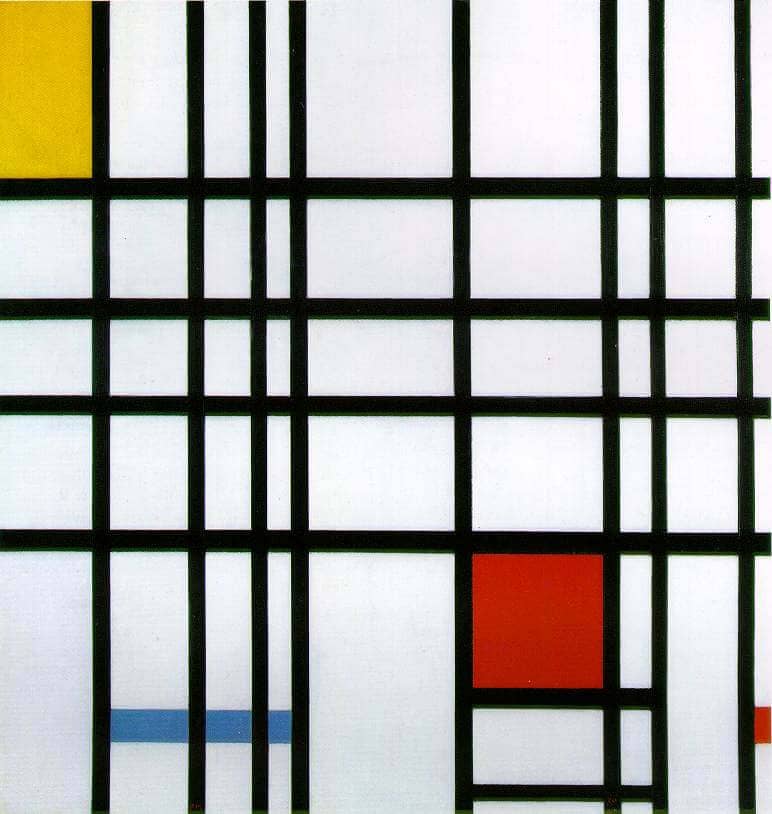
Piet Mondrian and Wassily Kandinsky were both really good at using color. They understood how colors can make people feel certain ways. Mondrian liked to use big, bright colors like red, blue, and yellow in his artwork. He made simple shapes and filled them in with these bold colors. One of his most famous works is called “Composition with Red Blue and Yellow”. In this painting, you can really see how he used these primary colors to make a strong statement.

On the other hand, Kandinsky liked to use lots of different colors in his art. His painting “Composition VIII” is full of many different colors. He used these colors to explore how they can make people feel. Both Mondrian and Kandinsky show us how color can be really powerful in art. They teach us that we can use color in smart ways to make people feel strong emotions.

Colors are also really important when we’re designing a website or a graphic. Warm colors like red and orange can make people feel excited and energetic. Cool colors like blue and green can make people feel calm and peaceful. By understanding how colors work, designers can use them to make people feel a certain way.

Businesses also use colors to make people feel a certain way. They do this to help people remember their brand. A good example is McDonald’s. They use the colors red and yellow to make people feel warm, energetic, and happy. These are feelings that we usually associate with eating fast food.

Understanding colors can also help you when you’re picking out clothes or creating a brand. By picking colors that match your personality and values, you can create a brand that people will recognize. When you’re picking out clothes, understanding colors can help you pick outfits that look good and express your personal style.

In Conclusion

Color theory is not just a tool for artists, but a fundamental aspect of everyday life. Understanding the basics of color theory can enhance your creativity, communication, and emotional expression through art, design, and branding. By exploring the impact of color on mood and emotions, as well as its practical applications in various industries, you can develop a deeper appreciation for the power of color in our lives.

So, whether you are a beginner in art or a seasoned professional, continue to explore and learn about color theory as a guide to creating impactful and meaningful work. Embrace the beauty and versatility of color, and let it inspire you to create art that truly speaks to the soul.

Enjoy this article? Read more from Emily here, and check out more color theory tips in this article.

Easy Color Theory for Beginners Read More »
Color Knowledge Tips That Will Make You a Better Artist

Introduction to color knowledge

Color knowledge is a fundamental aspect of art that has the power to evoke emotions, convey messages, and create captivating compositions. Whether you’re an aspiring artist or a seasoned pro, a deep understanding of color can significantly enhance your creative endeavors, and in turn, make you a better artist.

If you are new to the art world, I suggest you take a look at this article on color theory for beginners.

In this artsy article, we’ll dive headfirst into color knowledge, covering essential principles of color theory like primary, secondary and tertiary colors, how to create an effective color scheme, and basics of color mixing.

Color Theory: The Foundation of Creativity

Color Knowledge tip 1: Primary Colors are Red, Blue, and Yellow

Color Knowledge image of primary colors mixing in triple venn diagram to create secondary colors
Red, yellow and blue are the starting point to create more colors like orange, green, and violet.

Primary colors are the foundational hues in the world of color theory, consisting of red, blue, and yellow. These three colors are considered “primary” because they cannot be created by mixing other colors together.

On a computer, these inks are called magenta, yellow, blue, and black. Though, you’ll notice if you run out of black ink, the computer will offer an alternative to mix magenta, yellow, and blue. This mixture is “optical black” in the painting world. I’ll talk more about optical black in the section about mixing paint colors together.

Different combinations of the primary colors create all other colors on the color wheel. The primary colors are essential color knowledge for artists and designers.

If you mix two primary colors, you get secondary colors. For instance, if you mix even parts red and yellow, you will get orange. Blue and red make violet. Yellow and blue make green.

Color Knowledge tip 2: memorize The Color wheel

The color wheel further expands with tertiary colors, created by mixing primary and secondary colors. There are endless possibilities for color exploration in art and design.

Color Knowledge image of the color wheel showing primary, secondary, and tertiary colors
This color wheel shows primary, secondary, and tertiary colors.

Great, now that you’ve grasped the basic concept of the Roy G. Biv color wheel, let’s move on to relationships between colors. For more beginner friendly tips, check out this article on color theory for beginners!

Color Knowledge tip 3: Understand Color Harmony

Next, let’s learn about color harmony schemes like complementary, analogous, and triadic colors. Choosing the right color scheme can add a lot of visual and metaphorical depth to your art.

Complementary color schemes involve pairing colors that are located directly opposite each other on the color wheel. They are literal compliments, such as red and green or blue and orange. This scheme creates strong visual contrast and can make each color appear more vibrant when placed next to its complement. This color scheme is often seen in comic books, illustrations, logos, and even signage on the side of the road.

Color Knowledge image of complementary colors in everyday media like Christmas card, football team, and soda logo
Complementary colors contrast one another and tend to “pop” off the page.

Analogous color schemes use colors that are adjacent to each other on the color wheel, such as yellow, yellow-green, and green. This scheme creates a sense of harmony and cohesion. The analogous color scheme is ideal for creating a peaceful or monochromatic color palette in art or design.

Both The Kiss by Gustav Klimt and my painting inspired by the same work use analogous color schemes to create a sense of calm and peaceful harmony.

Triadic color schemes involve selecting three colors evenly spaced around the color wheel, forming an equilateral triangle. For example, red, blue, and yellow form a triadic color scheme. This scheme offers a balanced and dynamic contrast of colors. Triadic color schemes create visually striking and vibrant compositions.

Spiderman showing a tertiary color scheme of red, yellow and blue
This image shows the selected colors used in the comic book about Spiderman. Red, blue, and yellow make a triadic color scheme.

Color Knowledge tip 4: Know the difference between tint and shade

Saturation and value are essential aspects of color theory illustrated through the use of tints, shades, and tones.

Tints and shades determine values. Tints are created by adding white to a color and shades are formed by adding black to a color. Saturation is determined by tone, in which grey is added to the pure hue to mute the color.

Tints, shades, and tones showing color knowledge
Tints, shades, and tones change the color depending on how much white, black or grey you add to the hue, respectively.

Tints and shades alter both the brightness (value) and intensity (saturation) of colors. The level of darkness or lightness is crucial for creating depth in your artwork and originality in your color schemes.

Color Knowledge tip 5: Color temps (Warm vs. Cool Colors)

Color temperature is a fundamental color knowledge tip that helps convey emotion and moods.

Warm colors, such as reds, oranges, and yellows, are associated with warmth, energy, and excitement. Typically seen in the foreground of the composition, warm colors evoke feelings of passion and vibrancy.

In contrast, cool colors, like blues, greens, and violets, are calming and associated with serenity, tranquility, and a sense of distance. They tend to recede in a composition and can evoke feelings of calmness and introspection.

During Pablo Picasso’s Blue Period, the artist used a predominantly cool color palette. This color scheme included shades of blue (obviously) and blue-green as dominant hues. This deliberate choice of colors conveyed a sense of melancholy, sadness, and emotional turmoil in his artworks.

Color Knowledge image of Pablo Picasso's blue period about how color schemes can help convey emotions
Pablo Picasso’s Blue Period (1901-1904) is one of the most well known artistic uses of how color can signify emotion.

Color can serve as a powerful tool for expressing complex emotions and capturing the human condition.

One of my favorite moments of artists being angsty and non-conformists is the controversy surrounding “Blue Boy.” Painted by English portrait artist Thomas Gainsborough, the 1770 painting includes the unconventional use of blue as the dominant color for the subject’s attire, rather than as a background hue.

One of my favorite moments of artists being angsty and non conformists is the controversy surrounding "Blue Boy" by English portrait artist Thomas Gainsborough. The 1770 painting includes the unconventional use of blue as the dominant color for the subject's attire rather than as a background hue.
Blue Boy by Tomas Gainsborough challenged norms of its time by using blue in the foreground of the painting.

This departure from traditional portraiture raised eyebrows in its time. I find that something I love about learning art history is how artists challenge conventional norms. Sparking debate about artistic choices leads to innovation and change and progress.

Likewise, try to understand the interplay between warm and cool colors. This part of color knowledge is crucial for creating balanced and emotionally resonant color palettes in art and design.

COLOR MIXING

Color Knowledge tip 6: learn to mix Optical black

Color mixing techniques can greatly enhance the range and depth of your artwork. This section will focus on the important concept of “optical black.”

In this painting, I mixed phthalo (Phthalocyanine) blue with burnt umber to create this super dark optical black background to show color knowledge
I mixed phthalo (Phthalocyanine) blue with burnt umber to create this dark optical black background.

Optical black is a “fake black” which looks like black, but is instead created using color.

In art school, we were not allowed to buy or use black paint in our paintings. Turns out, creating optical black teaches you color theory and color mixing much better than simply using black.

Remember back to when we were discussing value and saturation?

Color theory is easy with a cute visual.

So then if Optical Black = Orange + Blue then Shades = Optical Black + Orange + Blue.

Whoever said art doesn’t include math was just a silly-billy.

Anyways, mixing complementary colors can create the visual appearance of black, despite no actual black pigment used.

To start, mix complementary colors from the color wheel. From there, continue to add colors until you reach the optical black that looks best for your chosen color scheme.

For example, if your painting uses yellow highlights, you may want your optical black to look more violet. How does this work?

Using complementary colors trick the color receptors in your eyes to believe the color is black, and not dark violet. This technique achieves rich, natural and deep shadows in your artwork without resorting to flat-looking black paint.

The same effect is achieved when you wear colored ski-goggles.

“[Ski-goggles] are often orange so at the end of the day the orange receptors are tired and the world looks blue.”

stoopidusername

Disney World also uses this technique to make their colors seem more vibrant. The sidewalks are painted red to trick the color receptors in your eye to make the grass and trees seem greener.

Disney World uses complementary colors in their park. The red sidewalks make the grass and trees look greener.

Color Knowledge tip 7: Use complementary colors for desaturation

Additionally, complementary colors tone down the saturation of a color. When you mix a color with its complementary color, the result is a desaturated, or less vibrant, version of the original color.

In the below painting of a skull still life, I chose a color scheme that included a golden yellow ochre and a muted violet. To achieve many of the greyish mid-tones, I chose to mix the yellow and violet together using varying amounts of each color.

This acrylic painting of a skull illustrates the use of optical black in learning color knowledge for painting.
In addition to making optical black using violet and yellow, I chose those same complementary colors as a base color scheme for this painting.

For example, if you have a highly saturated red and you want to reduce its intensity, mix it with a bit of green, its complementary color. The resulting mixture will be a less vibrant shade of red, leaning more towards a neutral gray or brown, depending on the proportions used.

I tend to love using complementary color schemes in my artwork. For this work, I started with a red wash and red base painting, then added the green layers on top to really push the color.
I tend to love using complementary color schemes in my artwork. For this work, I started with a red wash and red base painting, then added the green layers on top to really push the green color forward.

When using complementary colors to desaturate, it’s essential to be mindful of the proportions of added colors. Adding too much of the complementary color can cause the mixture to become too muddy or dark. This is particularly evident in watercolor painting as it is more difficult to lighten the painting back (for watercolors you paint light to dark).

Experimentation and practice will help you develop an intuitive sense of how to mix colors. Color knowledge like optical black and using complementary colors to adjust saturation and intensity can help you become a better artist.

Color Knowledge tip 8: Physically mix colors

Mixing colors is an essential skill for any artist expanding their color knowledge. For this section, we will focus on mixing paint.

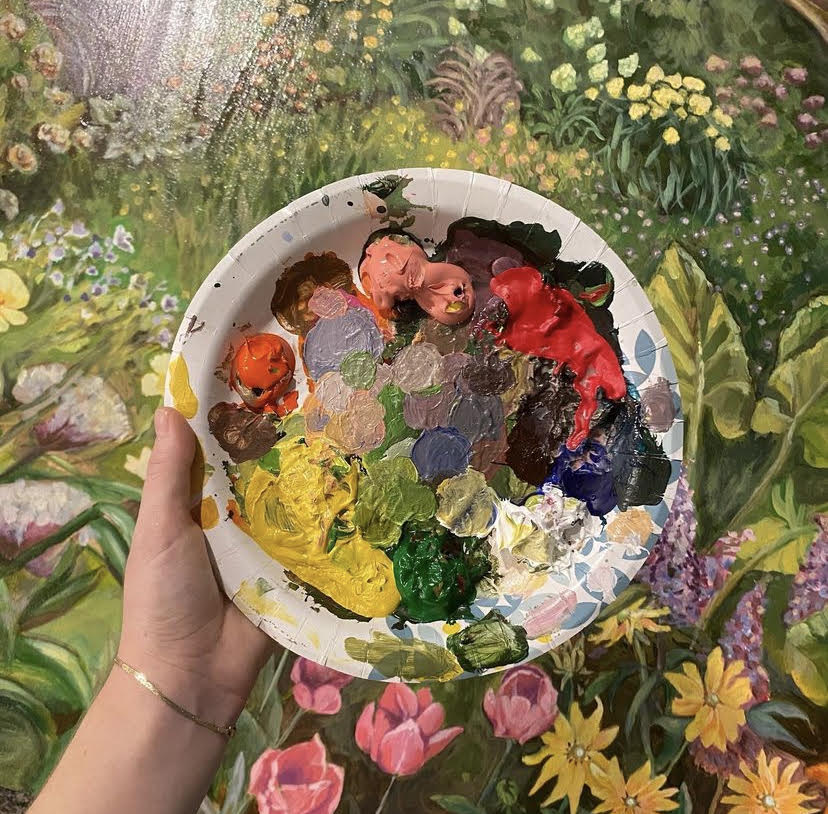
Begin with a clean palette and brushes. I also like to have a paper towel handy to dry my brushes. Then, squeeze small amounts of your chosen paint colors onto the palette. I like to use a paper plate as a paint palette, and I place the paint in a circle around the outer edge of the plate.

For example, the photo below features one of the paper plate palettes I used. Notice how I tried to keep the main paint colors clean and mixed my paint towards the center of the plate. You will also notice, I did not use black paint — I mixed an optical black using a dark blue and burnt umber.

I used this paper paint palette for a 4’x4′ garden painting with a lot of colorful flowers.

Next, use a palette knife or brush to blend the colors together gradually, starting with the lightest color and adding small increments of the darker color until you achieve the desired shade. Remember to test your mix on a scrap surface or a corner of the canvas itself to ensure it matches your vision before applying it to your artwork. Practice and experimentation will help you become proficient in creating custom colors for your art.

Follow my social media and newsletters for more tips on how to create a wider array of hues and tones, adding depth and complexity to your work through color knowledge.

Concluding color knowledge for now…

Color knowledge is a powerful tool for artists, allowing us to express ideas more effectively and create art that resonates with audiences. By mastering color theory, you can elevate your art to new heights. So, embrace the world of color, experiment fearlessly, and let your creativity flourish on the canvas of your imagination.

Understanding color theory and mixing colors is like having an artist’s secret toolkit. Whether you’re gently blending opposite, or complementary, colors to tone down the saturation or using clever mixtures to create “optical black,” these techniques are simply invaluable. I do want to remind you art lovers that there is so much more to know about color. If this is something that really interests you, please comment, message me, or join my newsletter to read more! I love color!!!

By grasping these fundamentals, you not only make your artwork visually engaging but also open doors to express intricate emotions and stories through color. So, dive into the world of color knowledge, and watch your art flourish with richer, more meaningful color scheme choices.

This is a super easy exercise for testing your markers to show what colors work and which markers have dried out. It also uses color knowledge to arrange the colors in a rainbow style order.

I realized this article was getting long, so I had to chop it up to allow for more in depth discussion of color knowledge. Trust me, there will be more color themed articles!

Color Knowledge Tips That Will Make You a Better Artist Read More »
Scroll to Top