pencil

How can drawing make you a more successful artist?

Introduction: How do you become a successful artist?

Why is drawing important? What does it teach you in the long run? Why does it seem like drawing is the beginning step in becoming a successful artist? What does learning about art have to do with becoming a better person? Why is drawing important to being a successful artist?

It is my goal to attempt to answer these questions by the end of the article. Whether you are just starting out, or a seasoned professional artist, it is important to know the base skills that drawing provides. Overall, drawing is important for several reasons, from cognitive and emotional reasons like self expression and to help release stress, to practical domains like improving hand-eye coordination and motor skills.

For a list of tools and mediums I recommend, check out my Favorite Art Supplies list and this article about my favorite paints and drawing materials.

If you are interested in learning more about basic drawing and painting skills, please check out my Art Advice page. If you are a beginner artist, I recommend 5 Easy Drawing Tips and How to Create an Artist Statement. These are great resources to becoming a successful artist.

Drawing is a form of Self expression

Drawing allows individuals to express themselves visually, providing an outlet for emotions, ideas, and experiences that may be difficult to convey through words alone. It’s a form of non-verbal communication that can be powerful and evocative. The article from Arts Academy in the Woods puts it perfectly:

“Art gives us a way to take a painful thought out of our heads and put it onto a page or into a drawing, painting, or performance. It thereby releases the emotions around that thought and gives it less power.”

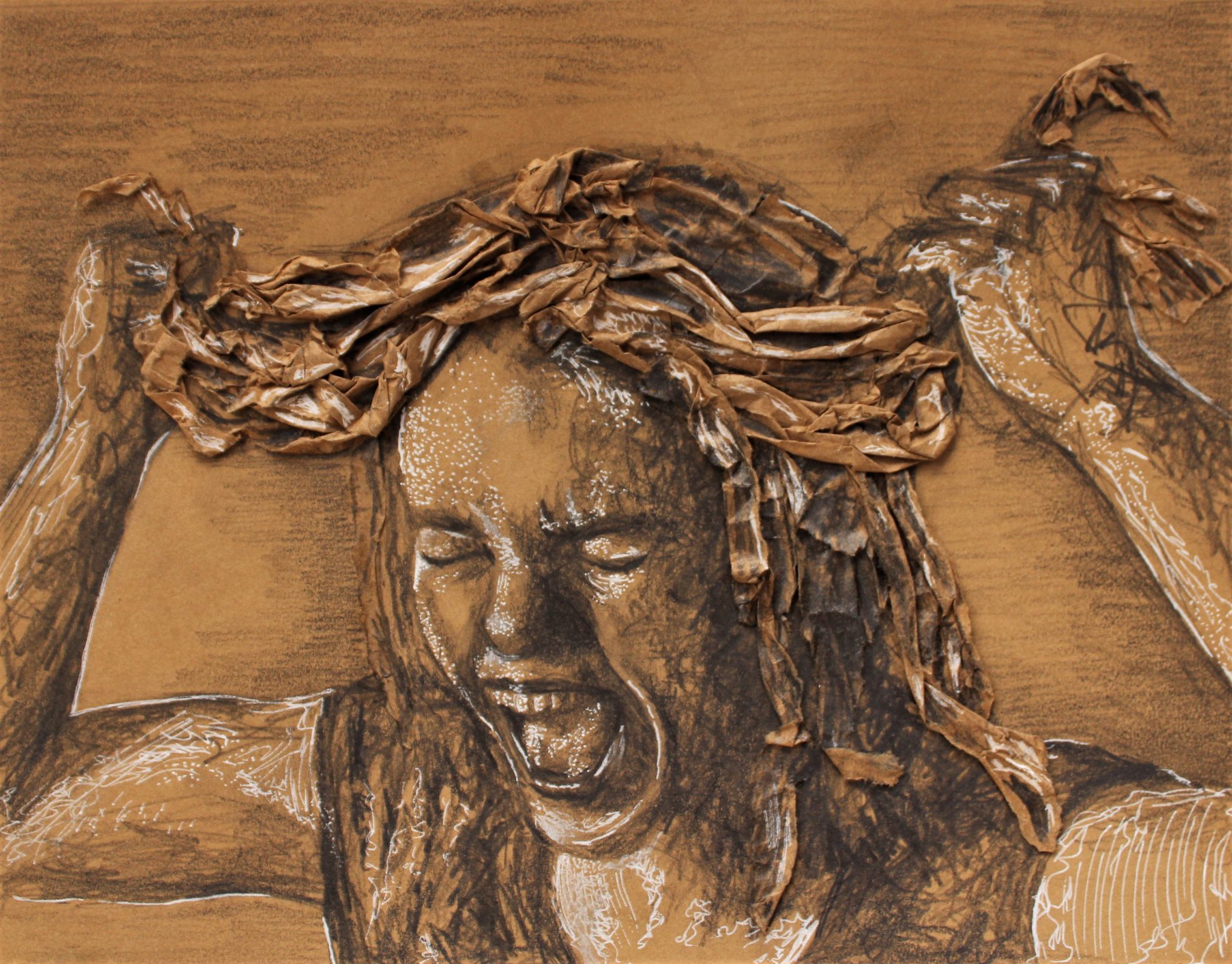
Brown and white artwork of stressed out woman pulling at her hair
Tension, 12″x10″ graphite and white pen on paper by Brianna Eisman

Drawing inspires creativity

Engaging in drawing stimulates creativity and imagination. It encourages you to think outside the box, explore new ideas, and experiment with different techniques and mediums. I first found a passion for art in school. Whenever I finished a test early, I would flip the page to the back, and doodle, sketch, and draw anything and everything I could imagine. Creativity is a skill, just like riding a bike or learning to code, you must practice being creative and using your imagination.

I believe that you truly become a successful artist when you make a mistake and have to think of a creative solution to fix it. This creative process teaches problem-solving skills, and I have found these skills help in many other areas of my life too.

draw more and become a successful artist! black and white pen marker drawing with organic shapes and lines by Brianna Eisman
Draw More, Sharpie and pen on paper by Brianna Eisman

Drawing improves observation

Drawing enhances observational skills as it requires a keen attention to detail, proportions, shapes, and spatial relationships. Performing blind drawing studies especially expedites this skill, and is key to becoming an experienced and successful artist.

Through practice, successful artists learn to perceive the world more deeply and accurately, honing their ability to notice subtleties and nuances in their surroundings, and in other people.

Drawing is a type of therapy

Drawing has therapeutic benefits and can promote relaxation, stress relief, and emotional healing. Many people, including myself, use art as a form of self-expression and introspection, finding solace and catharsis through the act of creating art. It’s also a sort of meditative process, especially one away from a digital screen.

Drawing is a Universal Language

Visual representations can transcend language barriers. Drawing was first used as a form of communication to pass down verbal stories through generations. The caves in Lascaux, France contain around 2000 Paleolithic cave paintings estimated to be 20,000 years old.

From art and design to science and engineering, drawing serves as a universal language that facilitates communication and understanding across cultures and disciplines.

Drawing helps develop motor skills

Drawing requires precise hand-eye coordination and fine motor skills, which are crucial for overall development, particularly in children. Practicing art helps improve dexterity and control over hand movements, which can have positive effects on writing, typing, and other manual tasks.

This skill is key to accurately translating your intended subject. That’s why drawing is taught first in art school, before other techniques like painting or sculpture. Art builds on itself and the more you draw, the better you’ll paint or sculpt or print.

An easy way to practice these motor skills, especially with children, is to create your own birthday and holiday cards. I share my process and inspiration in the article How to Wish Someone Happy Birthday, from an Artist.

woman using pink pen to draw homemade birthday card. This shows drawing is important in every part of life.
Draw your own birthday cards!

Drawing uses visual thinking

Creating art stimulates visual thinking, allowing individuals to organize and conceptualize ideas in a spatial manner. It encourages the brain to think in pictures, aiding in problem-solving, planning, and critical thinking across various domains. For example, my experience with writing in school started with writing artist statements. I used critical thinking to analyze what I was seeing in the painting, and what message the artist was trying to convey or communicate.

To be a successful artist, means you know how to communicate with your viewers. Whether you communicate through paint or sketches or an artist statement on the wall of the museum, bridging visual skills with written text is necessary.

Studies do show arts education improves academic performance. A study by Brian Kisida and Daniel H. Bowen analyzed “42 elementary and middle schools with over 10,000 third- through eighth-grade students.”

The study found “increases in arts educational experiences significantly reduce the proportion of students receiving disciplinary infractions,” “improve writing achievement” and “increase students’ compassion for others by… appreciation of art.”

Drawing encourages art appreciation

Engaging in the arts yourself, fosters an appreciation for artwork and the creative process, and helps you become a more successful artist. By creating your own artwork, you develop insight into the techniques, styles, and meanings behind other works of art, leading to a deeper understanding and enjoyment of visual culture. For example, once you learn color theory, you start to notice it everywhere; from football teams to soda brands.

To be a successful artist, you need to appreciate the arts. You can do this by learning about and analyzing artwork, attending museums, supporting local artists, and visiting arts markets and galleries. If you are interested in learning more about art history and art styles, I suggest you take this quick quiz I made!

gesture drawing pink and purple sketch showing how to be a more successful artist
Figure 2, 18″x24″ soft pastels on canvas by Brianna Eisman

Reading about art helps too. Searching for this article and learning about the creative process promotes appreciation of the arts. You are becoming a more successful artist simply by supporting my art journey, and inspiring me to continue to share my knowledge and passion for art.

Conclusion

Think of drawing as ‘step 1’ to becoming a more successful artist. Overall, drawing is a versatile and valuable skill that offers numerous cognitive, emotional, and practical benefits. It enriches the lives of artists and contributes to their personal growth and development.

How can drawing make you a more successful artist? Read More »
My 5 Favorite Artistic Mediums: How to Paint and Draw like a Pro

Art is a powerful means of self-expression that allows individuals to convey emotions, ideas, and experiences. Within the vast realm of art, various artistic mediums offer unique possibilities for artists to translate their visions onto the canvas.

In this Artsy Drawings blog post, we delve into five fascinating artistic mediums that have captured the hearts of many: acrylic, mixed media, watercolor, pencil, and gouache. I chose the order by which are my personal favorite artistic mediums. So, let’s explore the distinct qualities and creative potential of each of the five artistic mediums and discover why they are beloved by artists worldwide.

I also created a list of my Favorite Art Supplies, from brush pens to gouache paint.

Acrylic – my all time favorite of the artistic mediums

  1. Acrylic: Versatility and Vibrancy

I want to start with my favorite artistic medium: acrylic paint. This medium is becoming increasingly popular due to its versatility and vibrant color range. Many artists, like myself, appreciate the quick drying time of acrylics, which allows for layering and blending techniques. Rather than waiting around all day, (approximately 24 hours) for oil paint to dry, I can work much faster with acrylic paint, which can dry within 20-30 minutes. For example, the painting below, Pretty Plants #2, was completed in four total hours, mostly because I didn’t want to waste paint.

pretty green fern style plant painting in acrylic on canvas with red to white gradient background
Pretty Plants #2 by Brianna Eisman is part of an acrylic on canvas series featuring different plants on gradient backgrounds.

Also, I love the versatility of acrylic paint. You can change the consistency by adding water or acrylic mediums. These additions allow you to create transparent glazes or thick impasto textures. The fast-drying nature of acrylics makes it easier to correct mistakes or make alterations during the painting process.

This technique is great for impressionist styles. I had to use it often for paintings during my art classes, as I had limited time to work. When the class ended, I had to clean up quickly so my paints wouldn’t dry out. As a result, my early paintings had a lot of small strokes layered on top of each other, giving them an impressionist look. For example, the painting below, inspired by Edgar Degas’s dancers, has multiple layers of colors and strokes, especially in the tutu skirts, creating depth with a light yellow base and blues and pinks added on top.

Not sure what your art style resembles? Check out this art style quiz to help you find which historical art style matches your artwork!

this is a acrylic painting on canvas of two dancers wearing black leotards and fluffy white blue tutus. The dancers are stretching while seated on a wooden bench. The style is similar to Edgar Degas. The painting describes the use of favorite artistic mediums in which acrylic is one of my favorites for its impressionistic abilities.
Dancers Stretching by Brianna Eisman was inspired by impressionist painter Edgar Degas. I used acrylic paint on stretched canvas for this painting.

One of the key advantages of acrylics is its ability to mimic other artistic mediums. It can resemble watercolor when diluted or take on the characteristics of oil paint when applied with a heavy body. Acrylic paint can be used on a variety of surfaces, including canvas, wood, paper, and even glass or metal. These broad possibilities add acrylic paint to the list of favorited artistic mediums for many artists.

For me, I have built my acrylic paint arsenal over many years of experience. I prefer Liquitex Basics for my white paint (I use Titanium White more than any other color). I also like Lukas CRYL Studio Paints, although they’re a little more expensive.

Lastly, I like DecoArt Acrylic Paints for projects under 24″x 36″. DecoArt paint typically comes in smaller containers, but I find they are easier to store than larger tube style paints. The brand also just released an environmentally friendly acrylic paint set!

Mixed Media – Making me a trash monster, one sticker at a time

  1. Mixed Media: Limitless Creativity

Mixed media art involves the combination of different artistic mediums and techniques to create unique visual experiences. This next medium truly puts “artistic” in the artistic mediums list. Mixed media encourages artists to think beyond the boundaries of traditional artistic approaches. Mixed media, literally mixes artistic mediums. It allows for the incorporation of diverse elements such as paper, fabric, found objects, photographs, and even digital media. You can also classify the use of both paint and pens in the same piece as mixed media, as you are ‘mixing’ the artistic mediums.

Many of my sketchbooks use mixed media. Sometimes, I feel like a trash monster. I collect fortune cookie quotes and receipts and ticket stubs and stickers. I arrange them all in specific sketchbooks as a document of my life, my mental health, and my travels.

Hand of God by Brianna Eisman is a mixed media work featuring watercolor paint, ink, magazine cutouts, and stickers. This piece was created for Artsydrawings.com at Artsy Drawings. The reference material is for the blog about mixed media and favorite art mediums.
Hand of God by Brianna Eisman is a mixed media work featuring watercolor paint, ink, magazine cutouts, and stickers.

The beauty of mixed media art lies in its limitless possibilities and the freedom it provides for artistic expression. Artists can explore texture, depth, and layers, creating rich and multidimensional artworks with an unlimited number of artistic mediums.

I also think mixed media is one of the most environmentally friendly types of art. As I mentioned above, I sometimes feel like a trash monster, but you really can save money on art supplies by using mixed media. My colleague Emily wrote a great article about how to thrift art supplies, and I think second-hand art supplies could make for the best type of textured found-object artwork.

These limitless mixtures of artistic mediums invite experimentation and encourages artists to step outside their comfort zones, leading to innovative and thought-provoking creations.

Watercolor

  1. Watercolor: Elegance and Serenity

Watercolor paint has an ethereal and delicate quality, often capturing the essence of light, translucency, and fluidity. Artists love the subtle nuances and atmospheric effects achieved with this medium. So, the transparent nature of watercolor allows for luminous washes and seamless gradients.

I also find watercolor to be one of the more accessible art mediums. I absolutely love my cheap Crayola watercolor paints! All you need for watercolor is the paint kit, water in a cup, a brush, and maybe a paper towel or two.

This painting was done in my sketchbook in watercolor paint by Brianna Eisman for Artsy Drawings for Artsydrawings.com. The painting features my desk with my laptop open, clock, pens, sticky notes, water cup, phone, and salt lamp. The study was a quick exercise while watching a movie and I like it a lot.
Desk in Watercolor by Brianna Eisman was painted on a lonely night when all I wanted to do was paint and watch a rom-com on my computer. So I did just that.

Watercolor’s unpredictability adds an element of spontaneity and excitement to the painting process. The artist must adapt and work with the flow of water and pigment, resulting in charming imperfections and unique characteristics. This medium is perfect for capturing landscapes, still life arrangements, and expressive portraits, evoking a sense of tranquility and serenity.

Pencil Drawings

  1. Pencil: Timeless Precision

Pencil is one of the most fundamental artistic mediums, cherished for its simplicity and versatility. With just a simple pencil and paper, artists can create intricate drawings, detailed sketches, and realistic portraits. Likewise, the graphite shades offer a wide tonal range, enabling artists to achieve a remarkable level of precision and detail.

The following image features Design 3, the third design commissioned for a custom floral engagement ring. The patron chose a graphite medium to show fine details and edit the design as needed throughout the workflow of the project.

The following image features Design 3, the third design commissioned for a custom floral engagement ring. The patron chose a graphite medium to show fine details and edit the design as needed throughout the workflow of the project.
Design 3 by Brianna Eisman is a graphite sketch for a custom engagement ring design.

Pencil drawings possess a timeless quality, and the monochromatic nature of graphite pencil adds a sense of elegance and understated beauty. Overall, this medium is perfect for capturing textures, shading, and creating stunning grayscale compositions. Pencil art allows artists to focus on the essentials, emphasizing form, and exploring the interplay of light and shadow. It is also a good starting point for many artists, making it one of the most popular artistic mediums.

Gouache

  1. Gouache: Boldness and Opacity

Last but not least, is gouache paint! Gouache is still new to me, but one of the more powerful artistic mediums. I see this medium growing in popularity and I want to experiment with it more. Gouache paint combines aspects of both watercolor and acrylic and allows for many opaque layers added on throughout the process, especially at the end with a fine tip brush.

The following painting by me, inspired by the infamous Klimt masterpiece, uses gouache paint and features a couple embracing in a beautiful and intimate kiss. I bought this exact gouache paint set and I really loved it for a starter set. I will admit that I used the white quickly, but I always use white paint more than any other color. For the price and ease, this is a great paint set for any artist wanting to get into gouache.

Inspired by the Kiss by Gustav Klimt, this painting was created in gouache paint and features a couple embracing in a beautiful and intimate kiss. the style has many dots and lines, a stylistic technique I enjoy. This painting is done by Brianna Eisman as part of Artsy Drawings.
The Kiss by Brianna Eisman was inspired by the Kiss by Gustav Klimt.

Gouache’s unique opacity and matte finish give it a distinct aesthetic appeal. Gouache has this masterful ability to provide solid, vibrant colors. Artists can easily apply the paint to various surfaces, including paper, canvas, and illustration boards. The opaque nature of gouache allows artists to correct mistakes or make revisions by simply layering additional paint over the existing layers. Gouache allows for layering and reworking, making it ideal for illustrative works.

One of the key advantages of gouache is its versatility in creating both fine details and bold, graphic elements. Artists can achieve crisp edges, intricate patterns, and precise lines, making it a popular choice among illustrators and designers.

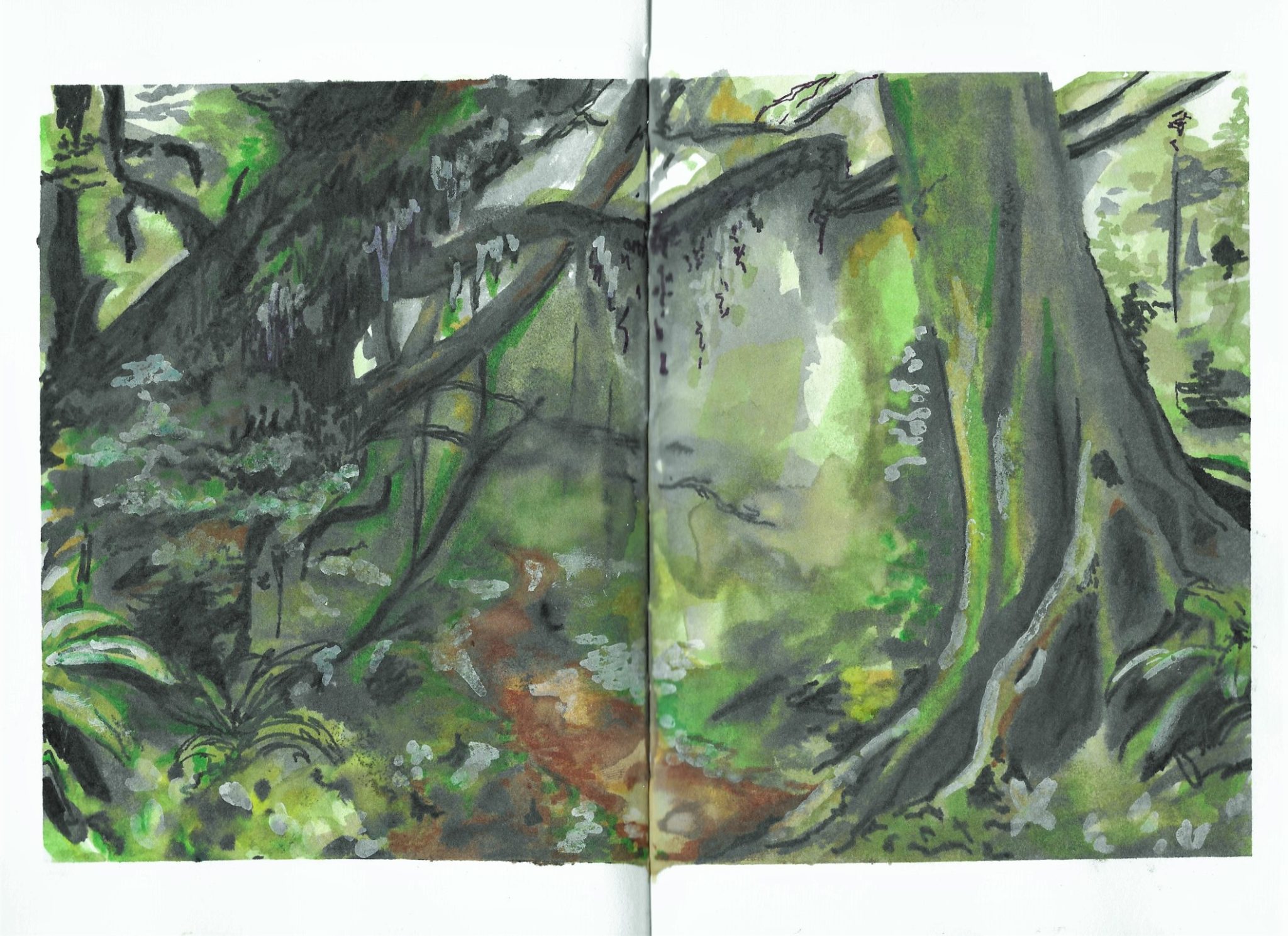
Beautiful Forest by Brianna Eisman was painted using gouache in a sketchbook. The painting was done through Artsy Drawings on artsydrawings.com. The painting shows a green dense forest with large mossy trees and lots of foliage. There is a single brown trail leading through the forest.
Beautiful Forest by Brianna Eisman uses gouache in a sketchbook.

Another noteworthy aspect of gouache is its rewetting properties. As a sustainable artist, this is one of my favorite parts! Unlike acrylics or oil paint, gouache can be reactivated with water, even after it has dried. This makes it possible to rework areas of the painting or blend colors seamlessly, providing artists with greater control and flexibility.

Furthermore, gouache’s quick-drying nature makes it convenient for artists who prefer to work in layers or require shorter drying times for their projects. This quality allows for efficient workflow, enabling artists to build up layers of color and detail without extended waiting periods.

I bought this exact gouache paint set and I really love it!

Conclusion – Favorite Artistic Mediums

Each of these artistic mediums possesses its own unique qualities and appeal, attracting artists with different preferences and artistic goals. Acrylics offer versatility and vibrancy, mixed media enables limitless creativity, watercolor exudes elegance and serenity, pencils provide timeless precision, and gouache showcases boldness and opacity.

These favorite artistic mediums — acrylic, mixed media, watercolor, pencil, and gouache — have captured the hearts of countless artists worldwide, including my own heart. Their distinct characteristics, creative potential, and ability to evoke emotions and narratives make them powerful tools for artistic expression. Please check out my Favorite Art Supplies list and comment below your favorite supplies!

Whether you are drawn to the vibrant colors of acrylics, the multidimensional possibilities of mixed media, the ethereal beauty of watercolor, the precise detailing of pencils, or the boldness of gouache, each medium offers a unique journey of artistic exploration. So, pick up your preferred medium, let your creativity flow, and embark on a captivating artistic adventure.

Not sure which artistic medium matches your art style? Take this quick quiz to better understand your art style!

My 5 Favorite Artistic Mediums: How to Paint and Draw like a Pro Read More »

Scroll to Top